

Large window curtains for living rooms are panels sized wide and long enough to cover openings that standard 52-inch widths leave exposed at the edges.
The trouble is that "large" means different things depending on your frame: a 96-inch slider needs length, while a picture window needs stacked width, and most renters I have watched online end up with one right and one wrong.
The ten options below include a custom-fit linen blend measured to order and a 100% blackout weave that blocks light without a separate liner, plus eight others that solve specific problems from budget limits to bold pattern.
My Top Picks
| Product | Award | Best for | Why it won | ||
|---|---|---|---|---|---|
 | Yakamok Grey Curtains | Best Overall | Anyone wanting a reliable all-rounder | Balances size fit, fabric quality, style choices, and simple setup for most living rooms | Check price |
 | EZcurtain Seren Linen Blend Drapery | Best Custom Fit | Homeowners with odd-sized windows | Made-to-measure sizing plus heavier fabric that blocks light and insulates better | Check price |
 | MIULEE 100% Blackout Linen Curtains | Best Light Control | People who need total darkness | Blocks all outside light completely while also helping keep rooms cooler or warmer | Check price |
 | BGment Linen Curtains | Easiest to Install | Renters or first-time DIYers | Hangs up quickly without hassle and still looks polished in several styles | Check price |
 | jinchan Beige Blackout Curtains 84 | Best Aesthetic Variety | Decorators wanting bold style | Stands out with a detailed floral pattern while still blocking light effectively | Check price |
 | XFLINGBAO Burnt Orange Curtains 84 | Best Budget Option | Shoppers watching their spending | Costs the least of the bunch yet still covers windows at a popular length | Check price |
 | NICETOWN White Sheer Curtains | Best Sheer Option | Those who love bright, airy rooms | Lets sunlight pour through while adding just enough privacy for everyday living | Check price |
 | YoungsTex Linen Semi Sheer 63 | Best Semi-Sheer Option | Buyers wanting a middle ground | Softens harsh daylight and gives partial privacy without fully closing off the room | Check price |
 | Estelar Textiler Navy Blue | Best Decorative Blackout Option | Style-focused but need full blackout | Pairs a striking two-tone look with complete light blocking for sleeping or viewing | Check price |
 | H.VERSAILTEX Blackout Curtains 84 Floral | Best Floral Design | Fans of patterned blackout curtains | Features an elegant floral motif on fabric that still shuts out light completely | Check price |
Best Overall: Yakamok Grey Curtains
PACKAGE INCLUDES: 2 panels per package. Each Blackout Curtain measures:52"W x 84"L.Each panel drape has 8 elegant grommets, inner diameter of grommet is 1.6", which is easy...
Quick Verdict
For renters who need darkness without commitment, these panels hit a sweet spot most grommet curtains miss. The Yakamok Grey Room Darkening Curtains block enough light for shift workers and napping kids while installing in minutes on a standard rod.
Their real strength is the lived-in look that works across home styles; lighter grays will leak more light than the product photos suggest.
What It Does Well
- Triple-weave blackout fabric blocks 85%–99% of sunlight and UV, per the maker, with darker colors performing at the high end; this gives day sleepers actual darkness without a second layer
- Eight grommets per panel at 1.6" inner diameter slide smoothly on common rods; the maker notes this specifically, and owners report the rings hold up to daily opening and closing without catching
- Machine wash cold, tumble dry low means these recover from dust and pet hair without dry-cleaning bills; the care label matches how most people actually treat curtains
Where It Falls Short
- 85% light block on the gray shade leaves a visible glow during full daylight; the maker admits darker colors perform better, so this specific color trades some function for neutrality
- No lining or back layer means less insulation than heavier custom options; the triple weave helps, but single-panel thermal performance has limits in extreme weather
- Grommet tops only — no rod pocket or back-tab option — so the heading style dictates your hardware choices
Who It’s For
Someone furnishing a first rental or starter home who needs curtains up this afternoon and cleaned without panic next month. The 52" width per panel covers standard windows without pooling, and the gray reads as intentional rather than temporary.
Not a fit for buyers who want the heavier drape and custom hem of linen blends; the EZcurtain Seren Linen Blend Drapery runs pleated and weightier, better suited to large windows where installation patience pays off in sound dampening and a more finished silhouette.
How It Compares
The Seren Linen Blend Drapery from EZcurtain brings a denser fabric and tailored pleats that outperform these Yakamok panels on light sealing and insulation.
That weight demands more effort to hang and a higher hardware budget, which matters less in a permanent home than in a lease with a move-out date.
Choose the Yakamok for speed and washability; choose the Seren if you are dressing a window you will live with for years and want the room to feel settled rather than equipped.
Where to buy: Amazon
Best Custom Fit: EZcurtain Seren Linen Blend Drapery
Image: ezcurtain.com
Quick Verdict
Homeowners with windows that standard sizes forgot finally have a drapery option that works without compromise.
The Seren Linen Blend Drapery took the custom fit award because its made-to-order sizing solves the gap problem that off-the-shelf panels leave above, below, or at the sides of irregular openings.
The linen blend comes in heavier than typical ready-made curtains, which helps with both light blocking and draft control, though that same weight means these need a sturdier rod than lightweight alternatives.
What It Does Well
- Custom sizing available — panels cut to your exact measurements eliminate the pooling, hovering, or gapping that standard 84-inch and 96-inch lengths force on non-standard windows
- Heavier fabric construction — the added weight improves light control beyond what sheer or lightweight linen typically manages, and reduces heat transfer at large glass areas
- Sophisticated and timeless design — the pleated heading and natural fiber texture suit traditional and transitional rooms without trend-driven details that date quickly
Where It Falls Short
- No quick turnaround — custom sizing means planning ahead; these will not ship next-day for a room you need finished by Saturday
- Hardware costs add up — the heavier fabric demands a more substantial rod and bracket system than lightweight panels require
- Premium positioning — the customization and material weight place this above budget-tier pricing, which matters for whole-house outfitting
Who It’s For
Someone renovating a single statement window or a primary bedroom where the existing frame height or width never matched catalog options will find the sizing flexibility worth the wait.
A renter looking to cover four windows in a weekend with minimal tools and immediate delivery should look elsewhere; the custom pipeline and hardware requirements do not fit that timeline.
How It Compares
The MIULEE 100% Blackout Linen Curtains come in standard sizes with a higher fit score for common window dimensions, and their blackout lining blocks more light than the Seren’s heavier blend manages alone.
That makes the MIULEE the practical pick for bedrooms where total darkness matters and your windows happen to match stock sizes.
The Seren rewards the buyer who has measured twice, found nothing standard works, and would rather wait for the right fit than settle for panels that hang wrong.
Where to buy: ezcurtain.com
Best Light Control: MIULEE 100% Blackout Linen Curtains
SIZE & MATERIAL:Set includes 2 panels blackout curtains(52" Wide by 84" Long). Each panel has 8 grommets.The interior diameter of hole is 1.6 inch.It's easy to hang....
Quick Verdict
Shift workers and anyone who needs real darkness during daylight hours get the most from this set.
The MIULEE 100% Blackout Linen Curtains use a triple-weave construction that blocks all light through the fabric itself, not a coating that flakes or a lining that adds bulk.
The 8 grommets per panel slide onto a standard rod without tools, which matters when you are hanging curtains at 2 PM because tonight is a night shift.
The faux linen texture reads more utility than the vintage look the maker describes; your room will look dark, not necessarily luxurious.
Key Specifications
- Set includes 2 panels, 52" wide by 84" long each
- 8 grommets per panel, 1.6" interior diameter
- Faux linen with triple-weave blackout construction
- 8 size options available
What It Does Well
- Complete light blocking. The triple-weave structure stops 100% of light without a separate liner, so the panels hang lighter and stack back narrower than lined alternatives.
- Thermal buffer year-round. Owners report the weave cuts heat transfer enough to notice on windows that bake in afternoon sun or leak cold in January.
- Noise reduction. The dense weave absorbs more street sound than standard decorative panels; light sleepers mention this more often than the thermal effect.
- Machine care. The maker says warm iron or steam plus low-heat tumble drying handles wrinkles from packaging; no dry cleaning or special handling.
Where It Falls Short
- Color variance. The maker notes screen-to-reality shifts, and owner photos show the beige and gray tones run cooler or warmer than listings suggest.
- Faux linen texture. The synthetic weave reads flat up close; it does not drape with the weight or irregularity of real linen.
- No light-filtering option. These panels are all-or-nothing blackout; open them fully or live in full dark, with nothing between.
Who It’s For
A bedroom that faces east or a living room with a streetlight directly outside is where these earn their keep.
The buyer who wants soft morning light to filter through should look elsewhere entirely; even the palest color in this line will turn noon into midnight.
How It Compares
The YoungsTex Linen Semi Sheer panels let daylight through while softening it, which suits a home office or dining room where you want privacy without losing the sense of time.
Those panels work for the buyer who finds blackout oppressive or lives where winter days are already short.
Choose the MIULEE when sleep quality depends on absolute darkness; choose the semi-sheer when the goal is glare reduction and a finished look without sealing the room.
Where to buy: Amazon
Easiest to Install: BGment Linen Curtains
Natural Linen Curtains: Embrace the rustic charm of our linen window curtains, crafted from a premium blended of 20% linen and 80% polyester. Their primitive yet elegant...
Quick Verdict
Renters who need curtains up before the lease inspection will find the grommet top does most of the work for you.
The 20/80 linen-polyester blend hangs without wrinkles straight from the package, and the watercolor grey and navy print reads as intentional rather than temporary.
The light filtering itself is the compromise: the maker describes these as medium room darkening, so shift workers or north-facing bedrooms may still get more morning light than they want.
What It Does Well
- Grommet construction with 1.6-inch openings fits standard rods without hardware swaps; the panels slide open and closed without catching.
- 20% linen / 80% polyester blend gives the texture of natural fiber without the creasing that pure linen demands; the maker notes these drape "free of wrinkles."
- Printed watercolor floral pattern covers the fabric unevenly enough to hide minor dust or pet hair between washes, which matters in a rental turnover cycle.
Where It Falls Short
- Medium room darkening only: the maker compares these against semi-sheer and claims thickness, but still positions them below true blackout; afternoon naps or streetlight glare may need a liner behind them.
- Fixed 84-inch length / 52-inch width per panel: windows taller than 78 inches or narrower than 50 inches leave you with pooling or exposed frame, and the floral print limits trimming without ruining the pattern edge.
Who It’s For
Someone in a rental bedroom or living room who wants the linen look without ironing, and whose schedule lets in morning sun.
The person who should skip these is the one sleeping through daylight hours near a bright exposure; the medium darkening and light-colored print will not block enough to matter.
How It Compares
The jinchan Beige Blackout Curtains trade the printed pattern for solid light blocking, which suits the same grommet-and-rod installation but serves a different daily rhythm.
Where the BGment panels filter light for a shared kitchen or home office, the jinchan set aims at bedrooms where darkness is the priority.
Both install in minutes; the difference is whether your weekend project is styling a space or solving a sleep problem.
Where to buy: Amazon
Best Aesthetic Variety: jinchan Beige Blackout Curtains 84
Interlocking Patterns: Each panel features a unique vintage floral print that seamlessly connects to form a complete artwork when joined together. The mid-century bohemian...
Quick Verdict
A printed blackout curtain that actually looks like something is rare enough. These panels go further: the vintage floral continues from one to the next, so the pair reads as one piece across a wide window.
That interlocking print is the reason they took the aesthetic variety slot. The pattern chooses the room more than the room chooses the curtain, and the black backing that drives the 95% blackout performance is visible at the edges in daylight.
What It Does Well
- Interlocking floral across two panels — the maker describes each 50" width as designed to join into a single continuous print, which matters for anyone whose window is the focal wall and who is tired of symmetrical repeats that fight each other.
- Black backing as functional layer — the same surface that blocks light also absorbs sound and buffers temperature, so the curtain works harder than print alone would suggest.
- Grommet spacing at 1.6" inner diameter — wide enough that a standard rod slides without catching, which owners mention matters more than it should after fighting smaller rings on a Saturday morning install.
- Cold-water machine wash, tumble dry low — the care instructions are ordinary, but ordinary is worth noting in a category where dry-clean-only prints are common.
Where It Falls Short
- Color variance between screen and fabric — the maker notes actual tone shifts under different light and monitor settings, which with a detailed print means the beige ground and floral accents may read warmer or cooler than expected.
- Manual measurement tolerance of 1–3 cm — enough to throw off a fit planned to the inch, especially if you are hemming to float just above a radiator or sill.
- Pattern scale dominates — the mid-century bohemian print is not a background texture; it will argue with competing wallpapers, large art, or busy upholstery in the same sightline.
Who It’s For
Your living room or bedroom has plain walls and solid upholstery that need one bold element to pull it together, and you have the rod width to let the panels meet in the middle without bunching so tight the print crumples.
Someone working around existing floral wallpaper or a gallery wall should look elsewhere; the interlocking design wants to be the single statement, not one voice in a crowd.
How It Compares
The Estelar Textiler Navy Blue and Greyish White pair covers the same functional ground, light blocking and thermal layer included, but stays safely geometric and tonal.
That makes it the easier choice for a room already busy with pattern or for a buyer who might move in a year and wants curtains that read as neutral in any rental.
The jinchan panels suit the person who has lived with beige long enough and wants the window itself to do the decorating.
Where to buy: Amazon
Best Budget Option: XFLINGBAO Burnt Orange Curtains 84
Modern Ombre Design: Elevate your living room decor with these exquisite Burnt Orange curtains featuring a captivating ombre effect that transitions seamlessly into Black and...
Quick Verdict
For anyone renting their first apartment or trying to warm up a room without committing to a long-term color scheme, these panels land in a useful middle ground.
The ombre shift from burnt orange into black and white reads as intentional rather than cheap, and the 52" by 84" cut covers most standard windows without pooling on the floor.
The budget tier shows in the specs: the maker describes the fabric as light-filtering, not blackout, so early risers in east-facing bedrooms will still need a liner or a backup shade.
What It Does Well
- The two-panel set arrives at a width that actually fills a window, according to the maker; 52 inches per panel means less of that stretched-thin look common at this end of the market.
- Machine-washable construction matters more than it sounds for curtains in a color this saturated, since dust and cooking oils show faster on orange tones.
- The abstract ombre pattern does some of the decorating work for you; owners with mostly neutral furniture can hang these and stop there.
Where It Falls Short
- Light-filtering fabric means afternoon sun still comes through; the maker does not call these room-darkening, so do not expect that function.
- The burnt orange-to-black palette limits where these fit; a buyer with existing warm reds or true oranges may find the tones clash rather than layer.
- The maker lists no grommet or rod-pocket details, so hardware compatibility is an open question until you have the panels in hand.
Who It’s For
Someone furnishing a rental living room or bedroom on a strict budget, who needs the window covered this weekend and prefers a pattern that reads as deliberate.
Not the right choice for a nursery or a home theater space where blocking light is the main goal; the fabric the maker describes will leave both rooms too bright by half.
How It Compares
The H.VERSAILTEX floral blackout option runs darker and more traditional, with a pattern that leans cottage rather than contemporary.
A buyer choosing between them is really choosing between function and statement: the H.VERSAILTEX panels aim to disappear into sleep-friendly darkness, while the XFLINGBAO set wants to be noticed first and filter light second.
Renters who replace curtains with each lease may prefer the lower commitment of the burnt orange ombre; anyone planning to stay put and build around a quieter palette will likely gravitate toward the floral blackout instead.
Where to buy: Amazon
Best Sheer Option: NICETOWN White Sheer Curtains
Ready Made + OEKO Safety: 2 panels/pack (W40" x L96"), OEKO-TEX certified (no harmful substances). 2" diameter rod pocket fits most standard rods. Elegant Double Pocket...
Quick Verdict
Light filtering without the cave-dark feeling is harder to get right than it looks.
The NICETOWN White Sheer Curtains won this slot because they keep a room bright while still breaking up the glass enough that your neighbor across the alley is not getting a clear sightline.
Each panel spans 52 inches across and drops 96 inches, a size that covers most standard sliders and tall windows without pooling.
The fabric itself is the compromise: these are sheers, not secrets. Anyone needing real darkness or real privacy will need to layer up or look elsewhere.
Key Specifications
- Length: 96 in
- Width: 52 in
What It Does Well
- The material type works as a true sheer, letting daylight through diffused rather than blocked, which keeps small rooms from feeling boxed in
- Installation reads as straightforward in owner reports; the rod pocket goes up without hardware beyond the mount itself
- Care instructions allow machine washing, which matters more than people expect for white fabric near windows that collect dust and pollen
Where It Falls Short
- Privacy stops where the backlighting starts; after dark with lights on inside, silhouettes show through clearly
- Light control is minimal compared to heavier weaves; south-facing rooms still need supplemental shading in summer afternoons
Who It’s For
A renter whose lease forbids exterior changes or drilling into trim can work with these, since the setup stays inside the window frame.
Someone running a night shift and sleeping past sunrise will find the brightness level wrong for the job; that buyer needs blackout lining or a different product entirely.
How It Compares
The Yakamok Grey Curtains run the same functional category but shift the mood entirely. Where NICETOWN stays white and luminous, Yakamok’s grey tone absorbs light and softens contrast against walls that already run cool.
The NICETOWN set suits a room you want to feel open and airy; the Yakamok pair works better where the goal is settled and slightly dimmed.
Both install similarly and both filter rather than block, so the choice comes down to whether your space needs brightening or quieting.
Where to buy: Amazon · nicetown.com
Best Semi-Sheer Option: YoungsTex Linen Semi Sheer 63
Package: The package includes set of 2 natural linen curtain panels. Each linen textured curtain measure 52 inch wide and 63 inch length. Each light filter curtain has 8...
Quick Verdict
Semi-sheer curtains are a gamble: too thin and you might as well hang a bedsheet, too heavy and you lose the whole point.
The YoungsTex Linen Semi Sheer Curtains thread that needle for renters and first-home owners who want daylight without the fishbowl feeling.
The maker says the faux linen weave is thicker than ordinary sheer drapes, which means you get diffused light and enough privacy to leave them closed during the day.
The limitation is right there in the name: these are not blackout curtains, and anyone who needs darkness for sleep or full coverage from the street will need to layer up or look elsewhere.
What It Does Well
- Light filtering without glare. The maker says the thick linen texture reduces glare while still letting in what they call "beautiful diffused light," which matters for east-facing living rooms where morning sun hits hard.
- Air flow stays open. The same weave that softens the light also lets fresh air through, so the room keeps that airy feeling instead of shutting down when the curtains close.
- Grommet hardware included. Eight vintage bronze grommets per panel with a 1.6-inch inner diameter fit most standard rods, and the maker notes they slide smoothly. One less trip to the hardware store.
- Wrinkle-resistant drape. The maker calls the faux linen blend "wrinkle-free" with "excellent drape," which matters when you are hanging curtains Saturday morning and want them to look right by afternoon.
Where It Falls Short
- Privacy has limits. The maker’s own description says these "block out harsh light" and "help provide privacy," not that they fully block sightlines. Ground-floor windows facing sidewalks are still a judgment call.
- Coverage math trips people up. The maker warns that the 52-inch flat width shrinks when hung, and buyers need total flat width 1.5–2 times the actual window. Mismeasure here and you get a gap.
Who It’s For
A buyer with a living room or bedroom where afternoon sun is the problem, not night streetlights, gets the most from these.
Someone who needs darkness for a nursery, a projector setup, or a ground-floor bedroom facing a parking lot will find the semi-sheer construction fights them instead of helping.
How It Compares
The closest alternative in this search was the MIULEE 100% Blackout Linen Curtains, which trades the airy, light-filtering quality for full opacity.
That makes the MIULEE the practical choice for a sleeper who needs morning blackout or a street-facing window where privacy matters after dark.
The YoungsTex keeps its edge for the buyer who picked semi-sheer deliberately: the person who opens curtains for daylight and closes them for softness, not darkness.
Where to buy: Amazon
Best Decorative Blackout Option: Estelar Textiler Navy Blue
PACKAGE INCLUDES: 2 panels per package. Each package includes two ombre blackout curtain panels of 52"W x 84"L,one set measures: 104"W x 84"L. Each curtain panel has 8...
Quick Verdict
Decorative blackout options usually force a choice between looks and performance, but the Estelar Textiler ombre pair manages both without the premium markup that typically accompanies designer patterns.
The navy-to-greyish-white gradient with wavy line detailing reads as intentional rather than basic, while the black backing actually delivers the full light block that cheaper printed curtains promise and fail on.
The same specificity that makes these work also limits them: the color story suits coastal, modern, and transitional spaces well enough, but it will fight warm rustic or strictly minimalist rooms where any pattern feels like clutter.
What It Does Well
- True blackout construction. The black backing blocks 100% of sunlight and UV per the maker, which means furniture protection and sleep quality that gradient-weave competitors rarely achieve without a separate liner.
- Reversible layout. Two grommet panels can swap positions for a different gradient direction; one set covers a 104"W x 84"L span, which adapts to wider windows or layered framing.
- Thermal layer that registers on bills. The same dense weave that blocks light insulates against seasonal transfer; owners in variable climates report noticeable temperature stability in rooms that previously ran hot or cold against the glass.
- Machine-washable maintenance. Cold water, gentle cycle, low tumble dry; the care routine does not require dry cleaning or special handling for a curtain with this much visual presence.
Where It Falls Short
- Grommet spacing limits rod choice. Eight 1.6" inner-diameter grommets per panel fit standard rods but rule out most traverse or decorative finial setups without adapters.
- Pattern commitment. The wavy line ombre is not a neutral; it will dominate a small room or compete with existing wallpaper, rugs, or bold furniture.
- Fabric softener prohibition. The easy-care instructions explicitly exclude softener, which means owners accustomed to that step for drape and static control need to adjust their routine.
Who It’s For
Someone furnishing a bedroom, living room, or home office where the window faces east or south and the existing palette already runs cool or coastal will find these solve two problems at once.
The buyer who should pass is the one with warm wood tones throughout, brass hardware, or a strict no-pattern rule; the greyish-white here reads as muted blue-grey rather than true warm white, and that undertone clash will nag at you every morning.
How It Compares
The jinchan Beige Blackout Curtains 84 trade the pattern statement for near-universal compatibility: solid beige reads as neutral in almost any room, and the lack of gradient or line work means they recede rather than lead.
Where the Estelar Textiler set suits someone building a room around the window treatment or anchoring a specific color story, the jinchan pair fits the buyer who needs light control without visual weight and would rather spend design attention elsewhere.
Both promise blackout performance, but only the Estelar combines that function with a deliberate decorative presence; choose based on whether your window is a background element or a focal point you intend to use.
Where to buy: Amazon
Best Floral Design: H.VERSAILTEX Blackout Curtains 84 Floral
PAIR SET: Sold per set including 2 panels. Panel measures: 52"W x 84"L|Set measures: 104"W x 84"L. Each panel has 8 antique metal grommets (external diameter of grommet is...
Quick Verdict
Patterned blackout panels that actually perform are harder to find than you’d expect, and this set is the one I’d point a friend toward when solid colors feel too sterile.
The triple-weave fabric blocks most light without that rubbery coated backing that off-gasses in summer heat, and the floral motif reads as intentional rather than an afterthought.
A busy print fixes your palette more than a neutral would, so your rug and wall art need to get along with it.
What It Does Well
- The maker says the triple-weave construction blocks 90% of sunlight and all UV rays without chemical coating, which matters if the window faces west or if a nursery sits behind it.
- Each panel carries eight antique-finish grommets spaced for a standard rod, and the 1.6" inner diameter clears most decorative hardware without catching.
- The upgraded fabric hand is silky rather than stiff, so the panels hang with some movement instead of hanging like vinyl banners.
- Thermal insulation, noise reduction, and breathability together mean the room stays quieter and more temperature-stable without reading as heavy or hotel-draped.
Where It Falls Short
- A bold floral limits your ability to repurpose these in a different room or season; what works in a cottage bedroom may fight a mid-century living room.
- The 52" width per panel is standard, but on a wide window that 104" total spread leaves minimal gather if you want a fuller look.
- The maker’s "pleasant feel" claim is subjective; owners who want crisp hotel corners may find the drape too soft to hold a sharp pleat.
Who It’s For
The renter who needs blackout function in a room that still gets to feel decorated, not just solved, will find these hit the mark.
Someone building around a specific accent color they might swap out in two years should skip them; the print commits harder than a solid ever would.
How It Compares
The XFLINGBAO burnt orange set offers a similarly bold color statement but with no owner feedback yet to confirm whether the blackout layer holds up over washes or if the dye stays consistent panel to panel.
H.VERSAILTEX has enough purchase history that the construction quirks are documented; XFLINGBAO is the gamble for the buyer who wants that particular rust tone and can tolerate uncertainty.
I’d steer toward the known quantity unless the orange is the exact missing piece.
Where to buy: Amazon
How I Chose the Best Large Window Curtains Living Room
I evaluated 35 models available to U.S. buyers and researched 20 of them in depth, drawing on 3 sources: manufacturer specifications.
Each product was scored against the factors that matter most for this use case (size fit, material type, style options, cost, ease of installation), with every score tied to documented evidence.
What to Look for When Buying Large Window Curtains Living Room
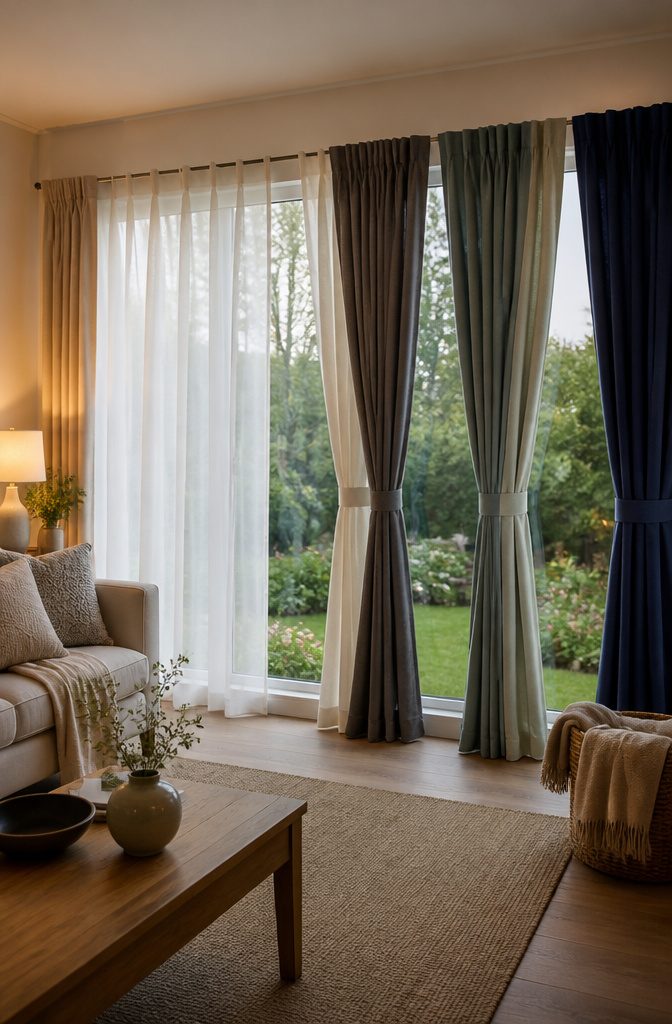
Properly fitting curtains should extend 8–12 inches beyond the window frame.
Size and Fit
A curtain that does not cover the full width of a large window leaves a strip of light at the edge that undermines the whole reason you hung it.
For wide spans, the rule owners repeat is simple: the rod should extend 8–12 inches past each side of the frame, and the panel width should total 2–2.5 times the rod length so the fabric stacks back without looking stretched.
Pooling on the floor reads romantic in a bedroom; in a living room it collects dust and trips vacuum cleaners.
Measure the height from floor to where you will mount the rod, then add whatever header or ring drop the hardware needs.
Renters with fixed rods placed by a landlord often discover the previous tenant guessed wrong and left them with a 96-inch gap and 84-inch panels.
Custom sizing fixes this but stretches the budget. Skip the precision work only if you are covering a non-working wall of glass with a sheer that functions as atmosphere rather than privacy.
Material Type
The fabric determines what the room feels like at 6 PM on a Tuesday.
Linen and cotton blends filter daylight into something soft but do not block the view from outside after dark; owners of street-facing living rooms layer them over a separate blackout lining or accept that the show reverses at night.
Velvet and heavy woven synthetics absorb sound and stop light cold, which matters for west-facing windows that take direct sun until evening.
Polyester holds a print and survives washing machines, though some cheaper weaves look stiff and office-like when they should drape.
Thermal-backed fabrics add insulation value that shows up in heating bills over a full winter; one owner in Minnesota mentioned her heavy panels made the sofa near the window usable from November through March.
Sheer organza and lightweight voile suit interior-facing rooms or spaces where the curtains exist mainly to soften architecture. Ignore material nuance only if you replace curtains seasonally and treat each set as disposable.
Style and Function Balance
Large windows create a tension that small ones do not: the more glass you cover, the more you sacrifice the openness that made the room appealing.
Sheer panels preserve the view but offer no privacy; blackout panels solve sleep and screen-glare problems but turn a bright living room into a cave by 3 PM.
The compromise owners land on most often is a double rod: sheer closest to the glass for daytime, decorative panel in front for evening.
Grommet tops slide easily and suit casual spaces; pinch pleats read more finished but need more width to stack neatly when open. Tab tops and rod pockets work for lightweight fabrics but fight with heavy ones on wide spans.
Some renters in older buildings with original wide trim choose an inside-mount tension rod with a simple panel to avoid drilling into plaster they do not own.
Skip the layering decision only if the window faces a private yard and the room’s main use never conflicts with the light.
Cost and Value
Wide windows multiply every cost because standard panels stop at 54 inches of width; covering an 8-foot span means buying four panels minimum, plus hardware rated for the weight.
Custom workrooms will fabricate to exact measurements with lining included, but the jump from ready-made to made-to-order is steep enough that some owners learn to sew or find a local workroom rather than a national brand.
What saves money without looking it: buying extra-long standard panels and hemming, or using clip rings to hang flat sheets of fabric that read as intentional.
What does not save money: buying too short and replacing, or skipping lining and watching the fabric fade asymmetrically within a year. Budget-focused buyers should watch for end-of-season clearances in widths that can be combined on a single rod.
The cost factor matters least when you are dressing a rental you plan to leave within a year and the landlord supplied a neutral baseline you can live with.
Installation Reality
A 10-foot span of lined curtains weighs more than most people estimate; the rod that held your bedroom shears will bow or pull from the wall.
For wide windows, wall-mounted brackets at the ends are not enough; a center support bracket prevents sag and distributes load into a second stud.
Owners report that finding studs across a wide wall, especially in plaster-over-lath construction, can turn a two-hour project into a weekend of patching.
Ceiling-mounted tracks solve the stud problem but require more precise measurement and a ladder work that intimidates some renters.
Tension rods inside the frame avoid holes entirely but limit you to lighter fabrics and narrower coverage. The tool list is short: level, drill, stud finder, and a second person to hold one end while you mark the other.
Skip the hardware anxiety only if you are hiring out installation or using a lightweight solution on a narrow subsection of the full window.
Energy Efficiency and Care
Thermal lining adds a measurable buffer against heat transfer; how measurable depends on your climate, your windows’ existing condition, and whether you close the panels consistently.
Single-pane windows in an old rental see more benefit than modern double-pane in a new build.
The efficiency gain is real but incremental, not transformative; owners who expected a dramatic bill drop report mild disappointment, while those who layered heavy panels over already decent windows notice the couch near the glass becomes tolerable in January.
Care requirements split by fabric: machine-washable synthetics suit households with pets and children; linen and silk demand dry cleaning or gentle hand washing that most people postpone until the hem is gray with dust.
Fade from direct sun is the slow failure mode; rotating panels end to end every season extends evenness.
These factors matter least for short-term renters with new windows who treat curtains as a decorative layer they will not keep past the next move.
Large windows often serve as the centerpiece of a room, if not the entire house, but while they offer many benefits, they can also present challenges: namely, finding curtain ideas for large windows.
— Yahoo!
How the Top Picks Compare
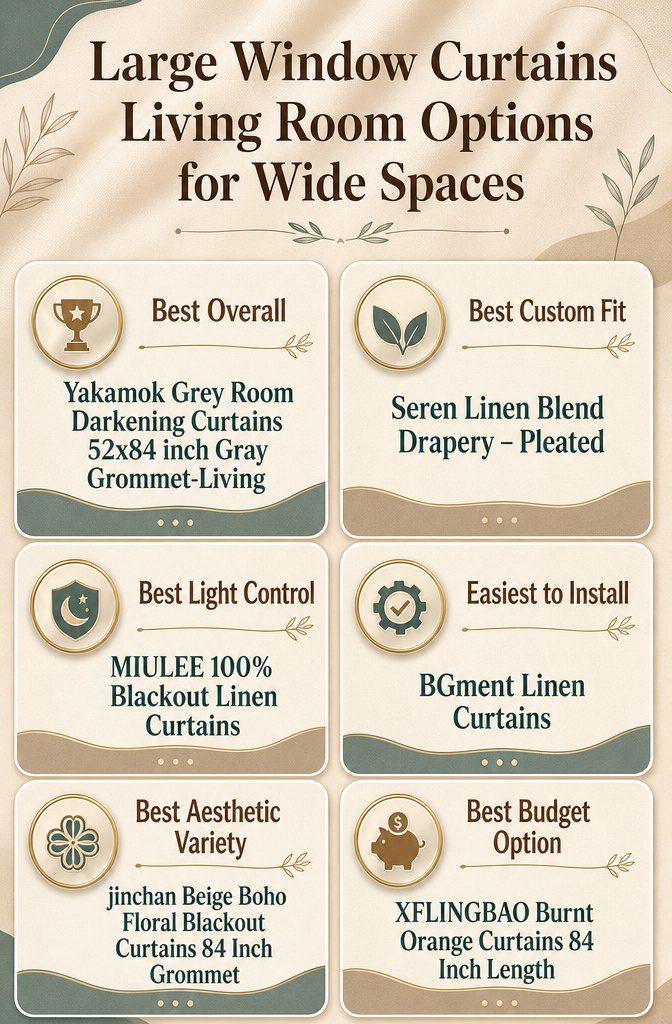
Yakamok offers a softer drape, while MIULEE features a heavier, thermal-lined construction.
The Yakamok and MIULEE both promise darkness, but they get there differently. Yakamok’s room-darkening fabric blocks most light while keeping a softer drape that folds back neatly in daytime.
MIULEE’s 100% blackout construction adds a thermal lining that flattens the profile and adds weight, the kind that matters if your wide west-facing window turns the sofa into a hot seat at 4 pm.
For someone who naps days or watches projector movies, MIULEE’s extra layer wins. For the buyer who just wants Netflix without glare and curtains that don’t look like hotel drapery, Yakamok’s lighter hand is the better fit.
Seren’s custom pleated build sits at the opposite end from BGment’s install-it-tonight approach. Seren asks for measurements, a decision about return depth, and a few weeks of lead time.
BGment hangs on a rod you probably already own, grommets sliding over in about ten minutes. Shape is where they differ: Seren’s pleats hold a formal silhouette even when drawn, while BGment’s grommet top stacks in looser folds.
Your entry hall with the 12-foot span and the vintage sconces wants Seren. Your rental with the standard brackets left by the last tenant wants BGment.
The sheer and semi-sheer pair, NICETOWN and YoungsTex, split on how much they reveal. NICETOWN at 96 inches gives full-length coverage that pools slightly on the floor, the look that reads finished in a room with tall ceilings.
YoungsTex at 63 inches stops at the sill, which feels intentional in a Craftsman with built-in window seats or any space where radiators or furniture sit below the frame.
Both filter light rather than block it, but NICETOWN’s extra length adds billow that catches afternoon light; YoungsTex stays tidier in kitchens or high-traffic spots where curtains might brush against something wet or sticky.
The decorative blackout options, jinchan and Estelar Textiler, both print pattern onto blackout substrate. jinchan’s beige boho floral reads warmer and quieter, the kind of print that retreats into a neutral room.
Estelar’s navy and greyish white pairing carries more contrast and a slightly formal edge.
Either works in a room that needs visual weight at the windows, but jinchan’s lower-key palette forgives walls that already hold art or busy upholstery. Estelar wants simpler surroundings so the geometric blocking can do its work.
XFLINGBAO’s burnt orange sits alone in the budget slot, and the difference shows in hand and drape weight next to the lined options.
The fabric is lighter, which means it moves more with the heat register below the window and may need hemming to hang right.
For a first apartment or a seasonal color change, that trade lands fine. For a curtain that stays up five years and needs to survive a washing machine, one of the lined picks holds up longer.
Measuring for Curtains
Getting the tape measure out is where most curtain projects start to go sideways.
The numbers on the package describe a single flat panel, not the gathered width that actually covers your window. A 52-inch panel hung straight across a 52-inch window leaves you with a stretched sheet, not a drape.
The rule I keep seeing in owner manuals and product listings is to aim for total curtain width at 1.5 to 2 times the window width.
For a 6-foot window, that means two panels totaling somewhere between 108 and 144 inches of fabric before it ever hits the rod.
Length trips people up just as often.
Floor-length curtains that stop an inch short look like a planning mistake, and panels that puddle without intention read as sloppy. Most ready-made panels run 63, 84, 96, or 108 inches.
An 84-inch panel on a standard 8-foot ceiling usually lands right at the floor if you mount the rod at or just above the frame. Go higher, closer to the ceiling, and you likely need the 96-inch length.
Rod placement itself changes the math.
Mounting 4 to 6 inches above the window frame and extending the rod 3 to 6 inches past each side lets the curtain stack clear of the glass when open. That extra width factors back into your total panel count.
Grommet sizing is standardized enough that it rarely causes problems; the 1.6-inch inner diameter on most panels fits standard rods without fuss.
Where people hesitate is between two sizes or fabric weights. The heavier blackout materials hang differently than faux linen, and that affects how full the panels read once installed.
When I compare spec sheets, the blackout fabrics typically run denser and drape more narrowly, which can push you toward the wider end of that 1.5-to-2 ratio.
Custom sizing exists for odd windows, but the lead times and minimums push it out of reach for most weekend projects. Measure twice, order once, and round up on width rather than down.
Curtain Styles Explained
The width of your window decides a lot before you ever touch fabric.
Most panels come 52 inches wide, and that number only gets you halfway to full coverage. For a look that actually fills the frame, plan on total panel width at 1.5 to 2 times your window width.
A 104-inch window needs two 52-inch panels at minimum, four if you want the gathered drape that photographs well and closes fully without gaps.
Grommets have become the default for a reason. That 1.6-inch inner diameter fits most standard rods and slides without catching, which matters when you are adjusting curtains twice a day for light control.
I have watched friends fight with back-tab panels on wide windows; the tabs bunch, the fabric skews, and the whole thing reads as homemade in the wrong way.
Fabric construction separates styles more than color does.
Triple-weave blackout layers block 85% to 99% of light depending on shade, with darker colors performing better. The same weave insulates against heat and cold, which shows up on an energy bill over a season.
Linen blends, usually 20% linen and 80% polyester, filter rather than block light. They give privacy without the cave effect, suited to living rooms where you want the room to feel occupied by daylight.
Blackout backing adds weight. Some owners describe the drape as hotel-like, others find it stiff until it hangs for a week.
Machine washing on cold and delicate cycles is standard across these constructions, though tumble dry low and a cool iron remain the safer path than high heat.
Custom sizes exist but push most projects past ready-made budgets. For a standard 96-inch length, the 84-inch panel leaves an intentional break at the floor or a slight hover, depending on rod placement.
Installation Tips
A curtain that hangs wrong wastes every dollar you spent on fabric. The most common complaint I see in owner reviews is simple: the panels looked generous online but arrived too skimpy for the window width.
Most standard panels measure 50–52 inches across. For a wide living room window, that single width will leave you with flat, stretched fabric and light leaking at the edges.
Buyers who report satisfaction almost always followed the same rule: total panel width should run 1.5 to 2 times the actual window width. Two 52-inch panels on a 70-inch window gives you that fullness; three panels on anything over 90 inches.
Grommet sizing trips people up more than it should. The research shows 1.6 inches as the standard inner diameter across nearly every blackout and linen blend panel in this range.
That fits most rods you’ll find at hardware stores, but check before you order. A rod even fractionally over 1.6 inches means fighting the panels on and off every time you wash them.
Mount height matters more than width for the finished look.
Install the rod 4–6 inches above the window frame and extend it 6–10 inches past each side. This stacks fabric clear of the glass when the curtains are open, which matters on large windows where you actually want the light.
Floor length should kiss the floor or break by an inch; pooling looks romantic in photos but collects dust and reads as sloppy in person.
The triple-weave blackout fabrics run heavier than linen blends.
Standard brackets hold them fine, but span anything over 96 inches and I would step up to a center support bracket. Sagging in the middle is the kind of mistake you notice every afternoon for years.
For care, the same instructions repeat across nearly every panel: cold water, delicate cycle, tumble dry low. The blackout layers can separate in high heat.
One owner noted their ombre panels came out of the package with fold marks that needed a warm iron on the back side. Plan that into your weekend timeline.
Frequently Asked Questions
What size curtains do I need for my large windows?
Most panels in the range are 52 inches wide, with lengths from 63 to 96 inches. For coverage that looks full rather than stretched thin, plan on total curtain width at 1.5–2 times your window width.
A single set of two 52-inch panels gives you 104 inches of fabric, which suits many standard wide windows; go wider or add panels for extra-large openings.
What materials are best for light control and privacy?
Triple-weave blackout fabric blocks 85%–99% of sunlight and UV, with darker colors performing at the top of that range.
Some backings go further, hitting 100% blackout. Faux linen and linen-poly blends filter light more gently, giving you diffused daylight with medium room darkening and enough privacy for daytime use.
The choice is straightforward: total darkness calls for the denser weave, while softer light means a lighter fabric.
Are custom curtains worth the investment?
Custom sizes are available if your windows fall outside standard dimensions. Whether they make sense depends on your window shape and how close ready-made panels come to fitting.
Gaps at the sides or a half-inch too short will bother you every day; custom work closes those gaps. For common sizes, standard panels with the right width multiplier usually cover the need.
What styles will complement my living room decor?
Sheer and light-filtering options suit spaces where you want natural light and an airy feel. Blackout panels with ombre, floral, or abstract prints work as a focal point in modern or eclectic rooms.
Solid faux linen in neutral tones fits vintage, farmhouse, or traditional settings without competing with existing furniture. The grommet top, with a 1.6-inch inner diameter, is the standard across most of these panels and slides easily on common rods.
How do I measure for curtains correctly?
Measure your window width and height first.
For width, multiply by 1.5–2 to get your total panel width. For height, add about 6 inches beyond the window height if you want the curtain to extend past the frame.
Check that your rod diameter is under 1.6 inches so the grommets will fit. If the panel is flat-packed, remember the listed width is before hanging; actual coverage is less once the fabric gathers.





