
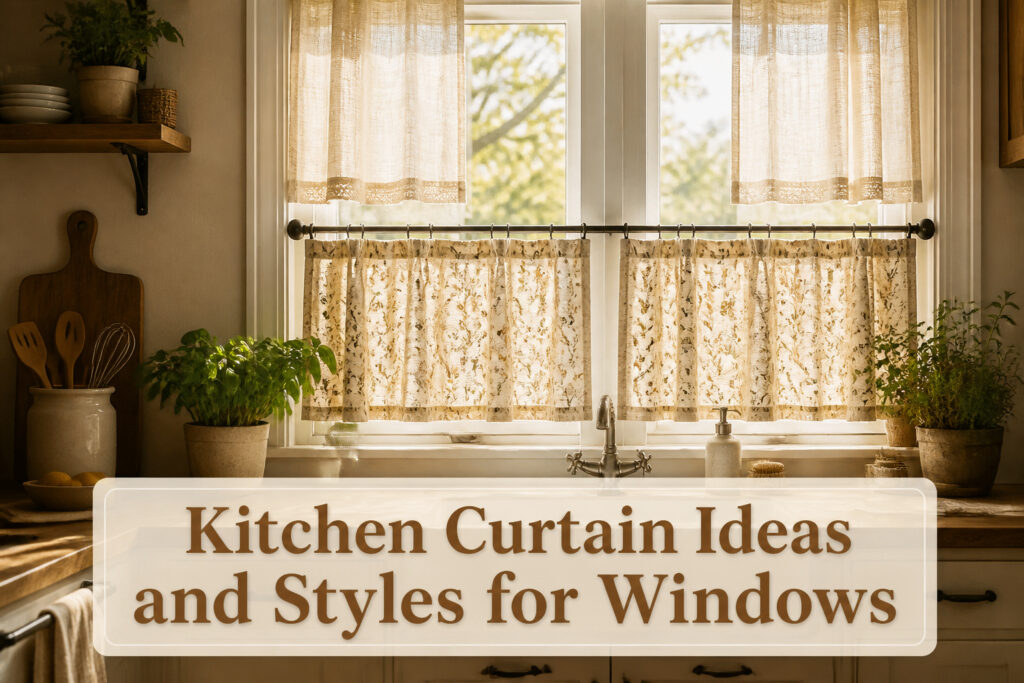
Kitchen curtain ideas range from a twelve-dollar drop cloth to custom board-mounted valances, and the right choice depends on whether your window faces a brick wall or a sidewalk.
A sheer over the sink earns its keep when privacy is already handled by architecture; alone on a ground floor, it leaves you exposed after dark.
The 8% linen, 92% polyester blend for café curtains hits the mark for washability and light filtration without the synthetic odor trap that polyester-heavy fabrics become near a stove.
1. Café Curtains
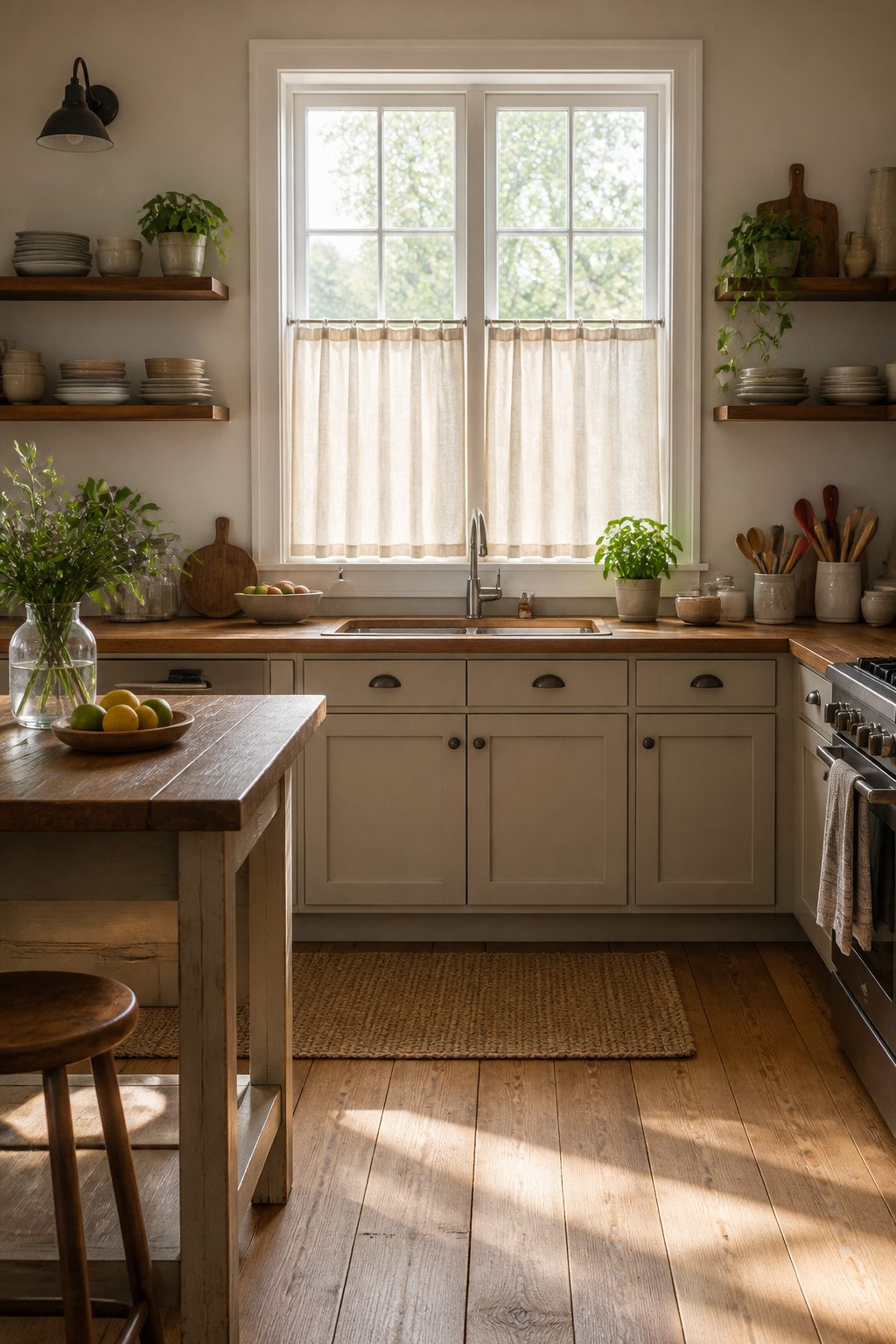
Café curtains cover the bottom half of the window and leave the top open, which is exactly what a kitchen needs: privacy at the sink without sacrificing daylight.
The fabric stays clear of counters and splashes, and the look reads as intentional rather than like you ran out of material.
Mount the rod a few inches above the frame, across the middle of the window at the top of the lower sash.
A tension rod works if you are renting and want to avoid holes. The 8% linen, 92% polyester blend filters roughly 35 to 45% of light, settles into easy folds, and holds up in the wash.
Cotton and semi-sheer options work too. Short panels stay cleaner because they avoid counter contact.
The style has stuck around because it solves a real problem simply.
A stripe, small floral, or solid keeps it timeless; anything too cute ages fast. Pair with a valance on a west-facing window if harsh afternoon sun is the issue, but most kitchens get enough from the half-coverage alone.
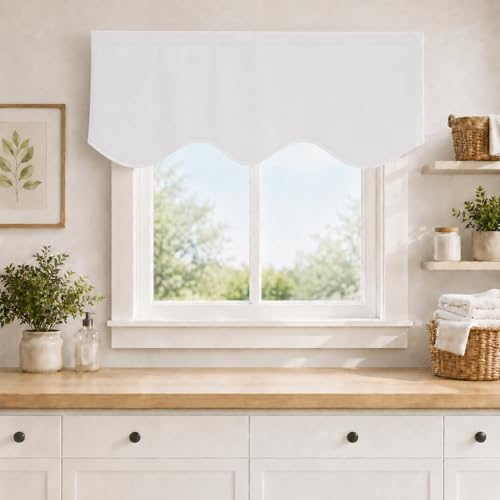
Package: 1 panel of 52 inch wide x 18 inch long / 132cm x 45cm valance curtain ( Length may vary from 1"-3" due to its' scalloped design). Dual rod pockets design allows easy hanging and slight adjustments, give the valance a nice fit.
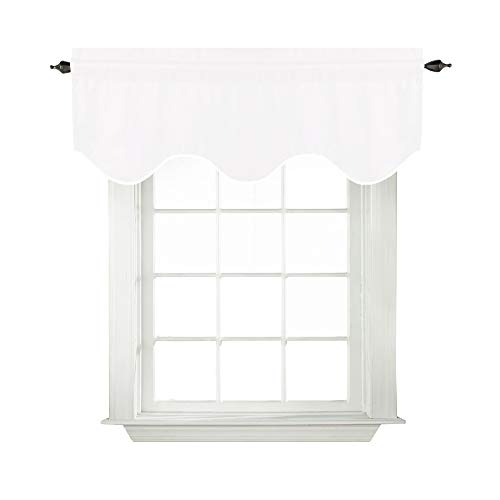
INCLUDED IN: Each package includes 1 panel of beautiful scalloped window curtain valance. Size measures: 52"W x 18"L. Constructed with 2" header, 3" rod pocket and 2" bottom hem, perfect fit up to 2" curtain rod
2. Valances
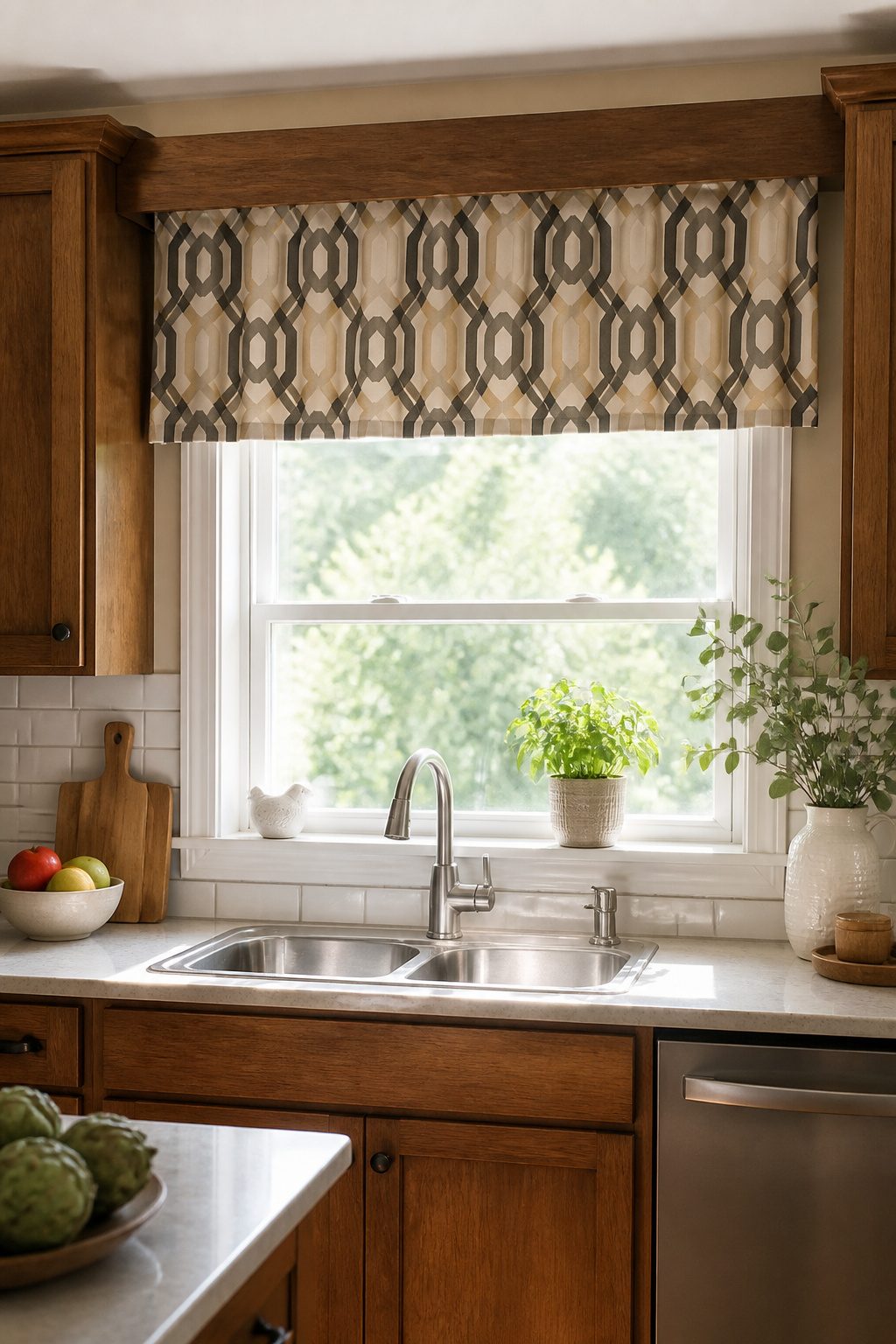
A valance covers just the top of the window, which is often all a kitchen needs.
It frames the glass, hides the hardware, and leaves the lower half open for light and access. That makes it practical above a sink where full panels would dangle into the faucet stream or need constant pushing aside.
Board-mounted valances hang from a flat lumber board rather than a rod, and the fabric falls more smoothly because of it.
Rods bunch the material; boards give cleaner lines that read as modern rather than grandmotherly. Minimal pleating keeps the look crisp and avoids the doily trap that valances can fall into.
The small amount of fabric means you can risk a bolder print or color than you would with full curtains, and the commitment stays low for renters.
Grease and moisture hit the bottom half of kitchen windows hardest, so a valance sidesteps the cleaning cycle that full panels demand.
It works alone when privacy is not the issue, or paired with blinds or shades when you need to block the view after dark.
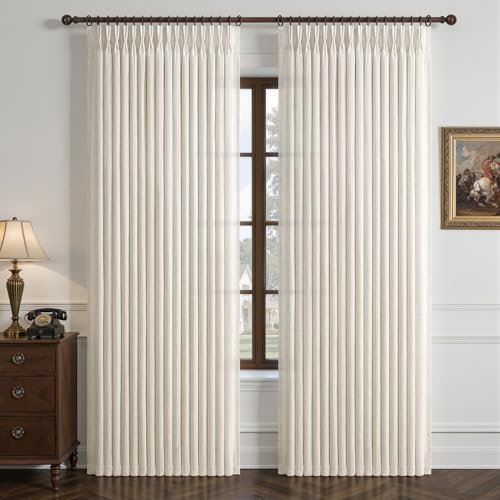
Memory Shape Pinch Pleated Design: Each 50 inch wide curtain panel is designed with 8 pinch pleats, here with 248°F memory shape trained technology ensure every pleated stays perennially sharp, effortlessly beautiful and neatly draped that elevates every window in the home.

Basic Information: Includes 2 curtain panels, each measuring 50 inches wide for a total of 100 inches. Easy care for machine washable in cold water, do not bleach, tumble dry low, iron on low heat if needed.
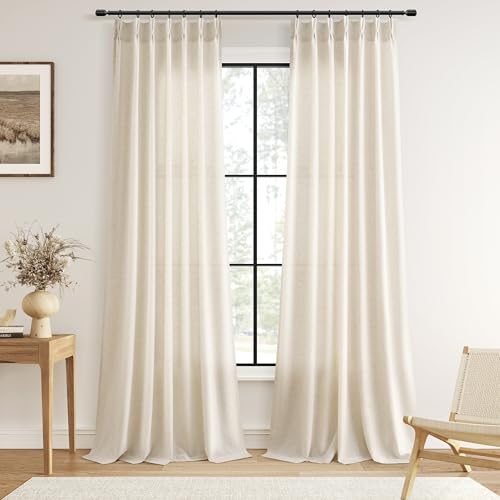
Pinch Pleat Design: The Pinch pleat design is a standout feature of these curtains. It creates an elegant and sophisticated look, adding a touch of charm to any room. The pleats are evenly spaced and well-defined, giving the curtains a neat and tidy appearance. This design not only enhances the aesthetic appeal but also helps to ensuring that the curtains hang smoothly and gracefully.
3. Roman Shades
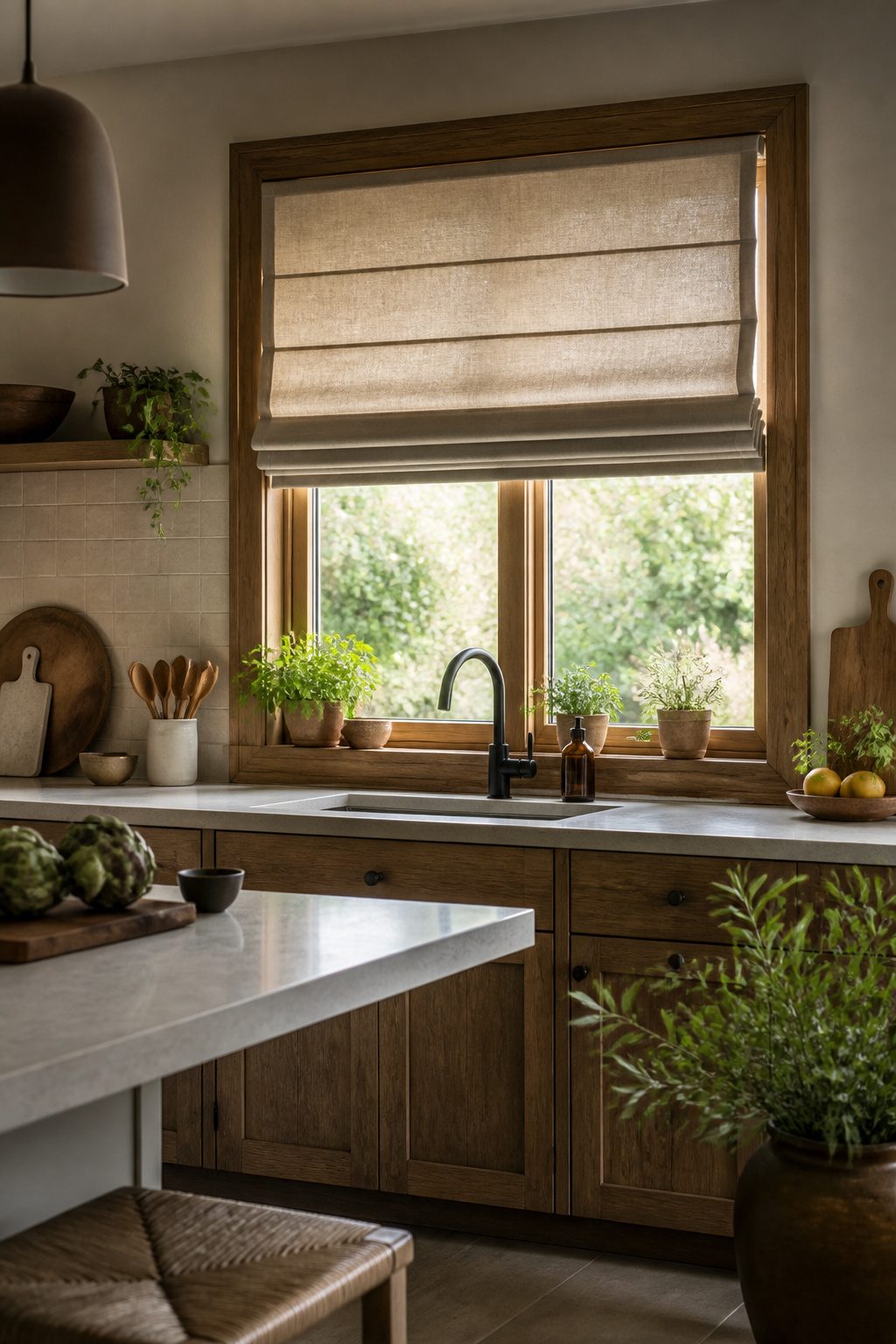
Roman shades stack flat in neat horizontal folds when raised, which keeps the top of the window looking tidy rather than bulky.
The fabric you choose matters more in a kitchen than in most rooms. Cotton, linen, and their blends hold up to humidity near the sink and stove far better than silk or velvet, and they wash repeatedly without turning shabby.
Polyester traps cooking odors for longer than natural fibers, so I would skip it unless the window sits well away from food prep.
The installed look versus DIY is a real fork in the road.
Store-bought roman shades with a cord-and-ring system run smoother and stack more evenly than most homemade attempts, but making your own is workable if you cannot find a pattern or size that fits.
Budget hunters should check estate sales or Facebook Marketplace for vintage bamboo or woven shades, then swap in new mounting hardware.
A tighter weave gives more privacy and blocks more light; looser weaves feel casual but let light filter through in a softer, dappled pattern.
Either way, measure the stacking height at the top before you buy, because a deep stack on a short window eats more glass than you might expect.

Order the exact width of your window frame. If your frame is 22", buy 22". No deduction – we make it to your size

No Drill Blinds: LazBlinds patented technology No Tools-No Drill system allow it no need to drill any holes on your window frame, great for Renter, Landlord, and Home Buyer. Easy to Install in 30 seconds with no tools-no drill, screws, or brackets. And it can afford maximum 30kg. Fit All Kinds of Walls, like woodiness metope, tile marble, concrete wall and rough tile.

【For inside mount】order the exact width of your window frame. If your frame is 26", buy 26". No deduction – we make it to your exact size
4. Sheer Curtains
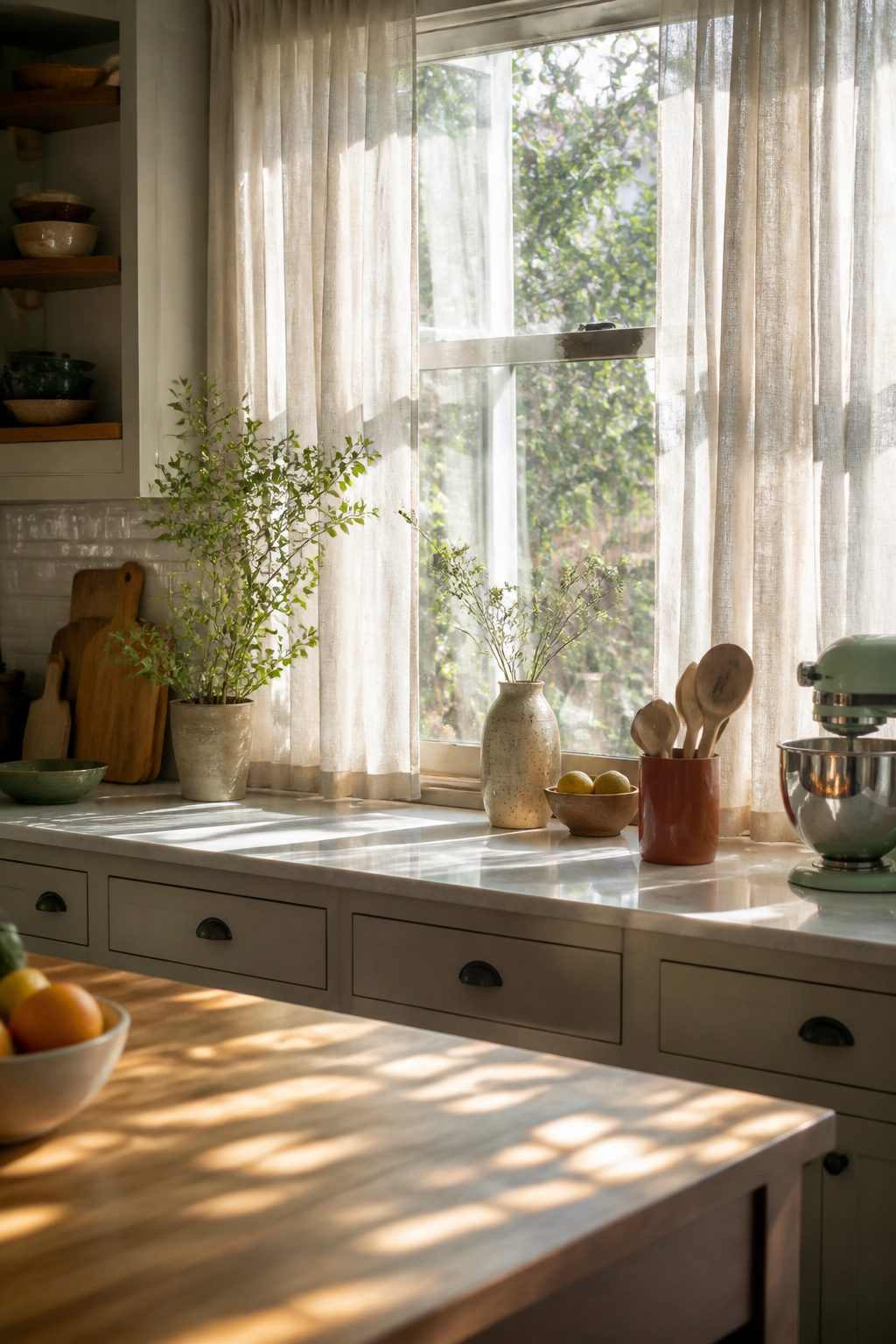
Sheer curtains filter sunlight into something you can actually use, that soft glow that makes a north-facing counter feel workable at 3 p.m. without flipping a switch.
The trade is privacy: they are essentially transparent after dark, and even during daylight they show movement and silhouette clearly enough that ground-floor windows facing a street or sidewalk are the wrong place for them alone.
Upper-story kitchens and windows that look out onto a fence or a quiet side yard are where they earn their keep.
The window over my own sink faces a brick wall six feet away; a sheer there gives me daylight and spares me the feeling of staring into masonry.
If you are set on that airy look but the exposure is tricky, a roller shade behind the sheer fixes it.
Draw the shade after sunset, pull it up in the morning, and the sheer still does its job all day.
The hardware costs more, a double rod or a separate mount, but it is the difference between a curtain that works for your schedule and one that works only when the sun is high.

【PACKING SPECIFICATIONS】: 2 pcs of white curtain rods, which can be extended from 26 to 39 inch, and the best use range is 28 to 36 inch,Scalable without drilling.

【Reinforced Support】 Our extendable curtain rod features a reinforced design with a 50% increase in wall thickness, providing unmatched support. It easily withstands 6 LBS of pressure without bending, ensuring a carefree user experience

【Superior Material】-Made from premium Inside and outside tube diameter: 13 / 16MM Carbon steel ,sturty and durable
5. Roller Shades
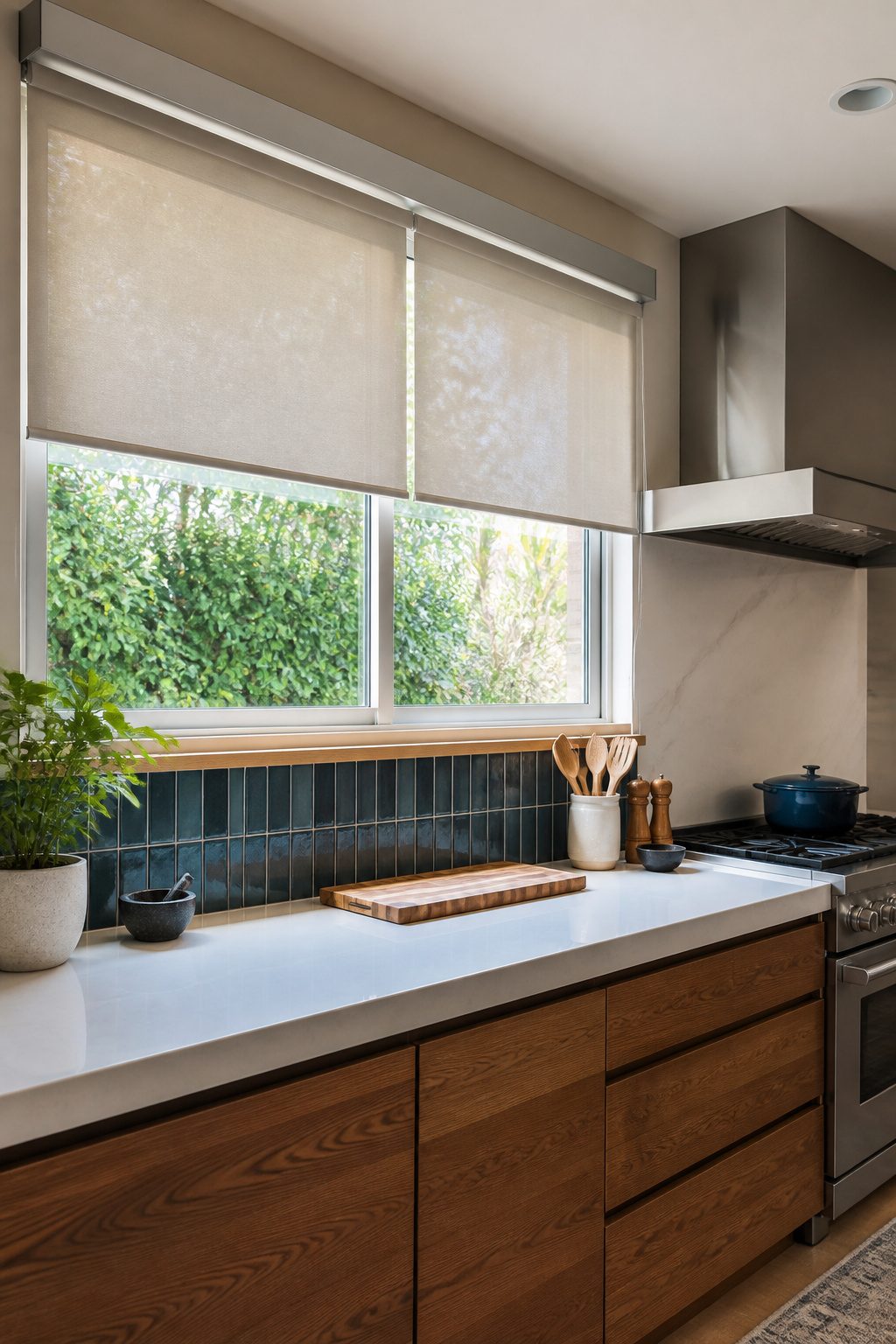
A roller shade is basically a tube of fabric that rolls down to cover the glass and up into a housing at the top.
That housing is the part renters notice first: it sits clean against the window frame and leaves no hardware to patch later.
The fabric itself is a single wipe-clean surface, which matters more in a kitchen than people expect until they sauce-splatter their first set.
Operation comes two ways. Spring-loaded versions push up and pull down by hand; chain-driven ones use a beaded loop for more precise control.
The chain wins if your windows are tall or you adjust light several times a day, but the spring mechanism has fewer parts to fail and no loop dangling near a burner.
Mounting works either inside the frame for a fitted look or outside to cover the trim entirely.
An outside mount also blocks more light and hides a less-than-perfect window frame, which is why it shows up so often in rental kitchens where the landlord’s "maintenance" was last done in 1992.
For renters, the outside mount plus spring operation is the combination that travels best: you fill the old holes with spackle, roll up the shade, and reinstall it at the next place in about twenty minutes.
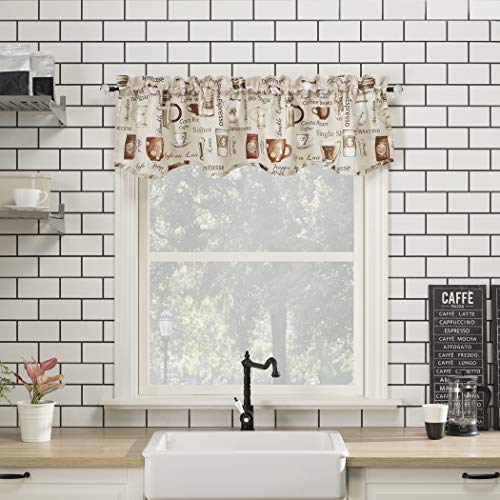

Material and Size: Crafted from polyester fabric in 26"W x 36"L, these panels add a smooth feel and practical coverage for everyday rooms.
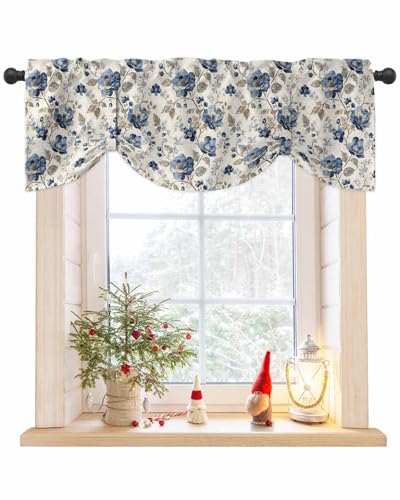
Well Made: Tie up valance curtain is made of high quality polyester fabric, which is soft, comfortable, durability, fadeproof, breathable, skin-friendly, long lasting using, providing a comfortable and healthy environment. Various themed patterns add warm festive atmosphere to your home decorations
6. Woven Shades
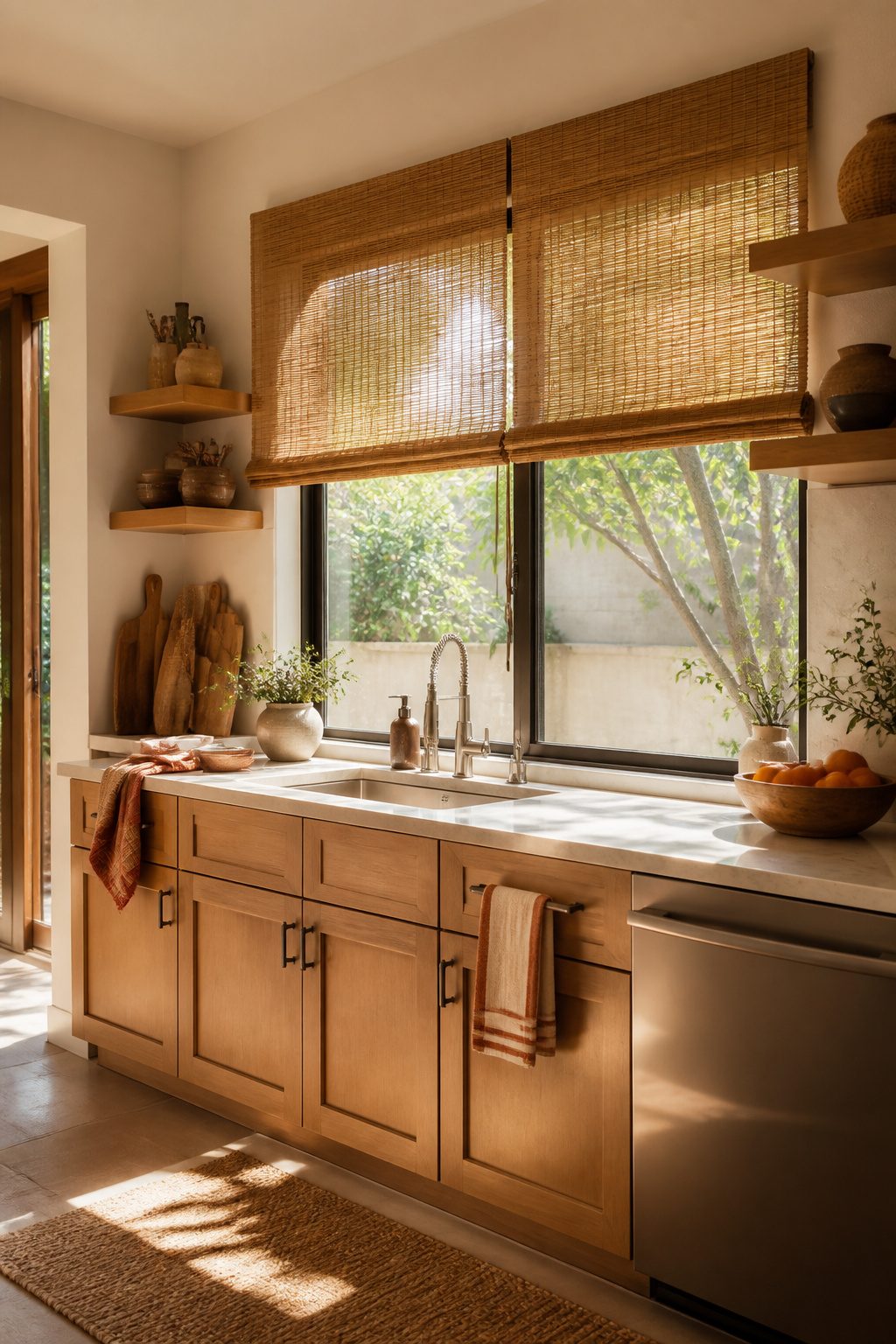
Woven shades bring in the kind of texture that reads as warmth rather than pattern.
Bamboo and jute are the usual materials, and the slight irregularity in the weave is the point: it catches light unevenly and stops the shade from looking like a factory product.
The lining decision matters more than people expect. A light-filtering liner keeps that soft, dappled glow while still blocking the view from outside; a blackout liner kills the effect entirely and turns the shade into something heavy.
For a kitchen, the lighter option usually wins unless the window faces a street at eye level.
Against painted cabinets, the natural tone acts as a bridge between the wall color and whatever wood is already in the room.
With natural wood cabinets, the match can go either way: similar tones read calm, while a deliberate contrast in warmth keeps the shade from disappearing.
I have seen tighter weaves sold as more private and looser ones pitched as more casual, but the real difference is how much light you lose; hold a sample up to a bulb before you decide.

LINEN BLEND FABRIC: These beautiful curtains are passed GLOBAL RECYCLED STANDARD certificate, crafted from rich flax linen blended fabric featuring a neutral linen effect, which gives it a slightly brownish tone(Color is not solid). Please CONFIRM whether you can accept this feature before purchasing

HIGH END LUXURY LINEN: Open woven of linen blended fabric.20% raw flax linen plus 80% polyester.Unlike 100% linen curtains too stiff and skin unfriendly,these linen/polyester not only keeps natural primitive aesthetic of linens but also brings soft drape effect,wrinkle free and shrinkage resistant
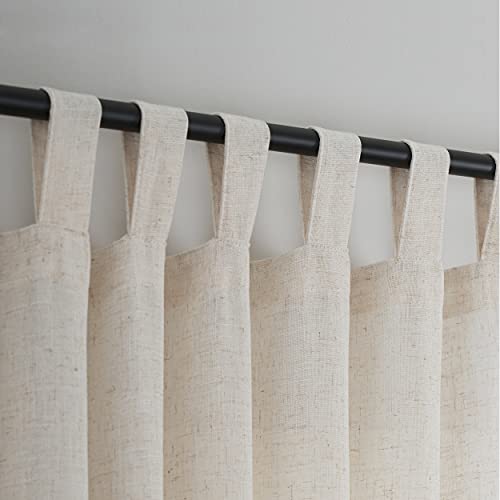
Versatile for Multiple Rooms & Decor Styles. Ideal for living rooms (bright yet cozy ambiance), bedrooms (gentle light filtering), studies (glare reduction for reading/working), and dining rooms (natural elegance for mealtime). The neutral linen texture complements diverse styles, from minimalist to modern farmhouse
7. Floor-Length Drapes
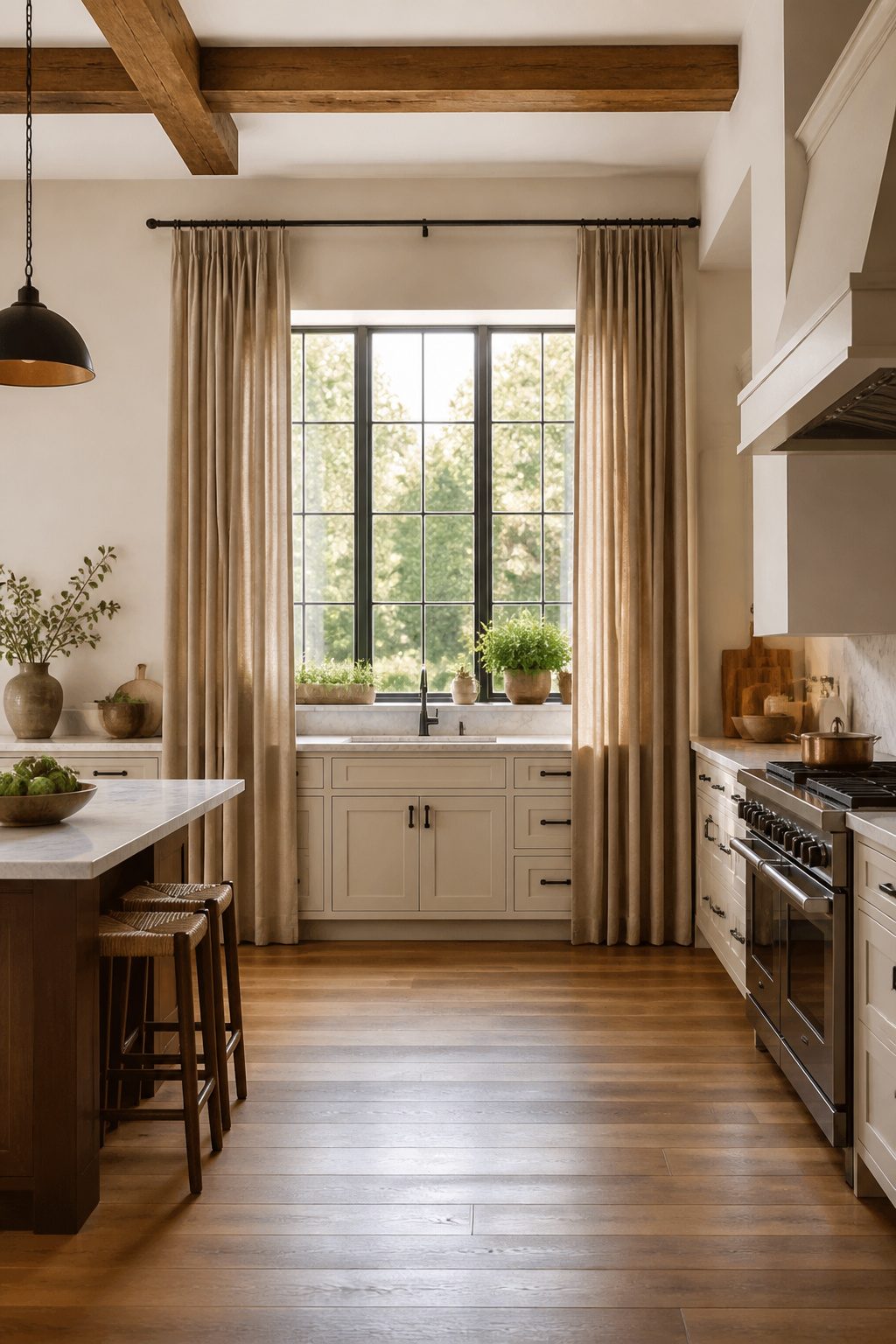
Floor-length drapes in a kitchen only make sense when the architecture invites them in.
A breakfast nook with a single tall window, an open-plan living area where the kitchen wall is mostly glass, or any space with ceilings high enough that the fabric can hang without crowding the countertops: these are the situations where the idea works.
In a standard layout with cabinets running under the window, the bottom of the fabric needs to clear the counter by at least a few inches or it will collect grease and get in the way every time you reach for the sink.
The fabric weight matters more than the length.
A heavy cotton duck or a lined linen holds its shape and looks intentional; anything too light, like an unlined voile or a thin rayon, billows at the hem and reads as a bedroom curtain that got lost.
Performance fabrics designed to withstand splashes and spills hold up better near cooking zones than standard decorator materials, though they cost more per yard.
If you are renting, tension rods will not support the weight of full-length drapes. You need a proper wall-mounted rod with brackets into studs, which means patching holes later or asking permission first.
For most kitchens under nine feet, shorter treatments are the smarter call. Save the floor-length look for the one window in the house that actually earns it.

CORDLESS MAGNETIC & NO-DRILL DESIGN: Our upgraded Roman shades feature a hassle-free, no-drill installation with ultra-strong sticky velcro that securely holds the shade without damaging your walls. The ingenious cordless magnetic folding system ensures silky-smooth operation while completely eliminating dangerous dangling cords, providing ultimate safety for homes with children and pets, and giving you total peace of mind.
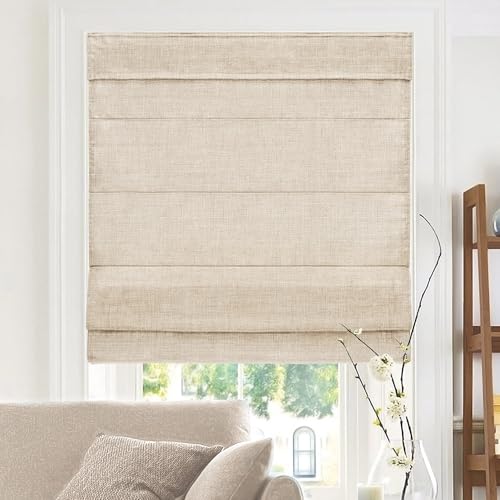
PRIVACY + LIGHT FILTERING (NOT BLACKOUT) – Softens sunlight and provides daytime privacy. At night with interior lights on, silhouettes may be visible (common for light-filtering shades).

CORDLESS & MAGNETIC DESIGN: Featuring a cordless magnetic lift system, this roman shade offers easy, smooth operation with enhanced safety. Effortlessly adjust the shade to your desired height. Secure magnets and lightweight linen fabric hold it firmly in place, allowing you complete control over light and privacy with flexibility and stability.
8. DIY Curtains
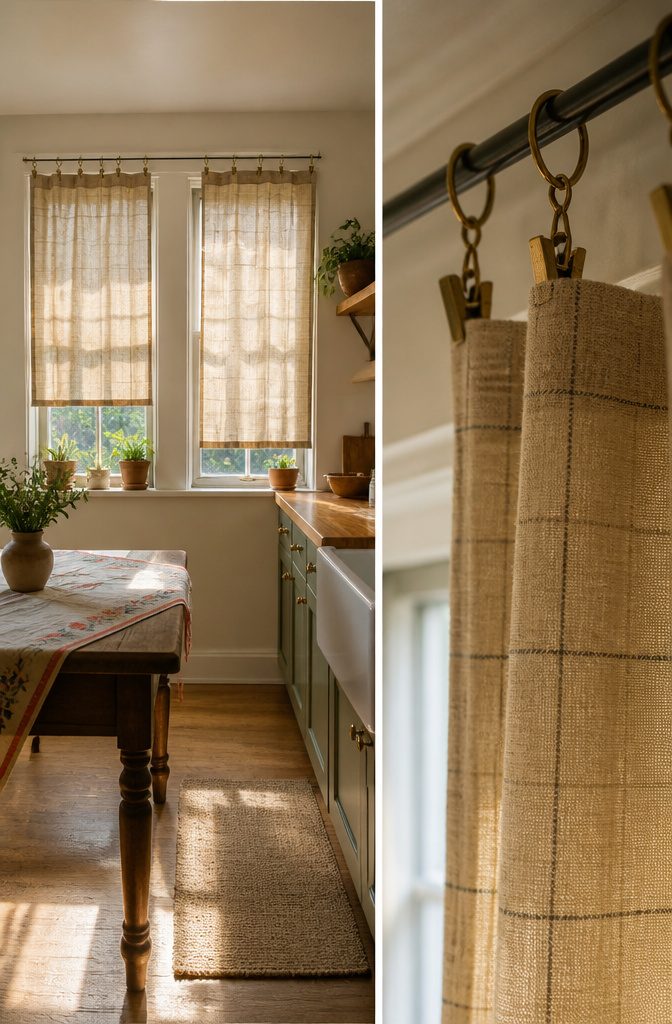
Drop cloth curtains start at about $12 for a 9-by-12-foot canvas piece, which is enough fabric to cover two standard kitchen windows with length to spare.
I like that the material already reads as finished; the faint grid lines and neutral color look intentional rather than improvised.
Hemming is where most people trip up. Hem after you hang, not before.
Fabric stretches differently once the rings clip in and the weight pulls vertical. I have seen beautiful drop cloth panels end up three inches short because someone measured on the floor.
No-sew iron-on tape works for clean edges if you do not have a machine, but the adhesive softens near a stove or sink over time.
For that reason, clip rings beat a rod pocket; they add structure and keep the fabric from pulling at the tape.
Vintage tablecloths are another route, especially the square ones with a border print. Turned on point and hemmed to window length, the border becomes a bottom detail no catalog sells.
The mistake here is running them through a machine with tight tension; vintage cotton can be thinner than it looks, and puckered seams are hard to reverse. Loosen the tension and test on a corner first.
A tension rod, probably $8 at any home store, keeps the whole project removable. That matters if you are renting or just like to change things without patching drywall.

【Size Introduction】- 2Pcs small tension rods 17-28 inch diameter:10/13mm.(Recommended best use range 17 to 26 inches)

【Size Introduction】Equipped with 2 tension rods,The actual length of the product is 17-28 inches (43-71cm).(Recommended best use range 17 to 26 inches (43-66cm))

Tension rod adjusts from 28 to 48", rod diameter-1/2" , caps diameter-3/4",2 pcs
Fabric That Survives Grease and Washing
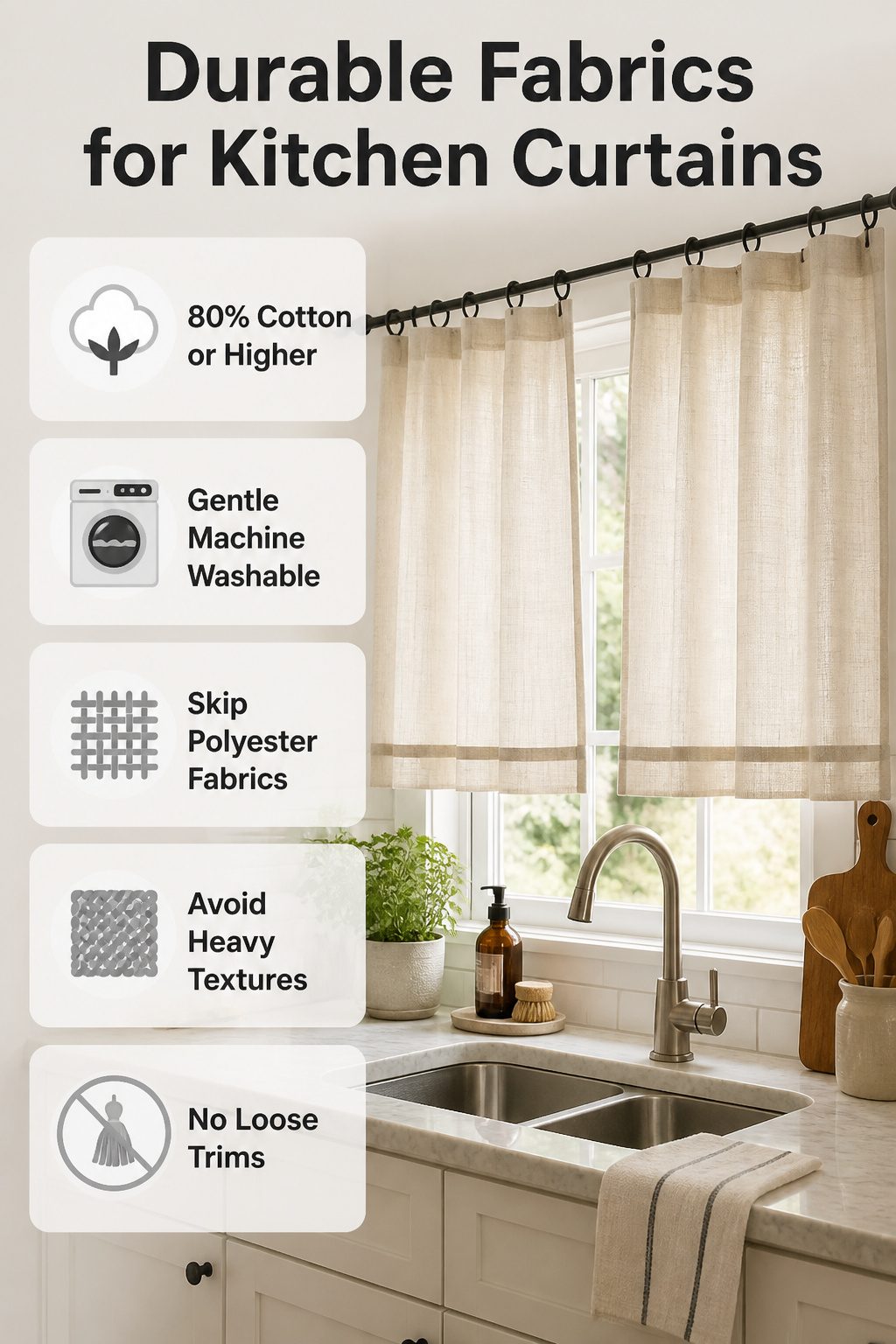
Cotton and linen blends are the fabrics that actually survive a kitchen, and the bolt end tells you what you need to know.
Look for 80% cotton or higher, or a linen-cotton mix in the fiber-content box; these handle machine washing on gentle and come out softer, not ruined. Polyester traps cooking odors for days, so skip it even if the price is tempting.
The same goes for anything dry-clean only, heavy textures that hold grease film, and loose trims like pompoms or fringe that collect splatter and pose a fire risk near the stove.
Realistic washing means a light shake or vacuum every couple of weeks, and a full wash when the panel sits near active cooking.
Fabric hung short, off the counter and away from the flame, stays cleaner longer and dries faster; flat, loose weaves beat high-pile textures for exactly that reason.
Ribbon trim works if you want detail, because it sits tight to the panel instead of dangling.

Jacobean pattern design Gently filters light while enhancing privacy Machine washable Includes 1 single valance. Tier curtains sold separately. Rod pocket design allows for...
Length That Clears the Counter
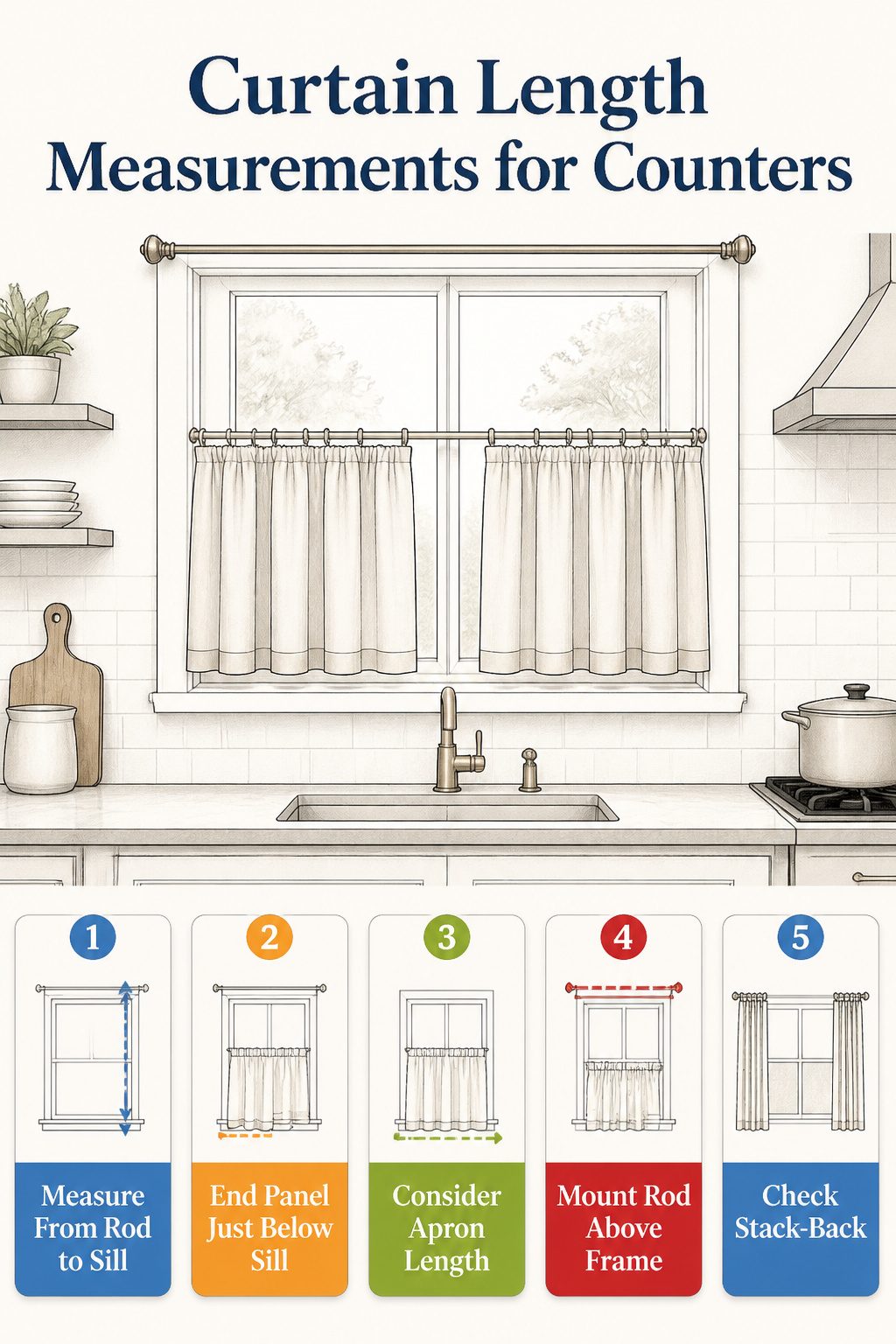
Café curtains and short panels only work if they actually clear the counter.
The sill-length rule is straightforward: measure from the rod to the sill and end the panel at or just below it, so fabric never trails onto wet granite or laminate where pasta water splashes or coffee drips.
Apron length is the exception worth knowing.
Dropping the hem two to three inches below the sill, to the bottom of the window frame, still keeps fabric clear of the counter while softening the line on taller windows that look stubbed out at sill height.
Rod placement does the real work of keeping curtains clear of the sink and stove. Mount the rod a few inches above the window frame, then extend it past the sides so the panels stack back without crowding the glass.
Over the sink, that extra height buys clearance for washing dishes; near the stove, it keeps loose fabric away from gas burners.
I measure the window width, add those extra inches for fullness, and check the stack-back against the wall space I actually have.
Kitchen windows are often non-standard, especially garden-style or over-sink units, so made-to-measure sizing gives the cleanest result. Tension rods work for renters, but only with lightweight fabrics that do not sag into the workspace.

Versatile Hanging Options: Set of 2 Panels.Each panel measures 52 inches wide by 84 inches long, with a back tab and loop pocket top design that provides three hanging...
Matching What Is Already in the Room
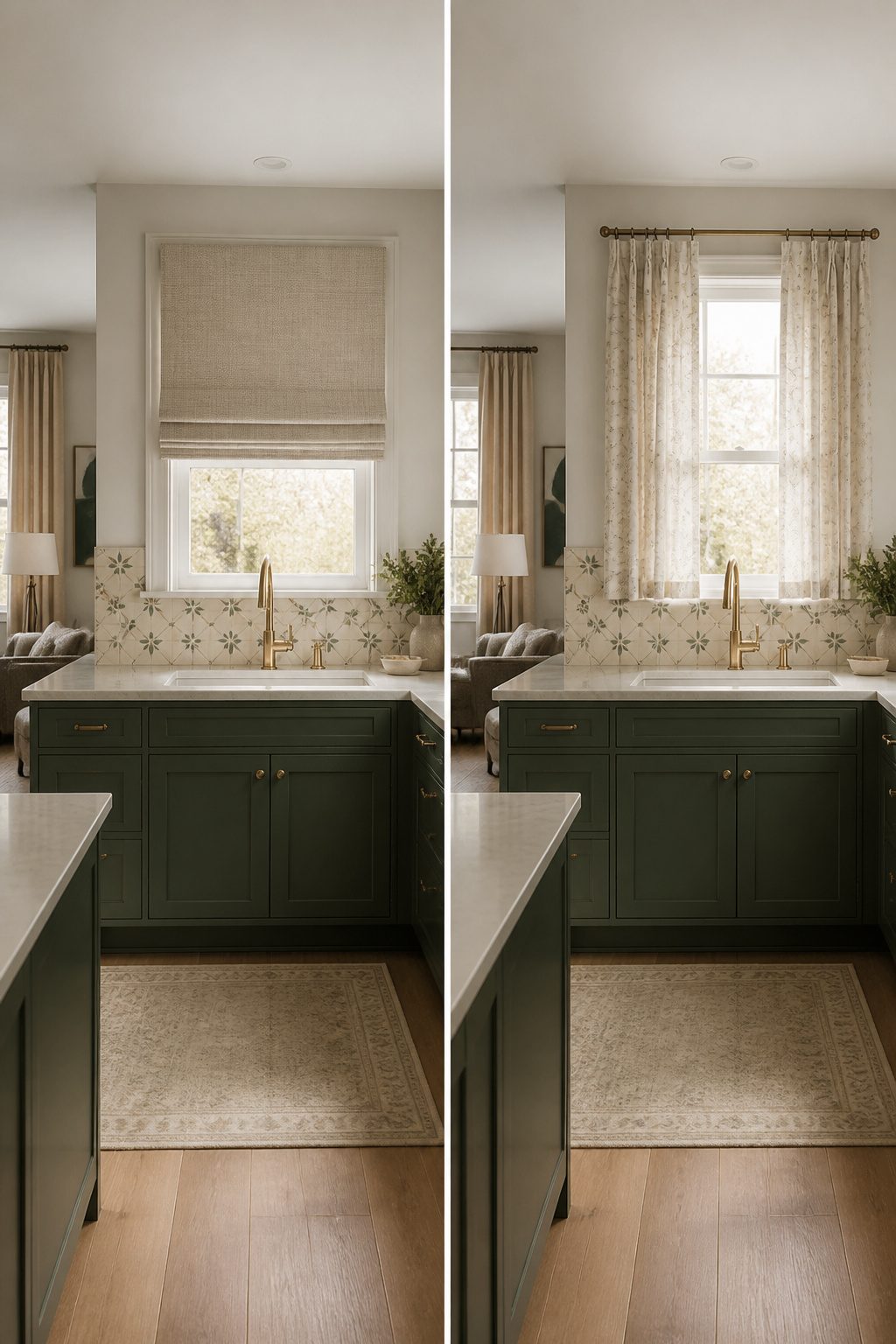
The safest move is to pull a color from the backsplash or a textile already in the room. That single swatch ties the window to something permanent, so the curtain reads as intentional rather than orphaned.
Matching the cabinets works when the cabinet color is interesting on its own.
Deep green lower cabinets, for instance, can carry curtains one shade lighter without going flat. White or neutral kitchens need the opposite: a soft stripe or check adds enough personality that the room does not feel like a rental turnover.
Walls are the last thing to match, and only when the space is small enough that competing elements fight for attention.
Monochrome curtains against the same wall color recede visually and let texture do the work instead: smooth paint against rough linen, glossy counters against matte cotton.
In open plans where the kitchen is visible from the living area, the curtain should nod to the larger room’s style even if the fabric differs.
A common trim, or the same color family in the valance, keeps the kitchen from reading as a separate planet. When the doubt is real, order free swatches and hold them against the cabinets in daylight before committing.
Layering Two Treatments
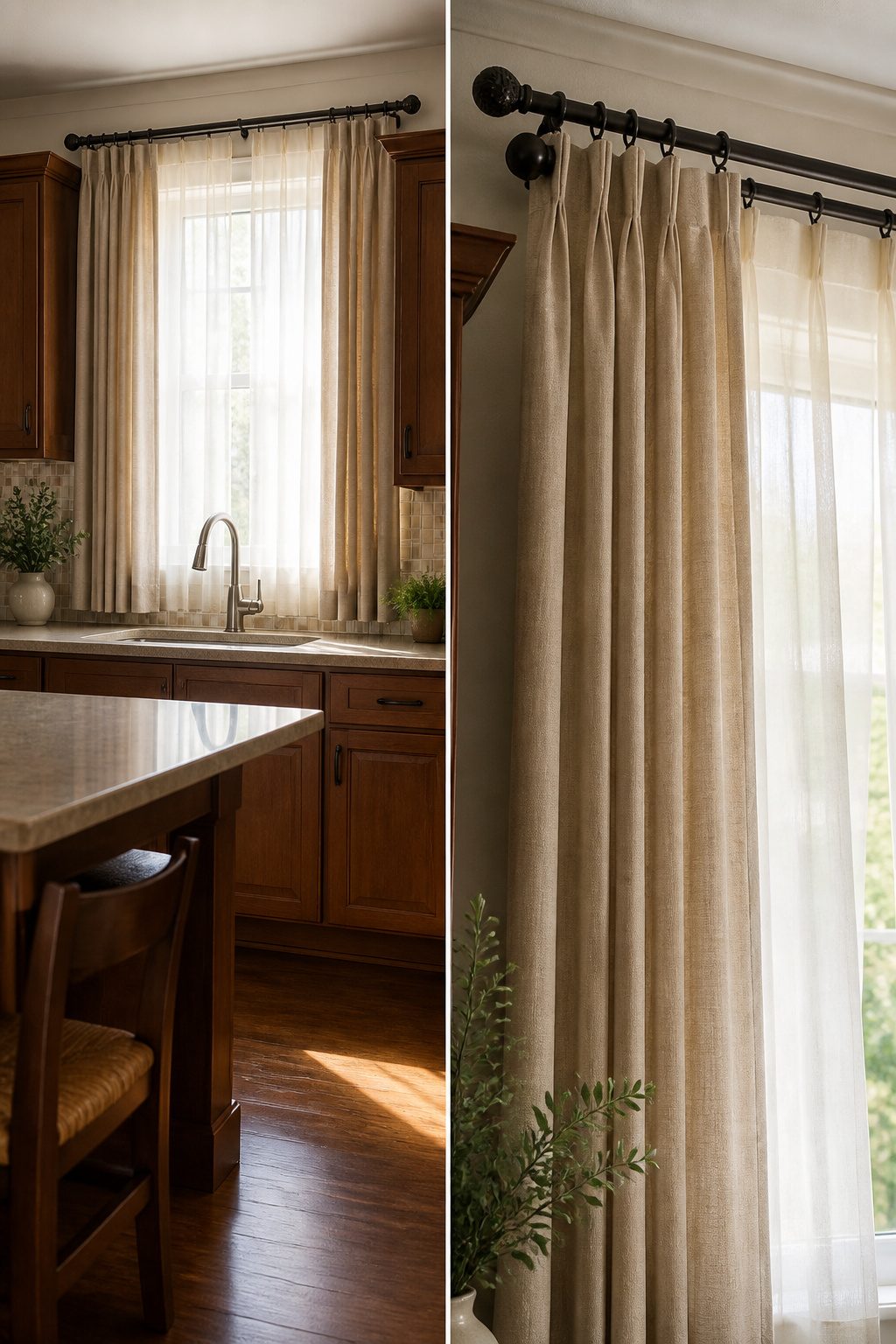
Layering two treatments is the only setup that lets a kitchen window adapt from morning coffee to evening cleanup without swapping hardware.
The pairing that convinced me, reading through a dozen of these, is a sheer closest to the glass with a heavier linen or cotton panel on the outside.
During the day, the sheer filters light soft enough that you still get the sun’s help keeping moisture-prone corners aired out. At night, the outer panel closes for privacy.
Woven shades work the same way if you prefer texture over fabric. A bamboo or jute Roman shade does the light-blocking job, and side panels frame it without competing.
Tighter weaves on the shade give more privacy; looser weaves read more casual but leak more light. Either way, the shade stacks neat when raised, so you’re not losing the view entirely.
The hardware is where renters get stuck. A double rod or track system costs more than a single, and the brackets need clearance your trim may not have.
For a window under about 24 inches wide, two layers can look like the curtains are wearing the window rather than dressing it. One layer, chosen right, usually wins there.
Frequently Asked Questions
What kind of curtains are best for a kitchen?
Light, washable fabrics in a short length work best.
Cotton and linen blends handle machine washing and repeated wear near humidity, while short panels stay off wet counters and away from stove splatter. Polyester traps cooking odors, so natural fibers win in active kitchens.
Are café curtains still in style?
Yes, they are a timeless kitchen choice because they solve a real problem simply.
Covering just the bottom half of the window gives privacy at the sink while leaving the top open for daylight. A stripe, small floral, or solid keeps the look current; anything too cute ages fast.
How high should you hang kitchen curtains?
Mount the rod a few inches above the window frame, extending it past the sides so panels stack back without crowding the glass.
For café curtains specifically, place the rod across the middle of the window at the top of the lower sash. That extra height buys clearance over the sink and keeps fabric away from burners.
What length should kitchen curtains be?
For most kitchen curtains, end the panel at or just below the sill so fabric never trails onto counters where water or sauce splashes.
Apron length, two to three inches below the sill to the bottom of the frame, softens taller windows that look stubbed out at sill height.
Floor-length drapes only work when the architecture invites them in, like a breakfast nook with a single tall window or ceilings high enough that fabric clears countertops by several inches.
Can you put curtains near the stove or sink?
Yes, but choose washable fabric and a length that clears the counter.
Near a sink, sill-length or shorter keeps panels out of the faucet stream. Near a stove, keep loose fabric well away from open flame or gas burners; a short café curtain is the safest choice in both spots.