Boho bedroom curtains span from a $46.75 cotton gingham panel to velvet that needs a stud-mounted rod, and the single deciding factor is how much light you actually want to live with.
Sheer linen turns morning sun into a glow that shifts to amber by evening, while three-layer autumn stacks let you dial privacy up through fall.
The catch is weight: cotton billows like a clothesline sheet, but velvet pools formal unless you break it with bullion fringe or a double-wrapped tassel tie-back.
1. Sunny Gingham Charm
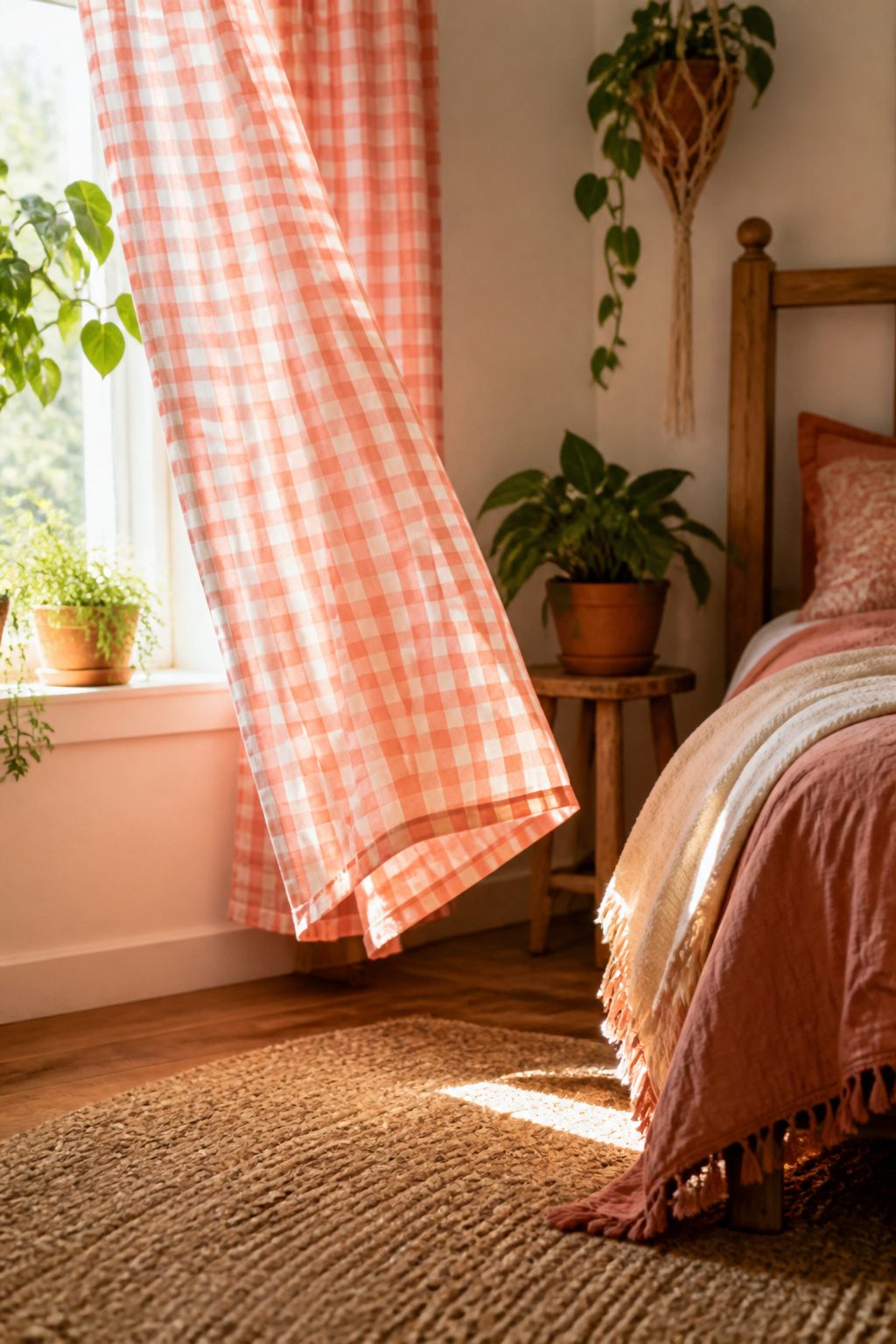
Gingham carries a baked-in memory of picnics and kitchen curtains, which is exactly why it loosens up a boho bedroom instead of tightening it into something prim.
The trick is scale. A check larger than one inch per square reads casual from across the room; anything smaller starts looking like a tablecloth or a uniform.
In a bedroom with standard eight-foot ceilings, that mid-scale windowpane hits the sweet spot between pattern and breathing room.
Cotton gingham hangs lighter than a linen blend or a canvas duck, which means it billows at the hem if you leave it long and pools less dramatically than heavier weaves.
That movement is the point. The fabric catches air when the window opens, and the whole curtain lifts like a sheet on a clothesline.
For renters, the low price of cotton broadcloth means you can buy extra width and gather it densely on the rod without the cost of designer yardage.
The sun-faded reds, corals, and butter yellows work best here; crisp black or navy gingham fights the relaxed mood you’re after.
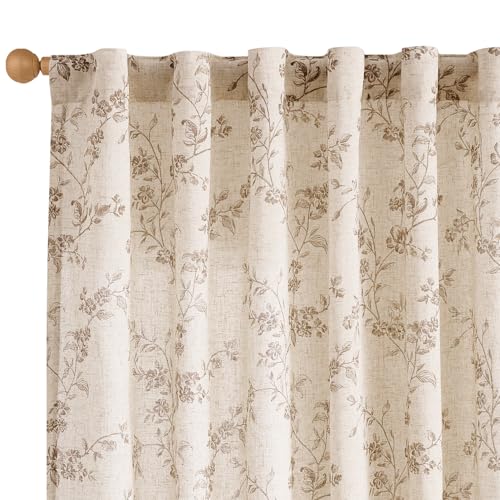
Ready Made: Package includes 2 linen curtain panels, each measuring 50"W & 84"L (100"W for pair). The linen curtains are crafted from open weave linen blend fabric and primitively natural effect make the curtain panels more drapery and aesthetic

BOHO CHIC DESIGN: Featuring elegant embroidery plaid patterns decoring on the cotton linen fabric. Both sided and bottom edges sewed along with beautiful handmade tassels. This bohemian style window treatment panel definitely increase the charm of any room.
2. Autumn Warmth Layers
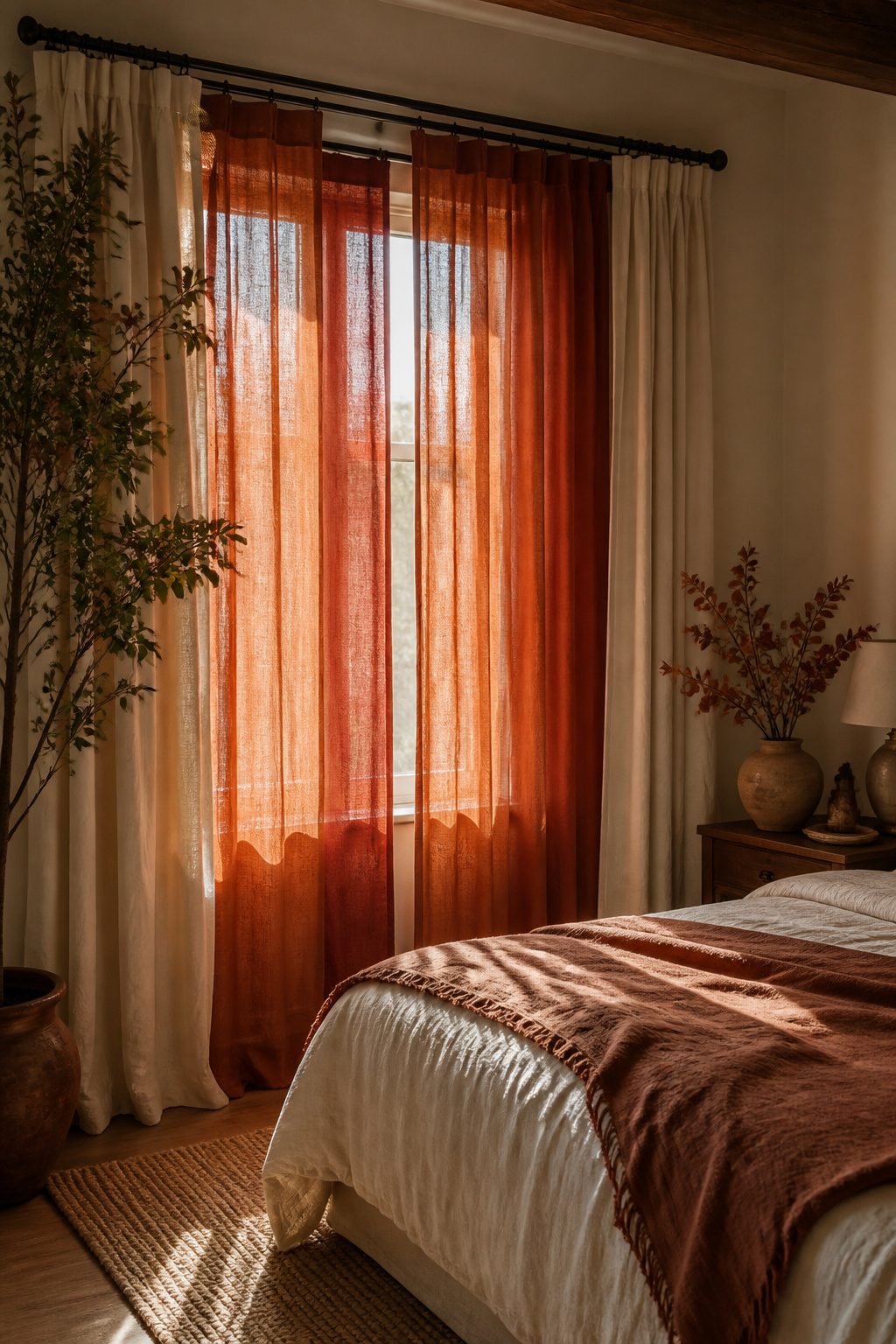
Terracotta, rust, and cream stacked in that order give the warmest fall window without reading like a costume.
The terracotta panel sits closest to the glass as a sheer or lightweight linen, the rust middle layer adds the actual privacy, and the cream outer drape in a heavier cotton catches light and frames the whole stack.
Linen against the window plus cotton toward the room builds weight you can actually live with: the linen breathes on warm September afternoons when the bedroom still holds summer heat, and the cotton layer keeps drafts off in November without turning the window into a quilt.
Three rods or a double bracket with the sheers on a tension wire inside keeps the install renter-friendly and under a Saturday.
The trick is keeping each fabric in a similar weave so the layers don’t fight; a slubby linen next to a polished cotton sateen reads messy instead of intentional.
I have seen the rust layer read too orange under cool LED bulbs, so test your actual bedroom light before you commit to the middle fabric.

Basic Information: Includes 2 curtain panels, each measuring 50 inches wide for a total of 100 inches. Easy care for machine washable in cold water, do not bleach, tumble dry low, iron on low heat if needed.

Packing Detail: The package includes 2 natural ivory linen curtains and each linen textured curtain measures 52 inch wide and 84 inch length(104" wide total). The top style of the curtains is bronze grommets with 1.5 inch inner diameter, fit well with most rods.

Packing Detail: The package includes 2 beige linen curtains and each linen textured curtain measures 52 inch wide and 84 inch length(104" wide total). The top style of the curtains is bronze grommets with 1.5 inch inner diameter, fit well with most rods.
3. Ethereal Canopy Glow
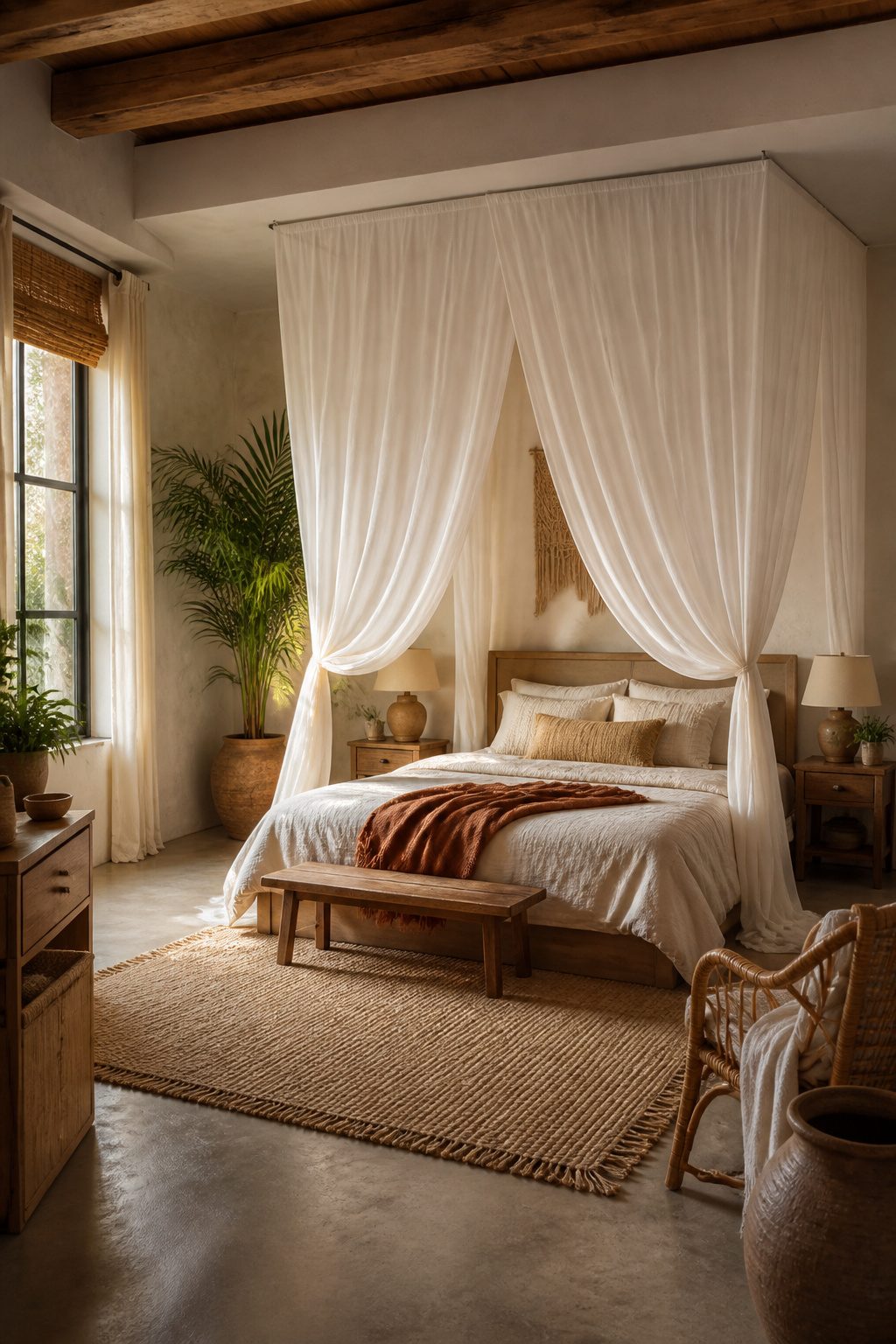
Sheer curtains stretched overhead turn the bed itself into the room’s anchor, not the window.
White or cream linen keeps the look grounded in boho rather than drifting toward bridal because the weave stays slightly slubbed and uneven, never the polished satin bridesmaids carry.
For renters, ceiling-mounted curtain tracks with adhesive backing avoid drilling into plaster or popcorn ceilings, and the hardware hides above the fabric line so you see only the drape.
Tension wire between two eye hooks works too if the span is short and the ceiling is smooth.
The light that filters through during morning hours lands softer than any bedside lamp, and the whole setup collapses into a laundry basket when the lease ends.

Ready-Made: Includes 2 beige lace curtain panels, each 59W x 63L; this 63 inch lace curtains 2 panel set offers 118 inches total width; 3 inch rod pocket fits most standard curtain rods for easy hanging and graceful gathers

Basic Information:The grommet top has an inner diameter of 1.6 inches. Each curtain panel is available in 35-inch and 52-inch width options. Available lengths: 63 inches, 72 inches, 80 inches, 84 inches, 90 inches, 95 inches, 102 inches, 108 inches, and 120 inches. Each set includes 2 detachable tiebacks.

Elegant Design: Lino Rosa curtains feature a minimal boho floral striped print, adding a touch of elegance and sophistication to any space. Complenting a wide range of interior styles such as bohemian, farmhouse, country and modern contemporary.
4. Jungle Window Magic
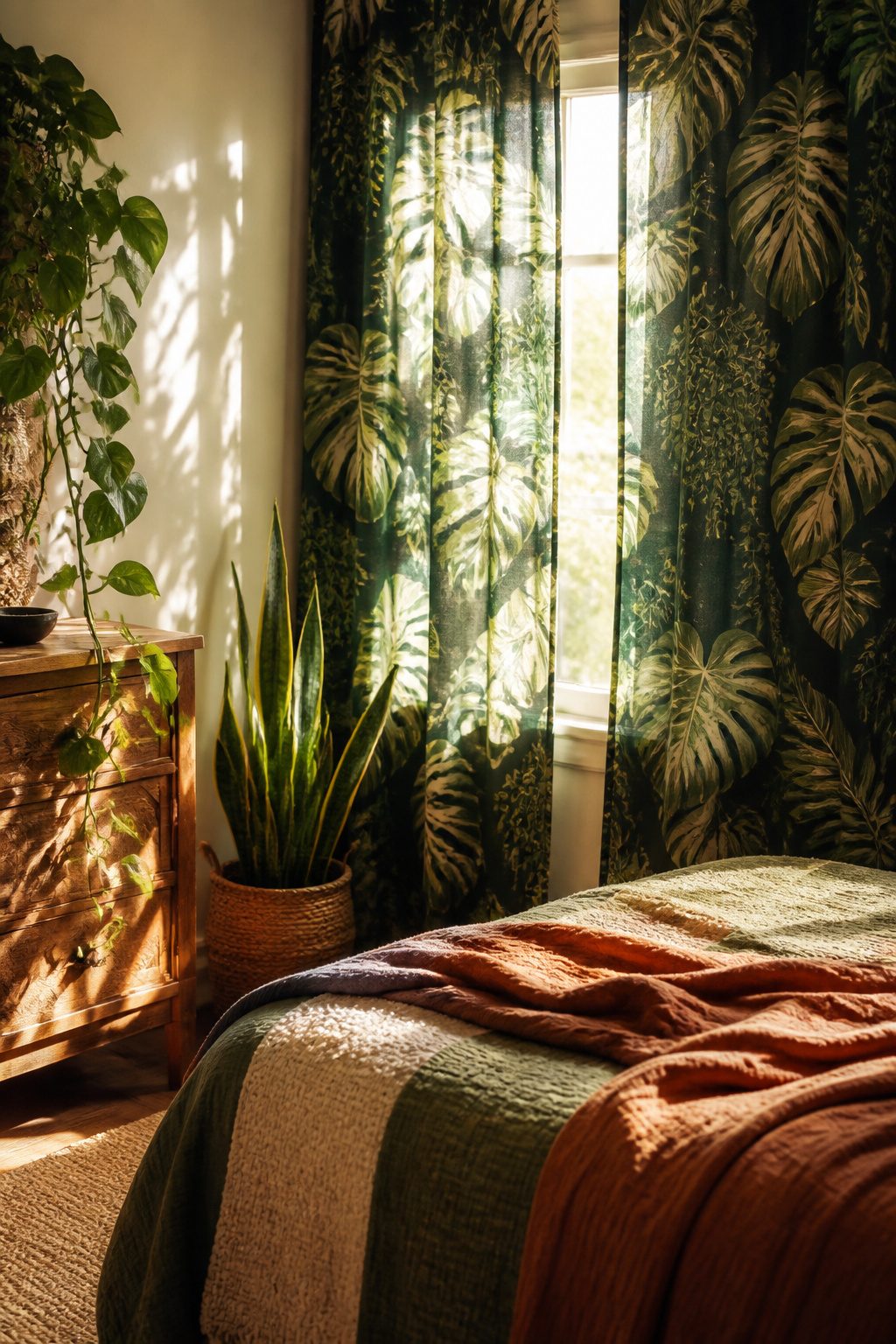
Deep green botanical prints with oversized leaves or trailing vines read louder in the store than they do once hung. The trick is pairing them with real plants: a pothos on the dresser, a snake plant in the corner.
The curtain pattern and the living leaves start competing for attention at about the same scale, so one large plant beats three small ones against a bold print. The small ones scatter the eye; the large one holds its own.
Morning light through these curtains is where the money goes. The leaf silhouettes turn into actual shadows on the wall, doubling the pattern so the fabric itself can stay simpler than the effect suggests.
A small bedroom benefits because the print reads as depth, not clutter; the eye travels into the green instead of stopping at the wall.
I have seen rooms where the curtains were the only pattern in the space and still felt busy, and rooms where the same print worked because the plant by the window was tall enough to meet it.
The difference was the scale of the living thing, not the fabric.

WELL MADE: Package contains 2 panels of 52" width by 84" length (104" wide in total). With pleat tape pocket & tabs on top, back loop (2.3 inch) and rod pocket (3.3 inch) which offer our customers multiple hanging options.

HIGH-QUALITY VELVET MATERIAL: Made from 300 GSM high-density velvet fabric, these curtains offer luxurious softness and durable quality. The plush texture and heavy weight enhance the elegance of your home, while fade-resistant and dirt-repellent properties ensure long-lasting beauty

LUXURIOUS VELVET FABRIC:Crafted from high-density velvet fabric, these curtains are silky-smooth, soft to the touch, and feature a rich, heavy drape for an elegant look,adding depth and luxury to living rooms, bedrooms, nursery and more.
5. Luxe Boho Drama
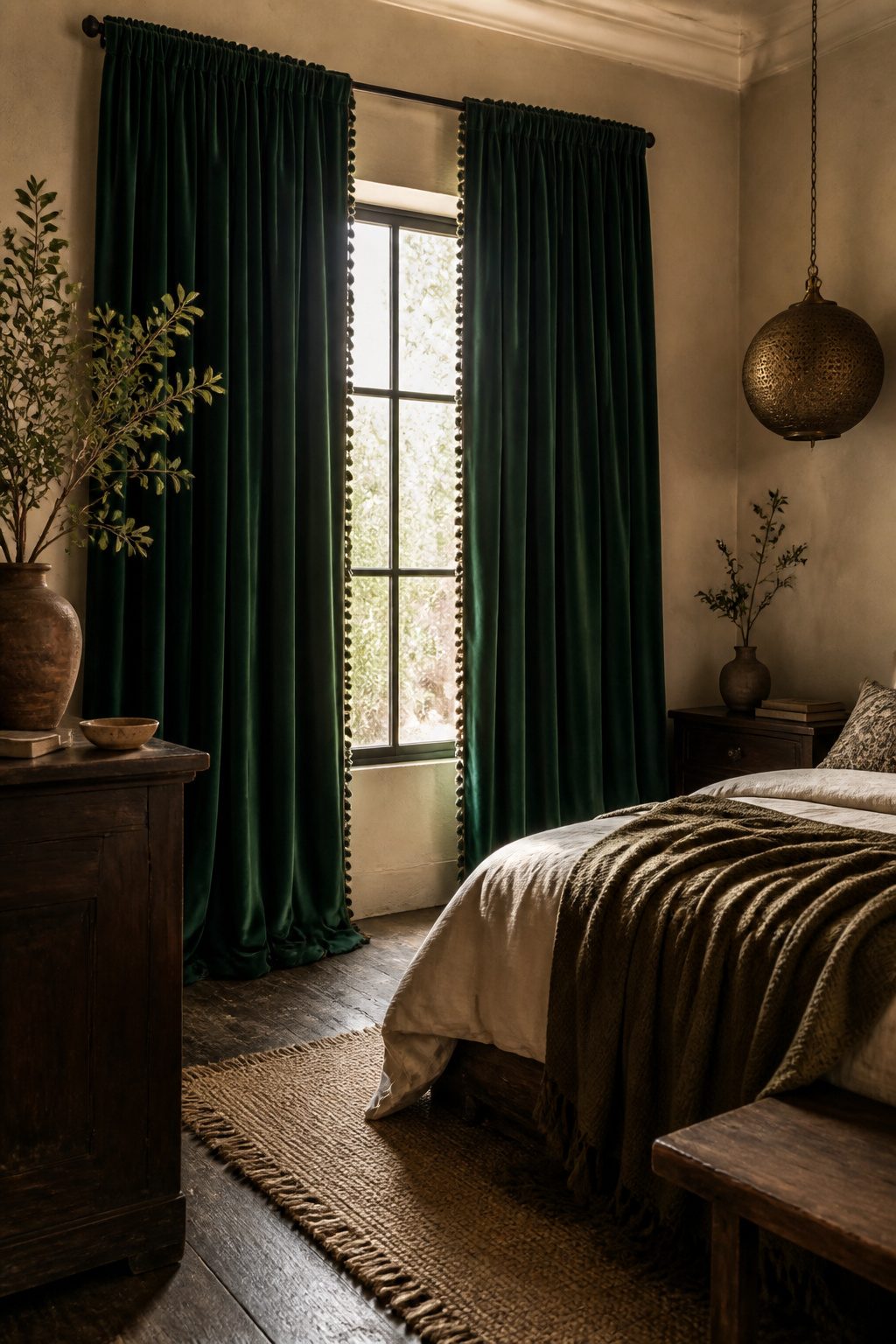
Velvet curtains in a saturated emerald or sapphire read bohemian only when the texture does the talking.
A heavy jacquard with a raised pattern catches light unevenly, which keeps the fabric from looking like it belongs in a hotel conference room.
The line sits at the trim. Bullion fringe along the leading edge, or a tassel tie-back you have to wrap twice, keeps the mood closer to a Marrakech riad than a Park Avenue library.
Without that rough detail, jewel-toned velvet goes formal fast; with it, you can hang floor-to-ceiling panels on a basic rod and still get the luxe-boho effect.
I would skip the matching valance entirely. One layered texture is enough, and two starts looking like you are trying to stage a period drama.
For renters, these fabrics work best as a single statement panel on either side of the window rather than a full draw, since the weight needs a stud or a heavy-duty toggle and most landlords do not love the holes.

Strong Magnets: Our wood bead curtain tiebacks magnetic are newest design and have a super strong magnet. Magnetic curtain tiebacks use upgraded version of nickel-plated magnets, which are smooth, and rust-resistant, screw fixing, does not fall off. This boho magnetic curtain tie backs hold the curtains back great

NO DRILL SETUP: Wrap, loop and slide the wooden bead to hold curtains in place without hooks, screws or drilling - an easy tool-free solution for renters, dorms and nurseries

Boho Elegance: Boho kitchen curtains featuring a delicate floral pattern on a linen blend fabric and comes with vintage tassel details. These tassel tier curtains effortlessly blend comfort and style infuse your home with effortless charm and laid-back elegance
6. Tropical Color Pop
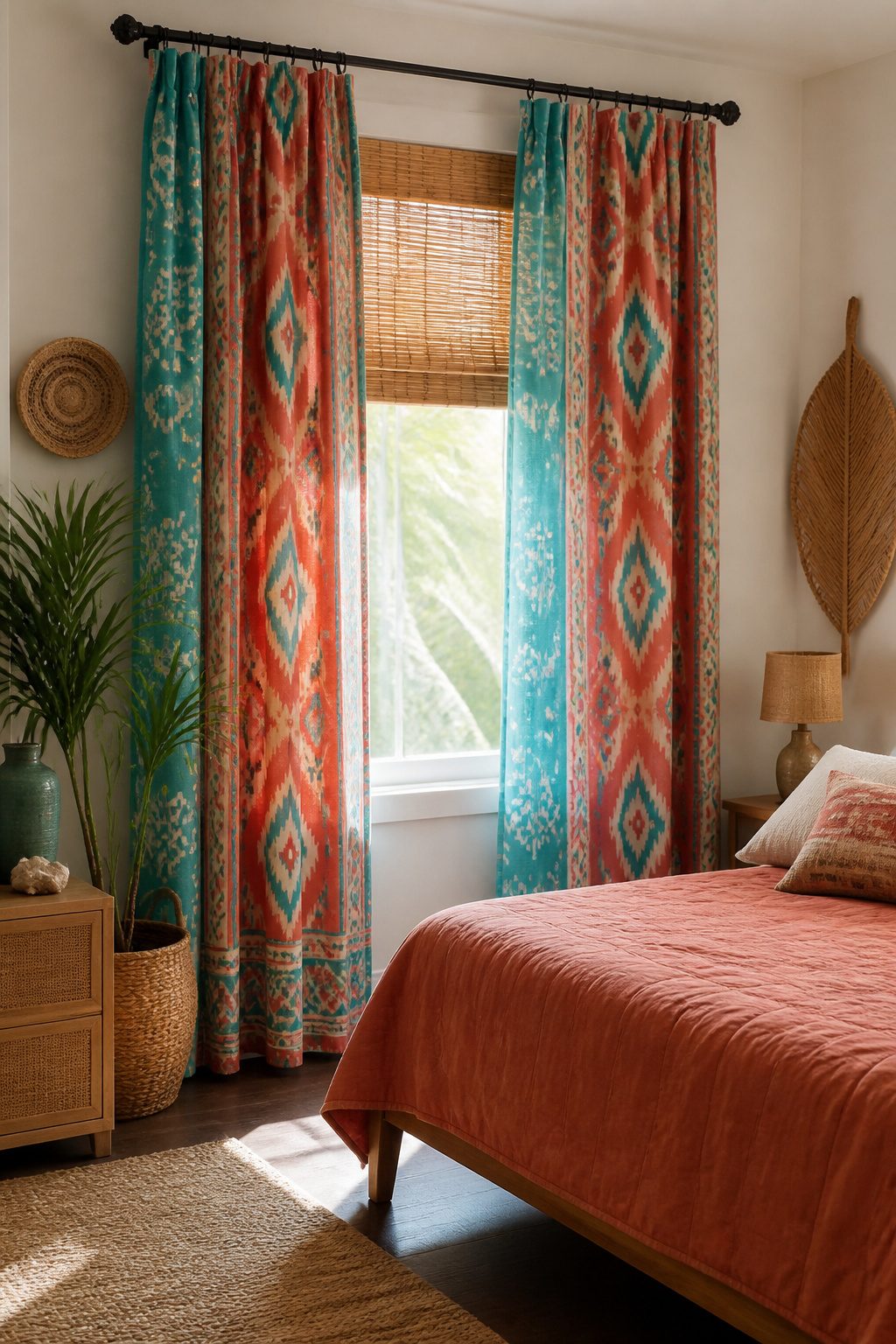
Ikat and batik patterns carry that well-traveled feel boho style reaches for, but the saturated coral, turquoise, or yellow that makes them sing can also keep a bedroom awake past bedtime.
The trick is grounding the loud with quiet walls: warm white or a barely-there sand tone behind the curtains lets the pattern read as intentional, not accidental.
The bedding needs to stay even quieter. Solid linen in oatmeal or a washed-out terracotta works; anything with its own competing pattern turns the bed into a second fight for attention.
I learned this the hard way with a pair of Indian block-printed panels in saffron and indigo, $46.75 on sale.
They looked stunning against my bare wall and completely wrong once I layered in a patterned duvet I already owned. The room felt like a market stall, not a place to sleep.
Bamboo shades underneath help, too. The natural fiber acts as a visual pause between the pattern and the window frame, and they filter morning light so the colors glow rather than shout.
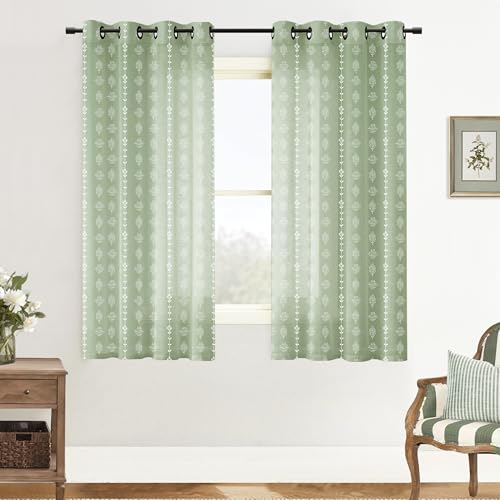
Elegant Design: Lino Rosa curtains feature a minimal boho floral striped print,adding a touch of elegance and sophistication to any space.Complenting a wide range of interior styles such as bohemian,farmhouse,country and modern contemporary.

1 Panel plaid curtain, which is a perfect window treatment for living room, bedroom, girls room, room divider, kitchen window, bathroom, kids room, basement and any other space

Elegant Design: Lino Rosa curtains feature a minimal boho floral striped print,adding a touch of elegance and sophistication to any space.Complenting a wide range of interior styles such as bohemian,farmhouse,country and modern contemporary.
7. Soft Pink Whimsy
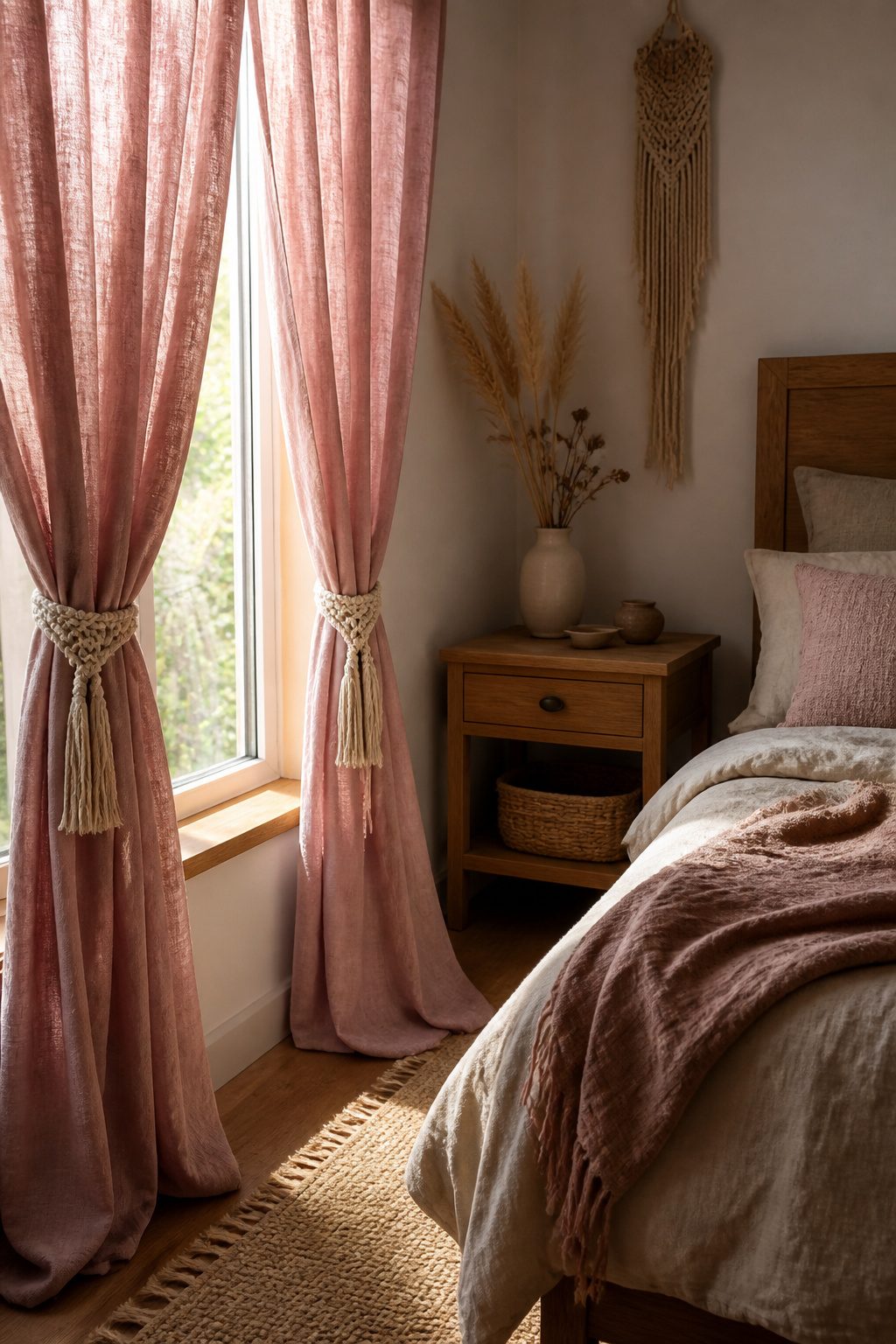
Dusty rose curtains sit in a tricky spot between sophisticated and saccharine, and the line usually comes down to texture.
A flat, polyester panel in blush reads dorm room fast. The same tone in a slubbed linen or a cotton weave with raw, uneven edges feels grounded, lived-in, like something that faded naturally in a sunny window over years.
Lace insets help if they are irregular, hand-placed, not symmetrical machine patterns. Macrame tie-backs work the same way: the knots should look like someone actually tied them, not like a uniform factory coil.
What keeps this palette from tipping too pretty is pairing it with the right wood.
Natural oak or walnut with visible grain and some wear cuts through the sweetness in a way painted furniture never does. The pink warms up the wood; the wood roughs up the pink.
A matte, unfinished nightstand against these curtains makes the whole room feel intentional, not decorated. The combo works especially well in smaller bedrooms where you want softness without clutter, since the limited palette lets you layer textures instead of colors.

Package Includes: Include 2 natural ivory linen curtains, each light filtering burlap neutral curtain measures 52" W x 90" L (104" wide total). With 7 back tabs and 3” rod pocket fits most standard rods and makes the maximum coverage of windows.
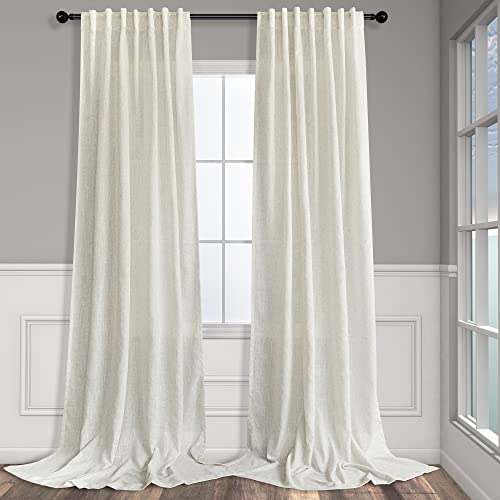
Basic Information: 2 LINEN PANELS in 1 package. Each panel measures width 52 x 84 length. 3-Way Hanging Options: Hang these curtain panels (1) using the back loops to create an elegant pleated effect, (2) from the 3 inch rod pocket for a classic look, or (3) using clip rings for easy, slide open and closed (clip rings are not included)

Natural Linen Blended: Made of 30% linen and 70% polyester, this linen curtain creates a substantially textured fabric with more fluid drape and soft to the touch. The cross-woven design brings subtle brown pattern and rich linen texture compared with plain polyester.
8. Eclectic Sunset Hues
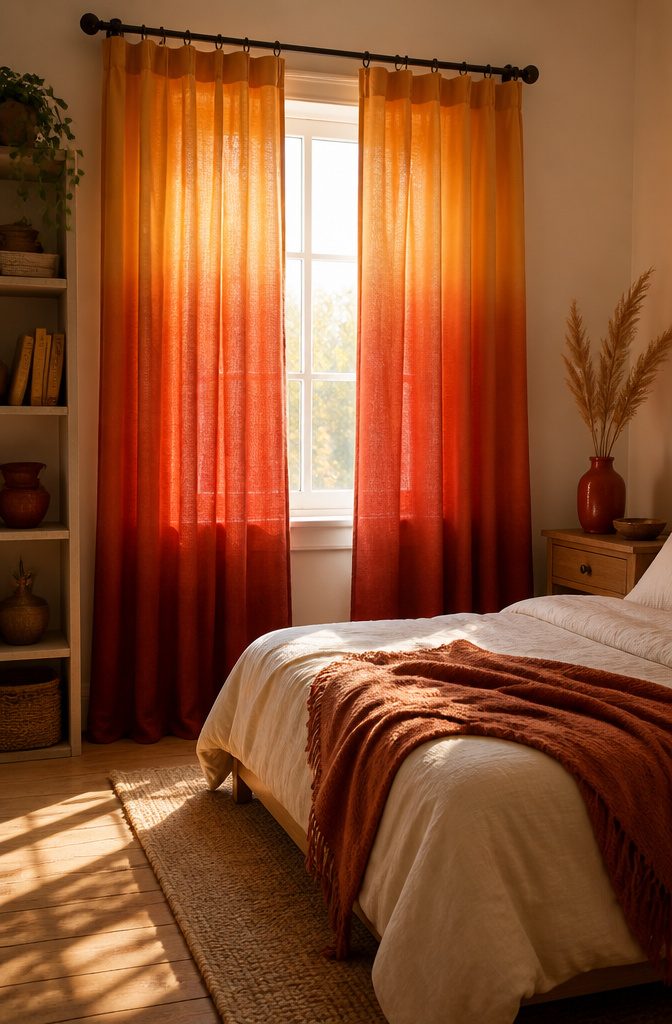
Ombre curtains that move from mustard through terracotta to deep rust do the wall art’s job for you.
The gradient should run top to bottom, light to dark, following how sunlight actually falls through a window. Dark rust at the base grounds the room; bright mustard at the header catches what light comes in.
I learned the hard way that matching these tones exactly across pillows and rugs turns the room into a paint swatch display. Better to pull one anchor color and let the others wander.
A terracotta throw on the bed, a single rust ceramic on the nightstand, maybe a mustard book spine showing on the shelf. The eye connects them without your having to.
The color-blocked version, with clean bands rather than a fade, reads slightly more modern and costs less.
Both styles work best on fabric with some weight; cheap polyester lets the light blow out the middle tones and you lose the shift entirely.
If your bedroom faces east and gets harsh morning sun, that washed-out middle is exactly what happens by 8 a.m.

UNIQUE DESIGN: Special weaving methods are used. Blended with thicker and brighter threads, these curtains display a perfect sheer-meets-burlap linen look with an unexpected shine, creating a collision between rustic and delicate, and yet still maintaining lightweight and sheer.

Boho Elegance & Farmhouse Charm: Boho curtains featuring a delicate floral pattern on a linen blend fabric and comes with vintage tassel details. These vintage curtains for living room effortlessly blend comfort and style infuse your home with effortless charm and laid-back elegance

Pleasent Experience: Made of 100% polyester fiber, high-quality fabrics give you a silky touch. Double-layer design, the front sheer and the back curtain achieve a perfect elegant look
9. Candlelit Serenity
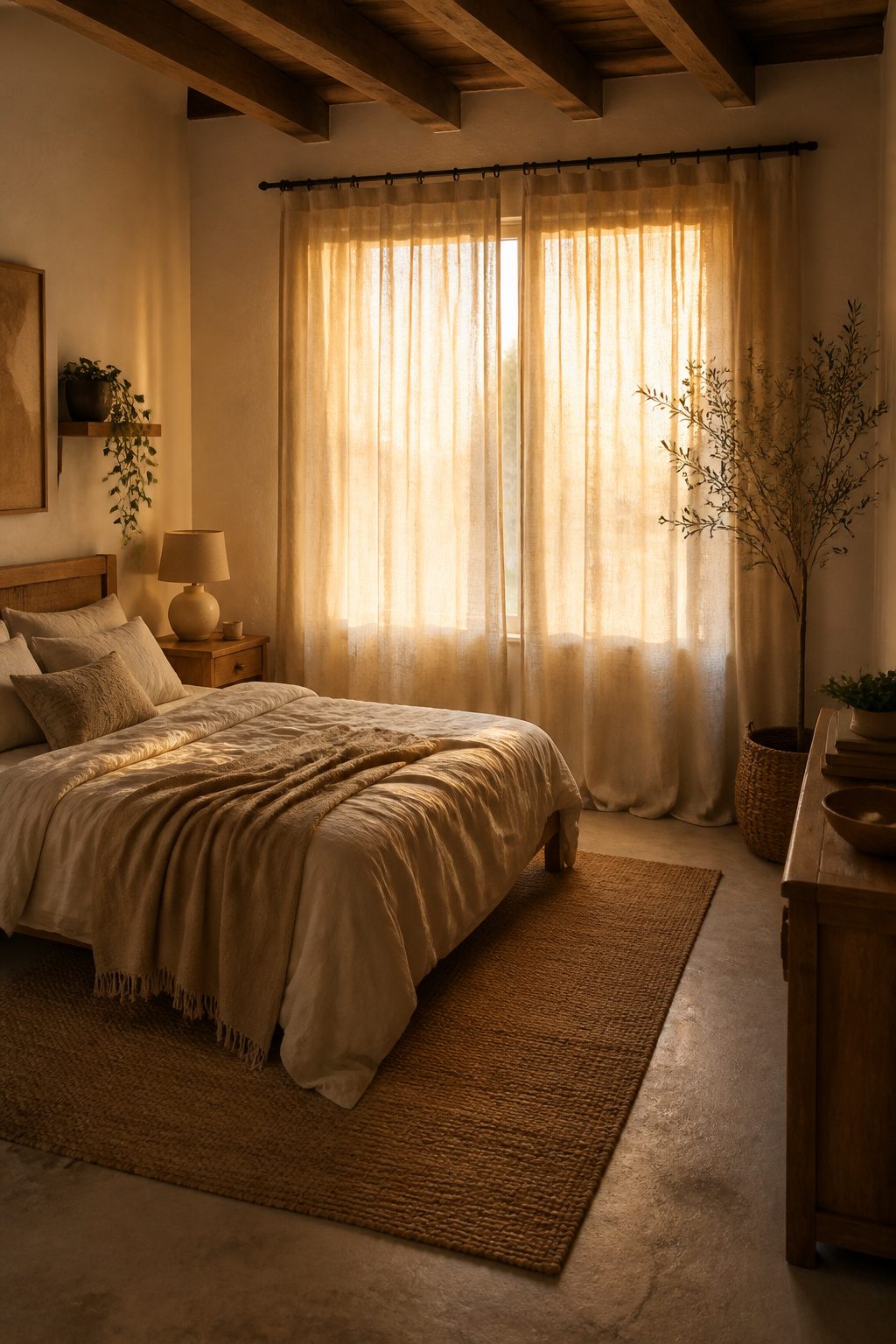
Heavy linen in warm cream or wheat does the work for you. The weave is dense enough to drop the afternoon sun to a low glow, then shift that same fabric toward amber as evening comes on.
Light transmission through a mid-weight linen runs something like thirty to forty percent, which means the room never goes bright or dark, just gradually warmer.
Color temperature changes across the day are what make this feel intentional rather than lazy. Morning reads as soft white, three o’clock turns buttery, and by six the walls pick up whatever the curtains have filtered into them.
No layering required, no second panel to manage. The fabric ages into itself, getting more relaxed at the fold lines rather than looking worn.
For renters especially, this is one swap that reads as a full decision.
Wheat or cream against white walls carries the boho warmth through texture instead of pattern, so the space still grounds itself even if your furniture is hand-me-down and your art is thumb-tacked.
Hang them high, let them pool four to six inches, and the room does the rest.

SUPERIOR VELVET MATERIAL: Crafted from thick 300 GSM high-density velvet, all StangH velvet curtains feature a plush, silky ultra-soft touch. The heavy, sturdy weave delivers sleek, elegant natural draping, while faint silver light reflection is a normal trait of premium velvet. OEKO-TEX STANDARD 100 & GRS certified, they are chemical-free, family-safe for kids and pets, and made of 50%+ recycled polyester for eco-friendly use.
HIGH-QUALITY VELVET MATERIAL: Made from 300 GSM high-density velvet fabric, these curtains offer luxurious softness and durable quality. The plush texture and heavy weight enhance the elegance of your home, while fade-resistant and dirt-repellent properties ensure long-lasting beauty

HIGH-QUALITY VELVET MATERIAL: Made from 300 GSM high-density velvet fabric, these curtains offer luxurious softness and durable quality. The plush texture and heavy weight enhance the elegance of your home, while fade-resistant and dirt-repellent properties ensure long-lasting beauty
10. Amber Glow Evenings
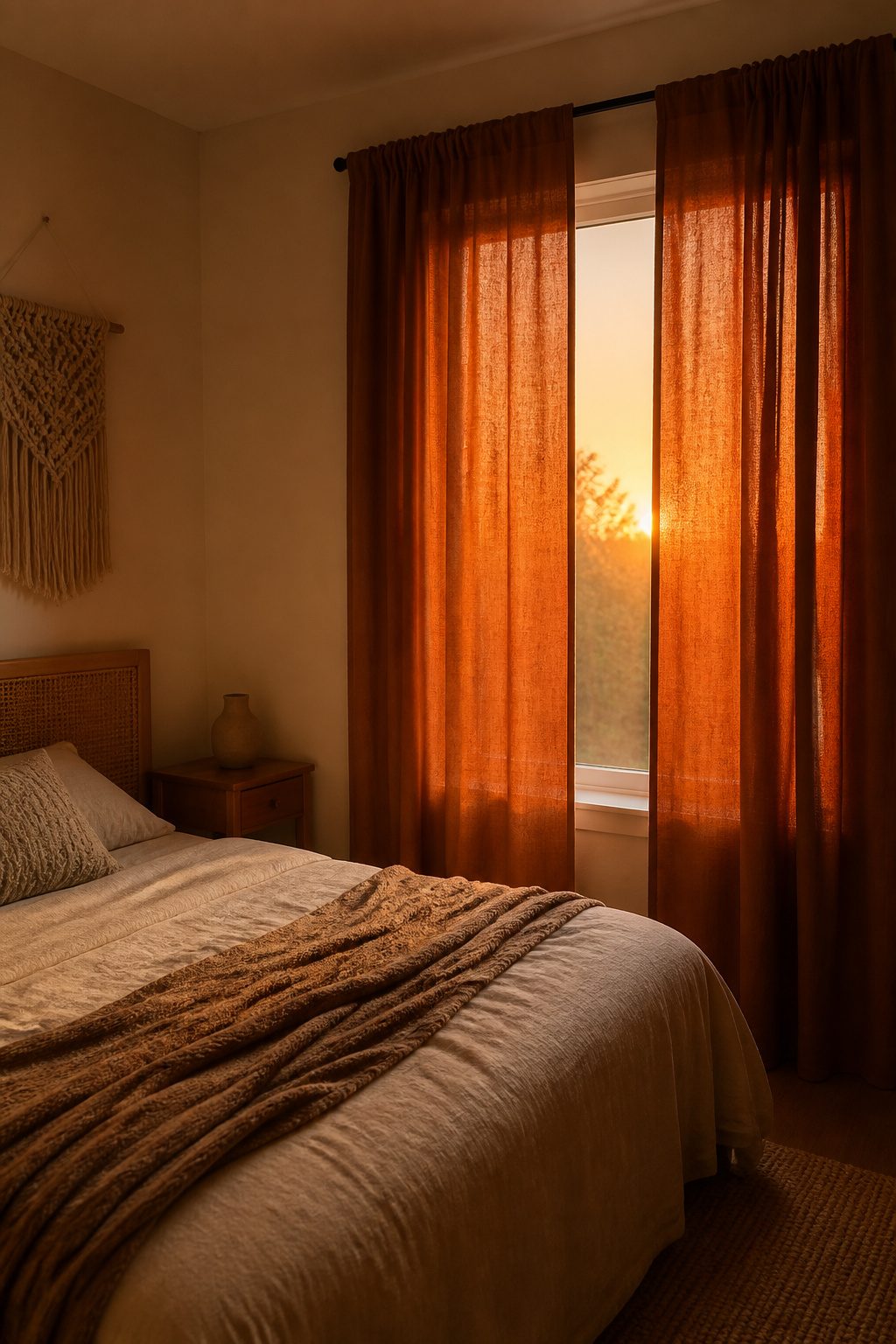
Orange fabric and amber light are two different effects, and the gap between them matters more than the curtain price tag. Thick rust-colored panels block afternoon sun and leave the room feeling heavy, like a diner booth at 3 p.m.
Sheer curtains in a warm marigold or honey tone do the opposite: they catch low western light and spread it across the walls as something closer to candle flame than construction cone.
Wall color decides which version you get. Cream, warm white, or bare plaster turns that filtered light into something golden and slow.
Gray with cool undertones, crisp white, or anything with a blue base turns the same curtain into a warning sign, the color of a parking cone glowing against snow.
In a rental with beige walls, the effect lands somewhere in between, neither magical nor broken, just a room that feels warmer after 4 p.m. than it did at noon.
The shift happens fast. One hour the light is ordinary, the next the whole wall is holding something like late summer, and the curtain is doing almost all of that work.
Sheer amber panels against warm neutrals are the only combination where the glow reads intentional, not like a forgotten filter left on too long.

Natural and Simple Look: Handmade curtain tiebacks, tassel decoration, suitable for all kinds of curtains, add more stylish. Simple design make such a difference in the overall look of the curtain. Whether your home style is American country, rustic, rural, bohemian, farmhouse or Mediterranean, Nordic simplicity style, this is the best match.

Boho Elegance: Boho kitchen curtains featuring a delicate floral pattern on a linen blend fabric and comes with vintage tassel details. These tassel tier curtains effortlessly blend comfort and style infuse your home with effortless charm and laid-back elegance

Boho Elegance: Boho kitchen curtains featuring a delicate floral pattern on a linen blend fabric and comes with vintage tassel details. These tassel tier curtains effortlessly blend comfort and style infuse your home with effortless charm and laid-back elegance
11. Evening Plant Haven
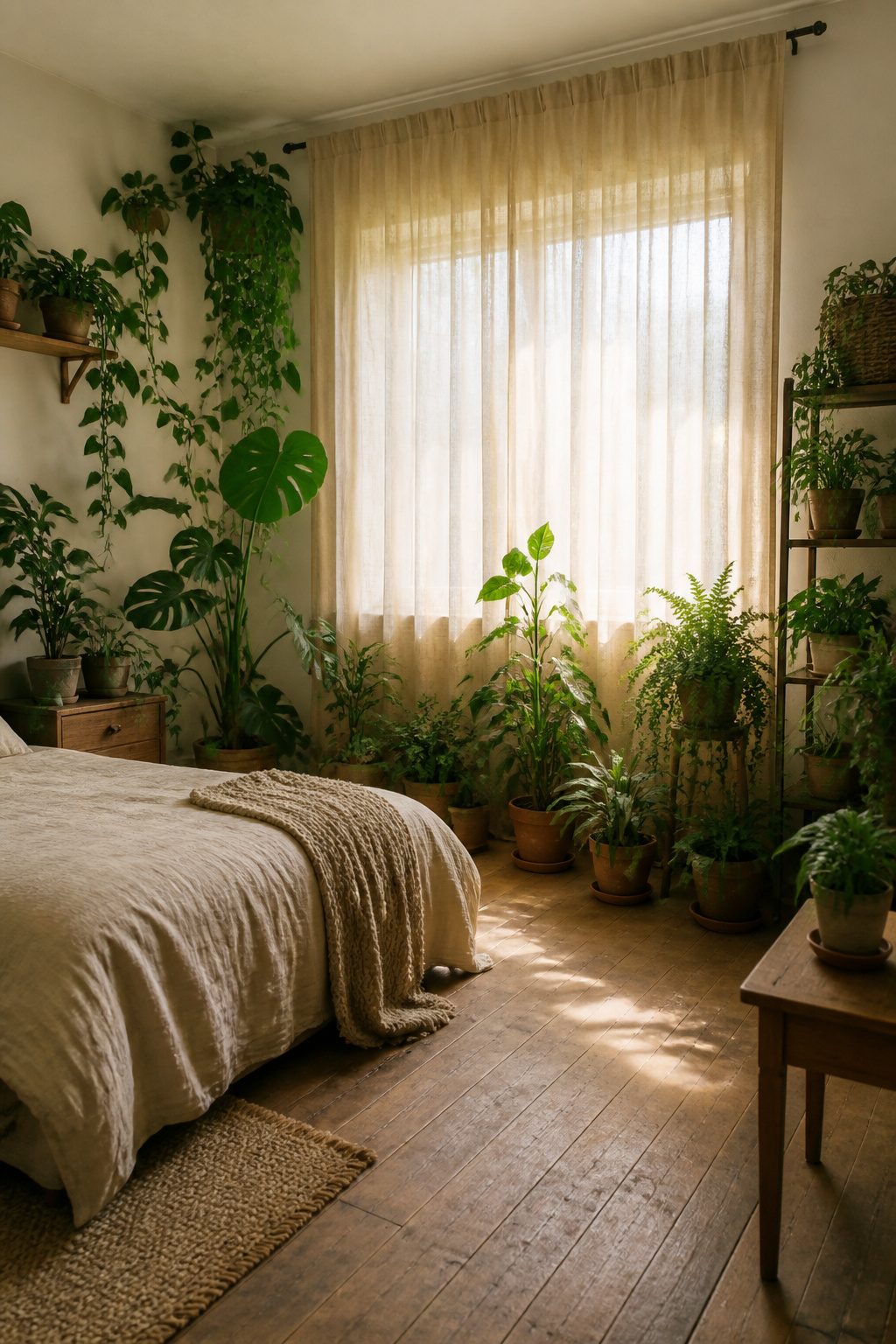
A window crowded with pothos, ferns, and trailing philodendron needs curtains that step back rather than compete.
Sheer linen in an unbleached oat tone filters the bright midday sun that would otherwise scorch delicate leaves while still letting enough light through for growth.
The fabric stays neutral, no botanical print or busy pattern that would turn the whole wall into competing wallpaper.
Moisture is the real enemy here.
Watering day means overspray and humidity pooling at the sill, so washable fabric is non-negotiable. I would skip floor-length panels that puddle on a surface where soil gets knocked out of pots.
A simple rod-pocket curtain ending at the sill keeps the fabric clear of the mess, and a quick wash every few months handles the mineral buildup from evaporation.
If the plant collection is dense enough, the curtain almost becomes a backdrop rather than a feature.
That is the point. The eye goes to the living green, not the textile behind it.
12. Soft Minimal Glow
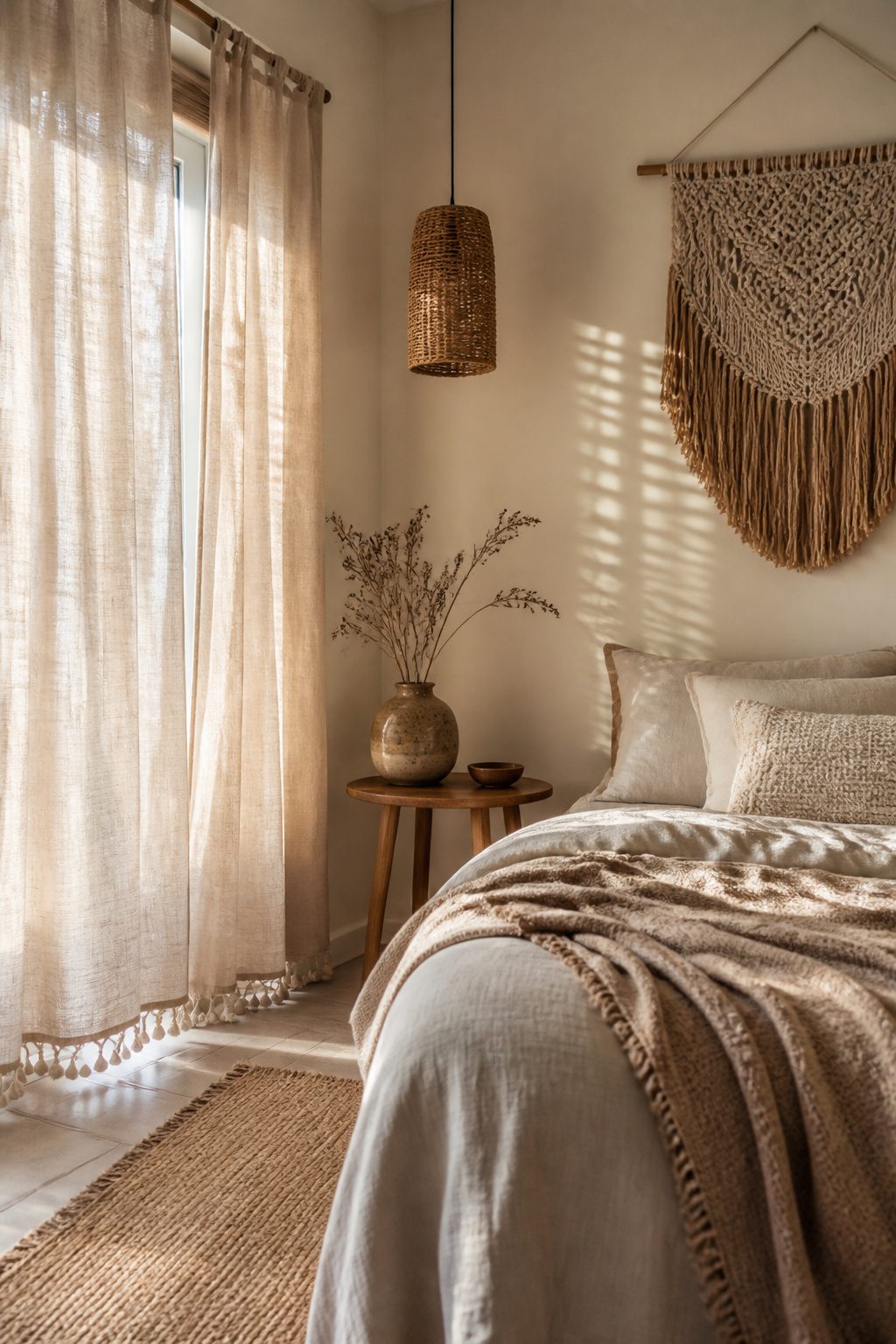
Linen panels with barely-there slubbing do the heavy lifting here. The weave catches morning light at an angle and throws faint stripes across the wall, which reads as pattern without committing to one.
That material honesty is what keeps the look boho rather than simply bare; the fabric is doing something, not just hanging there.
Minimal in this style means editing the distraction, not the warmth. A near-solid curtain lets you layer in a macrame hanging or a tassel trim without the room feeling like it is shouting in two directions at once.
The texture replaces print by giving the eye something to travel across slowly: a slub, a slight irregularity in the dye, the way the panel pools on the floor.
I would skip the tassels if the linen itself is already busy with slubbing.
Two textures competing for attention is where I have seen this go flat. One deliberate texture choice, kept large and simple, usually wins against a cluttered mix.
13. String Light Serenity
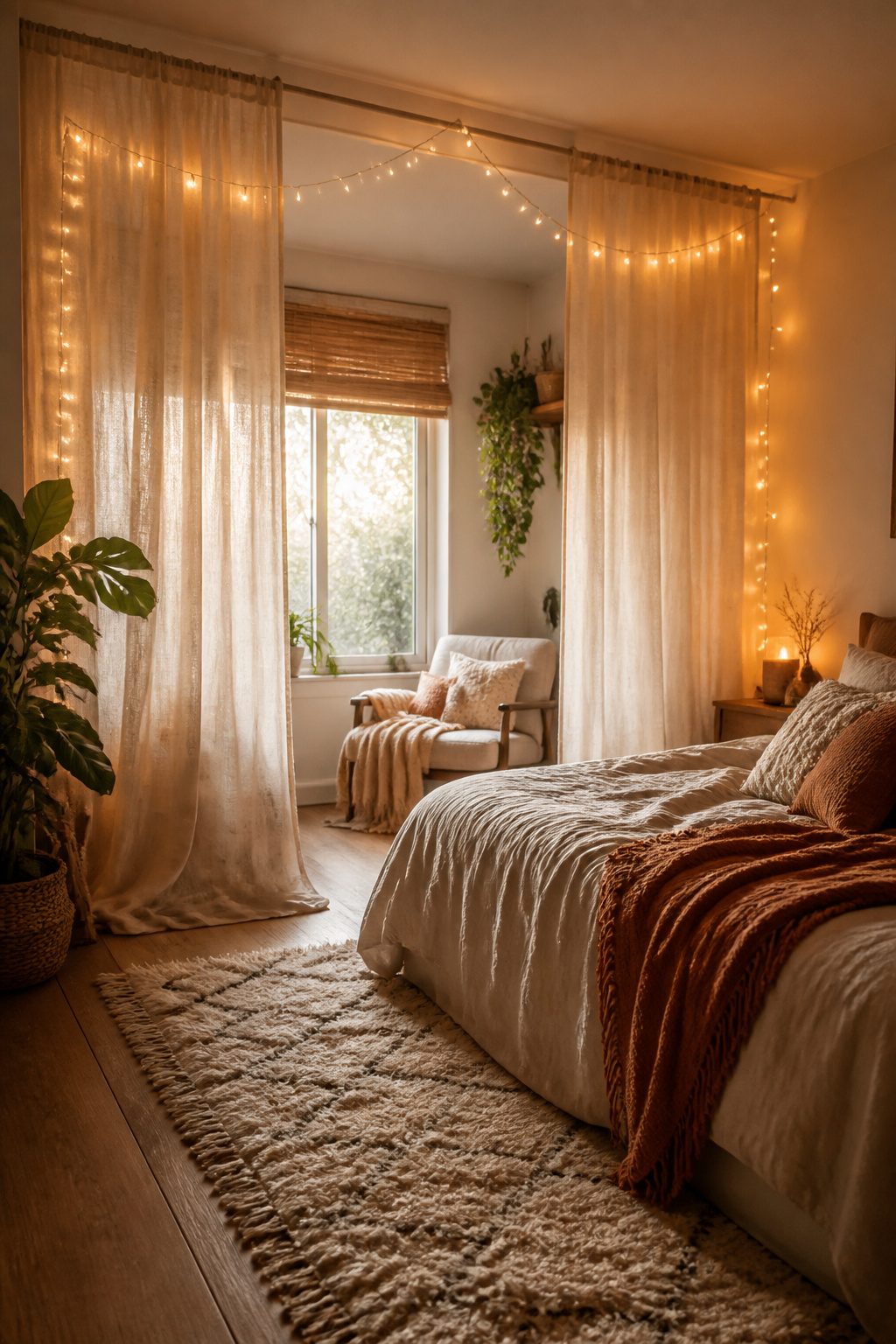
Sheer linen or a loose-weave cotton lets string lights read as glow rather than hardware.
The trick is distance: the fabric needs to hang far enough from the bulbs that heat dissipates, which in practice means a minimum four-inch gap between the lights and the drape, or mounting the strand on a separate rod behind the curtain layer.
LEDs run cooler than incandescent, but any fabric closer than that starts to smell like a risk to me.
Weight matters more than fiber content. A sheer with some body, something that pools slightly on the floor instead of clinging, keeps the lights from looking like a dorm-room afterthought.
The curtain moves, and the light pattern moves with it: on still nights you get a steady soft lantern effect, but walking past shifts the fabric enough that the bulbs flicker through the weave like water.
That movement is what sells the idea as intentional rather than leftover holiday decor.
For renters, a tension rod behind the main curtain rod costs maybe ten dollars and leaves no mark.
The lights drop straight down, the sheer hangs in front, and the whole setup comes down in two minutes when the lease ends.
14. Vintage Sunlight Corner
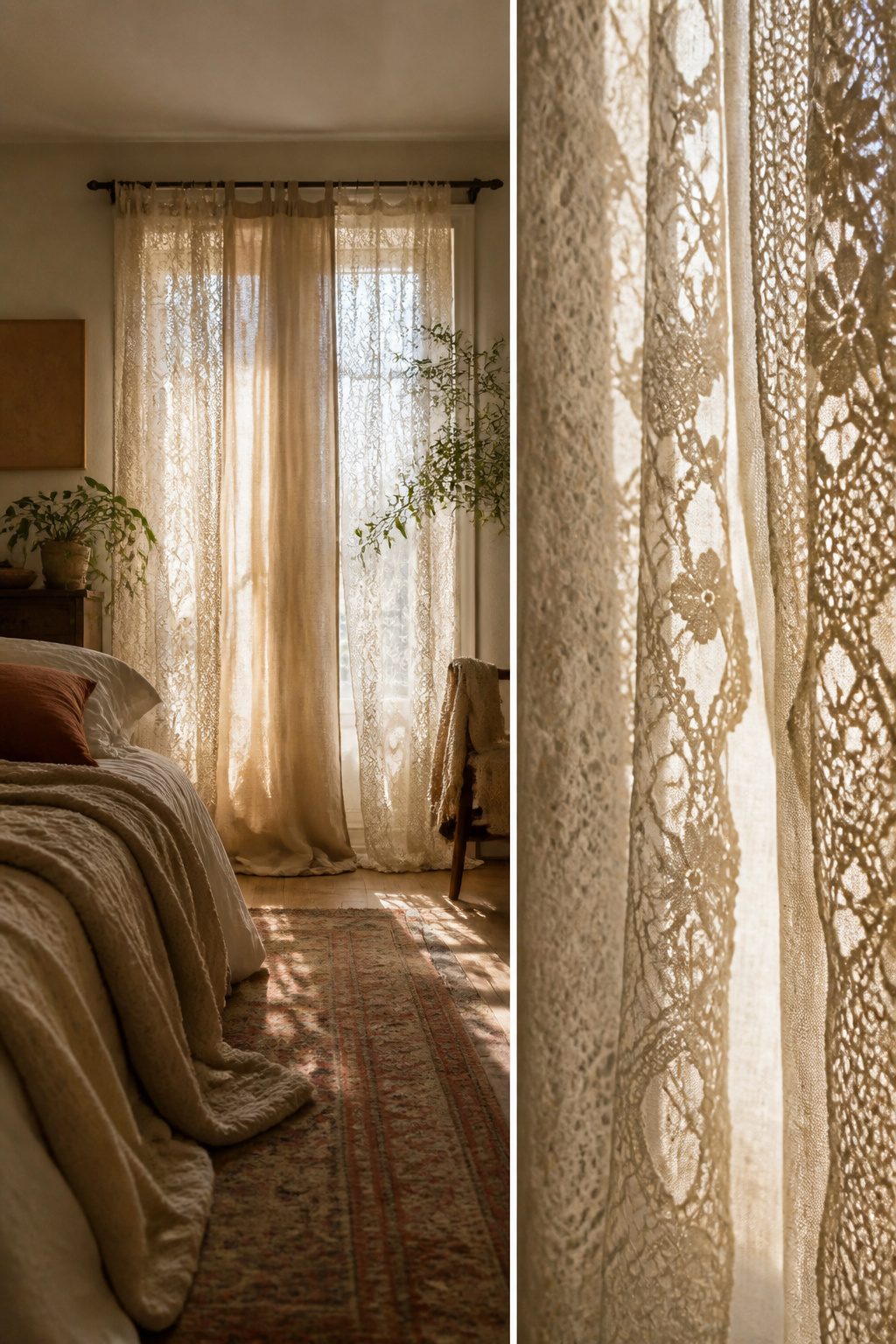
Lace or crochet panels layered over solid curtains give that collected-over-time look boho rooms need, but the sourcing decision matters more than most people expect.
Actual vintage openwork textiles carry the soft irregularity of handwork, yet holes, sun rot, and fragile seams are common; reproduction panels from retailers like Saffron Marigold run $46.75–$76.50 and skip the durability gamble entirely.
If you do find vintage pieces at estate sales or thrift stores, hold them to the light before buying. Thin spots that look merely "romantic" in the store become actual tears the first time you slide them open.
Mismatched sizes are almost guaranteed with found panels, which is where the layering becomes practical, not just decorative. Mount the shorter lace panel on a separate rod placed 3–4 inches in front of the solid curtain, not behind it.
The gap lets both layers read as intentional, and the solid curtain does the actual light-blocking work while the openwork filters morning sun into something softer than bare window glare.
For panels too narrow to cover the window alone, pair two mismatched lace pieces on the same front rod and let the solid curtain behind them span the full width. The overlap reads as collected, not mistaken.
The light quality is the real payoff. Macrame or crochet casts patterned shadows that shift through the day, turning a plain wall into something that changes from breakfast to evening without any electricity involved.
Balance matters here: let the openwork be the texture event and keep the base fabric simple. A slubby linen or self-patterned cotton in a quiet weave like herringbone or basketweave gives the eye a place to rest.
Too much pattern in both layers and the room tips from layered to cluttered, especially in a bedroom where you want the last thing you see at night to feel calm, not busy.
15. Bold Patterned Statement
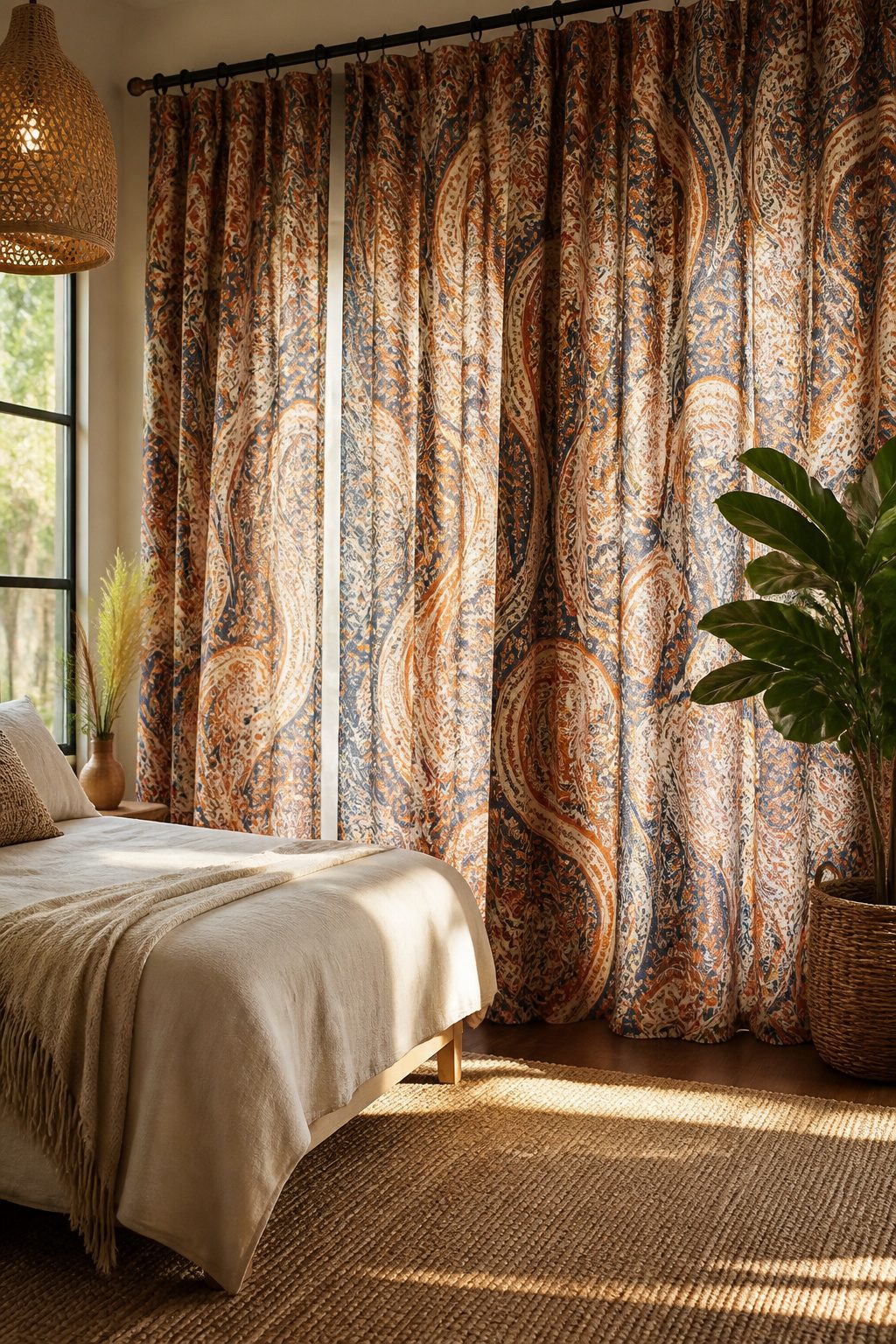
A single wall of paisley or mandala print at scale does the work of three competing patterns.
The print wants breathing room: panels wide enough that the motif repeats no more than twice across the full span, hung high and pooling slightly so the eye reads the curtain as architecture, not fabric tacked to glass.
Anything busier than a twelve-inch repeat on a standard bedroom window starts looking like upholstery.
The rest of the room has to go quiet. Plain linen bedding, unpatterned rugs, wood tones rather than painted furniture.
What convinced me, reading through dozens of these setups, is how often someone pairs the bold curtain with a patterned bedspread and a textured wall hanging and loses the single gesture entirely. One strong voice, everything else in the chorus.
Scale relative to wall height matters more than window width. A floor-to-ceiling drape with a large-scale print reads intentional; the same fabric cut to sill length looks like a mistake in proportion.
Renters working with standard eight-foot ceilings should look for repeats in the 14–20 inch range, hung from a rod placed four to six inches below crown molding. The print fills the vertical space without crowding it.
16. Nighttime Glow Elegance
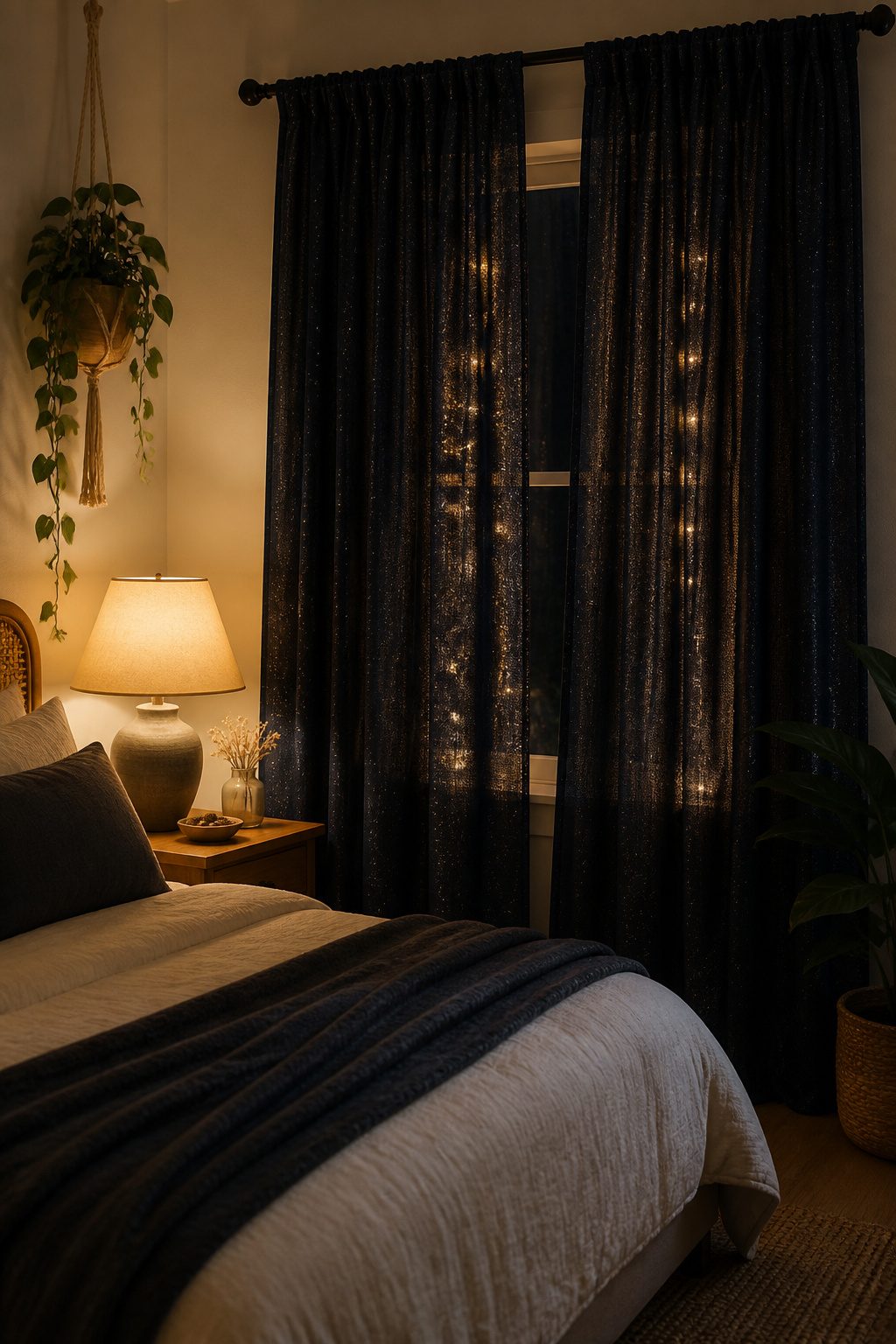
Dark-base curtains with metallic or reflective thread details catch lamplight in a way that changes the whole room after sunset.
During the day, the metallic reads as subtle texture, almost a faint shimmer you might miss if you weren’t looking for it.
At night, with a bedside lamp or string lights behind them, those same threads throw back warm pinpricks that feel like candlelight without the fire hazard.
Charcoal, deep plum, and midnight navy work better than true black for the base color.
Black can tip into stage-curtain territory once the lights dim, especially if the metallic is gold or brass. Plum or navy keeps the warmth that boho rooms need while still giving the threads something to pop against.
The line between atmospheric and theatrical sits at about one-third metallic to two-thirds matte weave. More than that, and the curtains start performing instead of settling in.
I look for fabrics where the reflective thread runs only in scattered horizontal lines or in the irregular "slub" of the weave, not in dense vertical stripes that read as formal or costume-like.
Hanging them a few inches wider than the window frame helps too.
The metallic catches light at the edges where the fabric curves, not in flat sheets across the whole panel, and that unevenness is what keeps the effect lived-in rather than staged.
What Boho Curtains Are Made Of
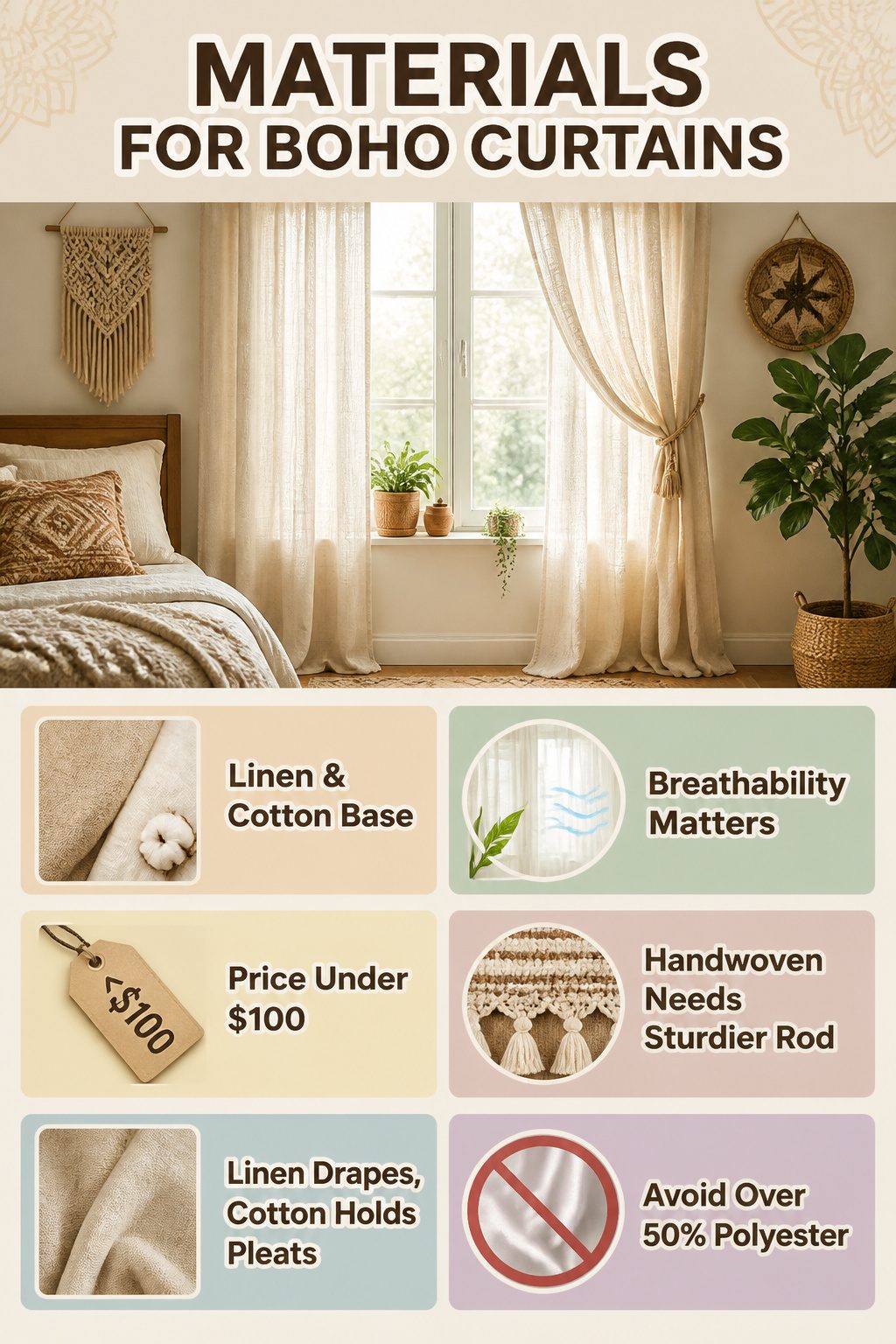
Linen and cotton form the base of any boho bedroom curtain worth hanging. The sources keep coming back to these two, and after reading enough of them, the reason is plain: they breathe.
A bedroom traps humidity from breathing and sweating through the night, and a synthetic that seals that moisture against the glass breeds mildew behind the rod where you will not notice until the wall stains.
Linen wins for drape, especially the pre-washed kind that arrives soft enough to hang straight out of the package.
It falls in those loose, uneven folds that read as relaxed rather than sloppy. Cotton holds crisper pleats if you want a more structured look, and it takes dye in ways that let those vivid boho patterns sing.
Both age better than polyester; where synthetic sheers go yellow and stiff after a few summers, linen just softens and slubs a little more.
The blends are where you compromise. A little synthetic adds wrinkle resistance and keeps the price under a hundred dollars for a standard window, which matters when you are dressing three windows on a Saturday budget.
Anything over fifty percent polyester, though, and you lose the airflow that makes a bedroom feel like a sanctuary instead of a hotel room.
The handwoven market-finds, the ones with the tassels and the irregular weave, those are almost always cotton or linen base with wool or jute accents.
They are heavier, which means they block more morning light, but they also need a sturdier rod than the tension pole you were hoping would hold.
Patterns That Read Boho
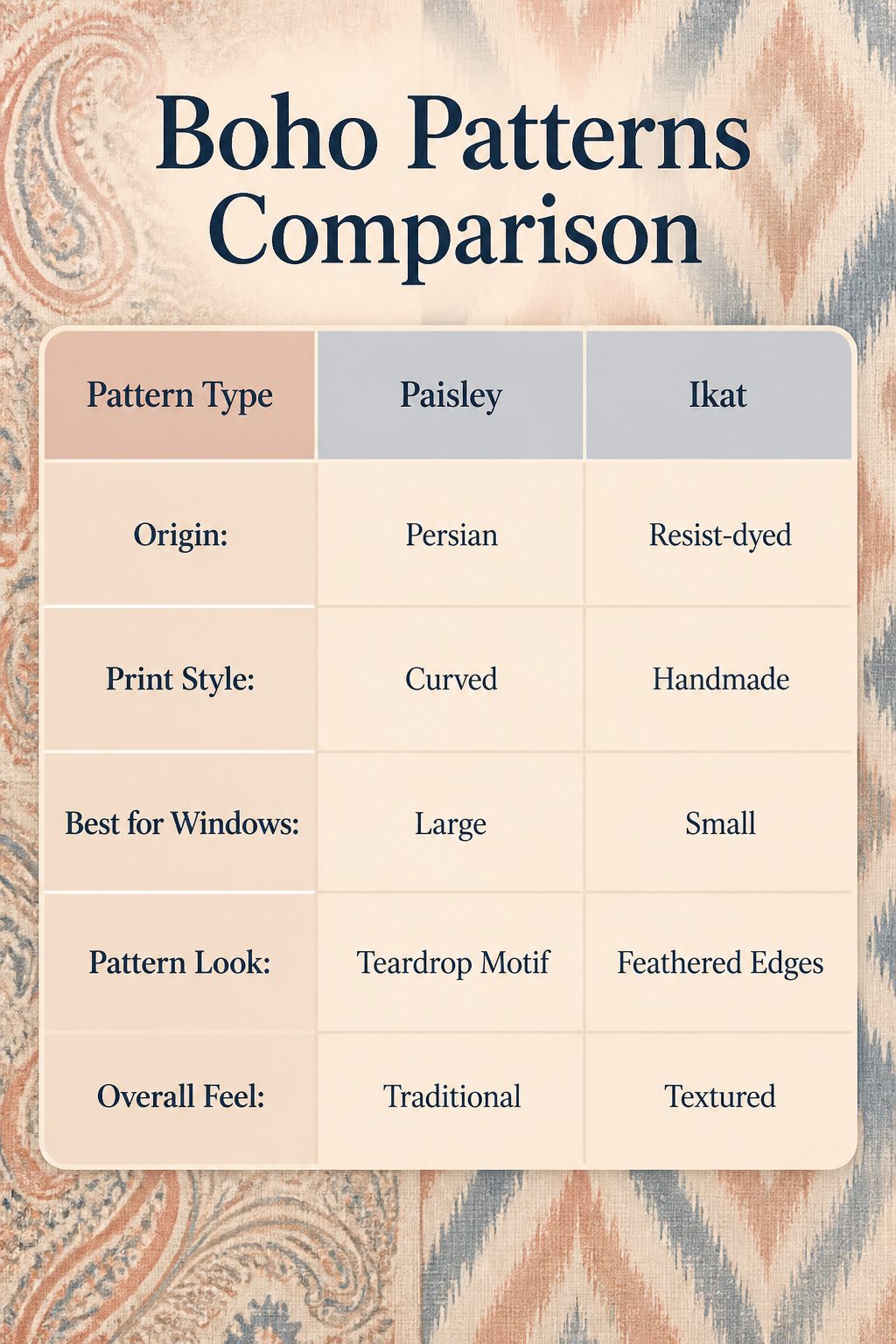
Paisley carries its Persian roots in the curved teardrop shape, while ikat comes from resist-dyeing threads before weaving, giving those feathered edges that read handmade rather than printed.
Mandala patterns pull from Hindu and Buddhist geometry, and floral motifs tie straight back to the 1960s flower-child thread of bohemian style. The global mix is what makes boho feel collected, not decorated.
A large-scale ikat or mandala belongs on a big window, where the repeat has room to breathe.
Small windows get busy fast with oversized prints and end up looking like fabric swallowed the frame. For those, a tighter paisley or a scattered floral keeps the energy without the overwhelm.
Mixing patterns works when you vary the scale and keep the color story tight. A bold paisley curtain layered over bamboo shades grounds the room because the natural material acts as a visual pause.
Pairing two loud prints on the same wall is where things tip into chaos; one patterned layer plus one solid or natural texture is the safer play for a weekend project.
If the walls are already doing something, let the curtains stay simpler. Solid cotton in a warm neutral with patterned trim can carry the boho signal without competing.
Layering Without the Bulk
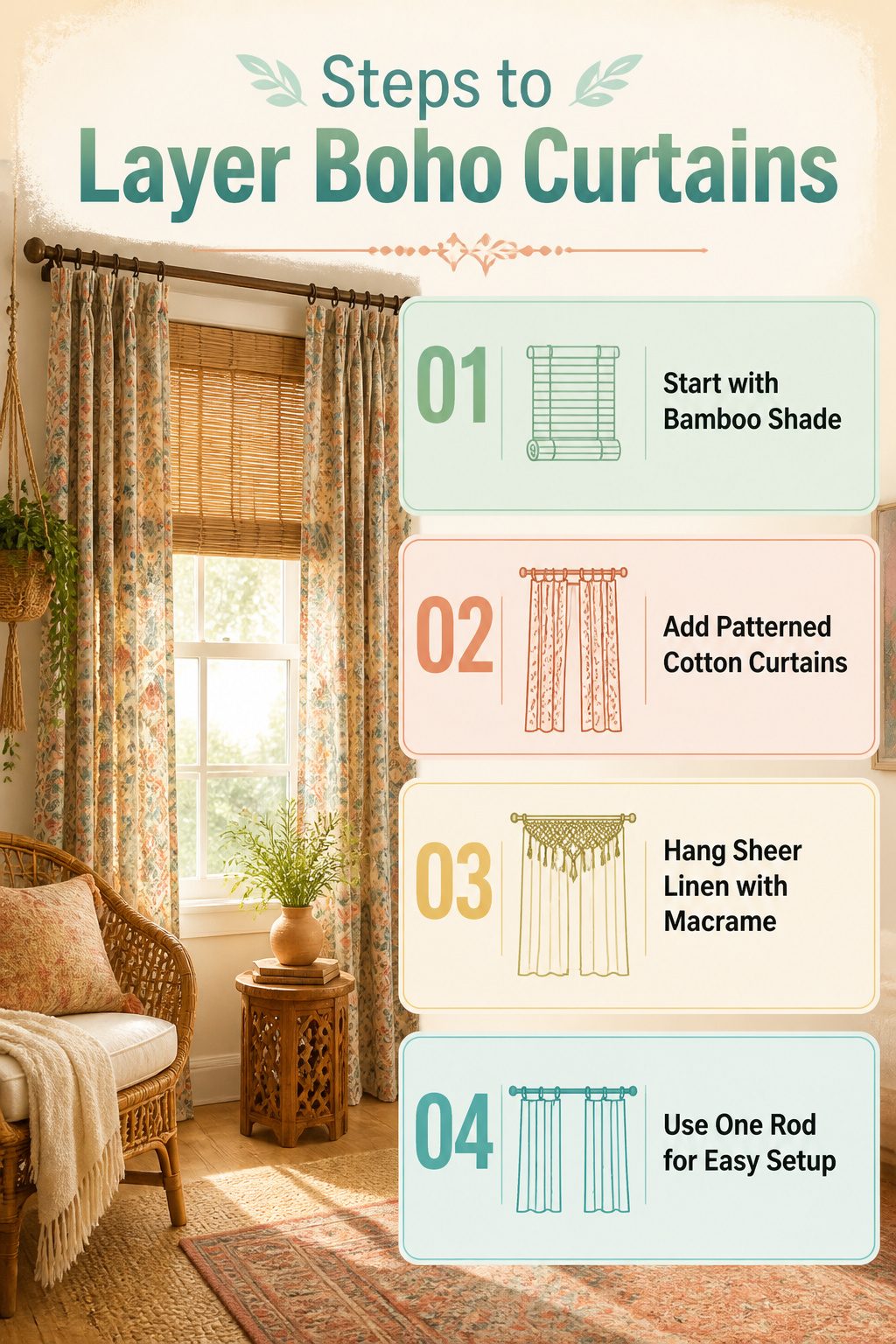
Layering boho curtains without turning the window into a fabric pile takes a formula.
The one that keeps the room feeling intentional starts with a bamboo shade as the base layer, then adds patterned cotton curtains for color and that global influence the style needs.
The shade gives structure, the cotton brings the print, and together they read as chosen rather than accumulated.
Sheer linen hung with a macrame piece above it, almost like a valance, works for bedrooms where the goal is calm. The linen keeps the light soft, the macrame adds texture without weight, and nothing competes for attention.
Renters without many drilling options can run both layers on one rod, clip rings, or a double curtain bracket that mounts to the existing frame.
Two rods only earn their holes when the layers need to move independently, like a shade that lifts daily and curtains that stay put. Otherwise, the single rod keeps the wall intact and the look cleaner than most people expect.
Hardware That Finishes It
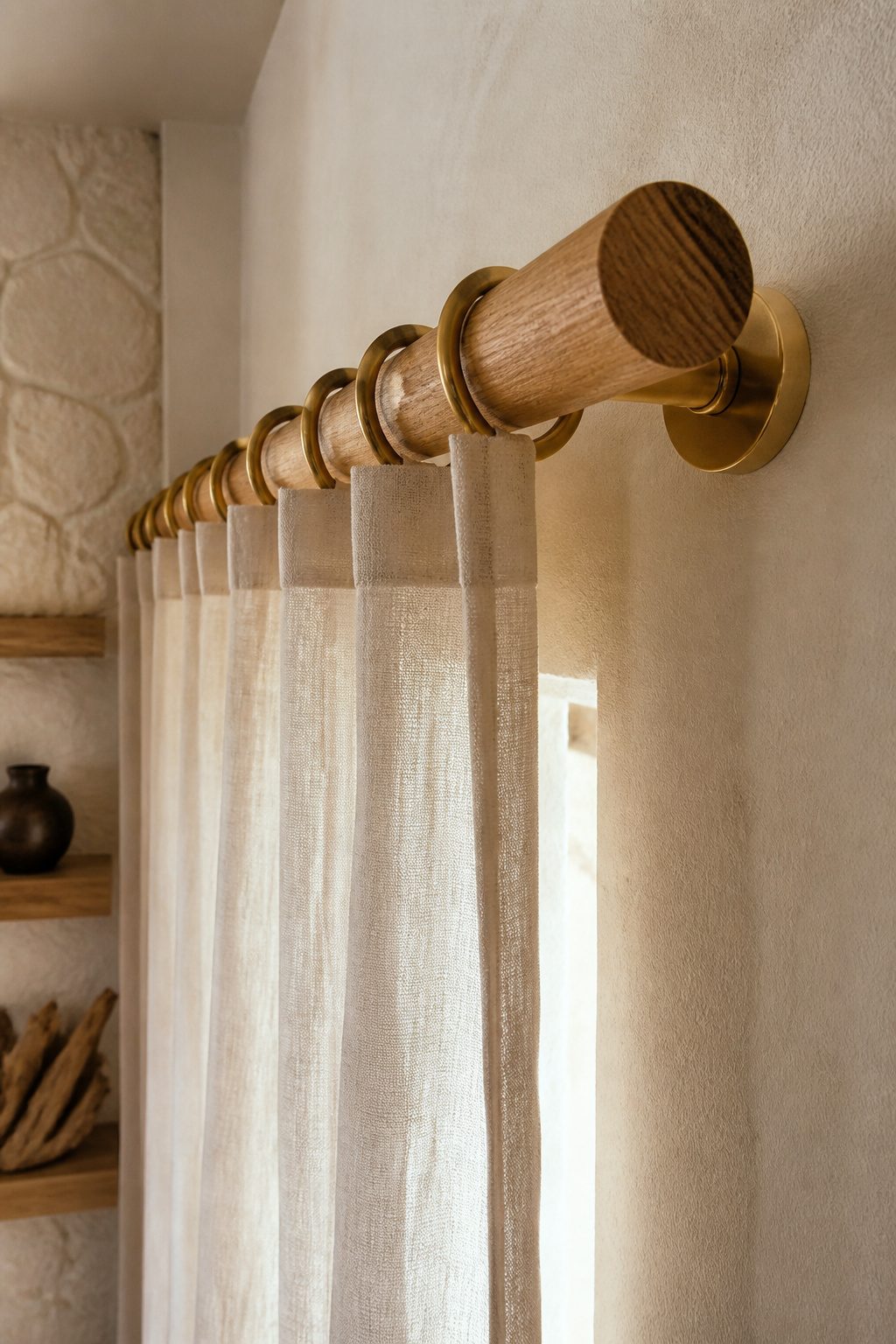
Wooden rods and driftwood branches carry the boho mood straight through to the wall, but the bracket underneath matters more than most people notice.
A three-inch diameter oak rod looks substantial until it sags in the middle of a six-foot span because the bracket spacing was too wide.
Bracket spacing should tighten to every four feet when the fabric runs heavy, like lined velvet or a triple layer of linen and sheers.
Rental walls demand a different calculation. Adhesive strips rated for curtain rods exist now, but the weight limit printed on the package assumes a smooth painted surface, not the textured plaster common in prewar apartments.
Tension rods inside the frame avoid holes entirely, though they read as more functional than decorative and tend to show when the curtains part.
A clean compromise is a slim brass rod held by magnetic brackets on a steel door frame, if the geometry works.
Driftwood looks effortless until you try to level it. The natural curve becomes part of the look, but the rings need to glide without catching on a knot.
Sanding the underside where the rings travel fixes this, and a coat of matte polyurethane keeps the bark from shedding onto the floor.
I have seen hardware become the statement piece in rooms where the curtains stay plain muslin, and disappear entirely where the fabric carries the pattern. Both work, but mixing the two, ornate rod with busy print, usually fights itself.
Frequently Asked Questions
Can boho bedroom curtains be modern?
Yes.
Modern boho curtains pair clean lines and minimal hardware with natural fabrics like linen or cotton. Sheer panels with subtle tassel trims or sleek rods balance simplicity with the relaxed character that defines the style.
Do boho bedroom curtains have to be patterned?
No.
Solid fabrics in earthy tones work just as well as global prints like ikat or paisley. The key is layering; add macrame, tassel trims, or textural slubbing to build depth without relying on pattern.
Are boho bedroom curtains only for large spaces?
No.
The style works in small bedrooms and apartments when you stick to lighter fabrics and a cohesive earthy palette. A single bold print or sheer layer can add visual depth without crowding the room.