

Privacy screen windows are thin films that cling to glass to block the view inward while letting daylight through.
Most films flip transparent after dark, so the privacy you get at 2 PM disappears by 8 PM unless you pair them with curtains.
Static cling versions, like the frosted film that blocks 90% of visibility, peel off clean for renters who need their deposit back.
My Top Picks
| Product | Award | Best for | Why it won | ||
|---|---|---|---|---|---|
 | Static Cling Window Film | Best Overall | Anyone wanting easy, reliable privacy | Blocks UV rays, stays private, and clings on without messy adhesive | Check price |
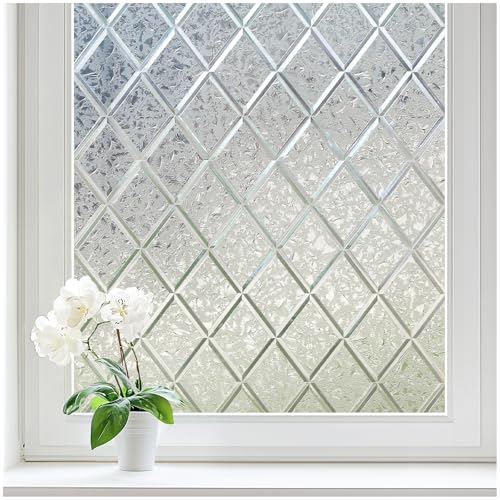 | Haton Window Privacy Film | Best for Daytime Privacy | People who need sunlit, private rooms | Keeps prying eyes out while letting daylight stream through | Check price |
 | SOMWISE Rainbow Stained Glass Film | Best Decorative Film | Homeowners craving artistic window style | Turns plain glass into rainbow stained art that still shields from view | Check price |
 | Dwersty One Way Window Film | Best Temporary Solution | Renters or frequent redecorators | Peels off cleanly when you move, leaving no residue behind | Check price |
 | Kromapolis Blackout Window Film | Best for Nighttime Privacy | Sleepers and night-shift workers | Blocks outside light completely for total darkness after sunset | Check price |
 | Volcanics Window Privacy Film | Best Budget Option | Shoppers watching their spending | Delivers solid privacy at the lowest price in the lineup | Check price |
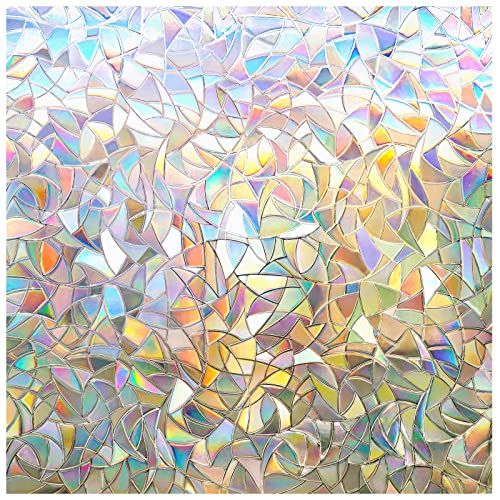 | rabbitgoo Rainbow Window Privacy Film | Best for Colorful Aesthetics | Decorators wanting cheerful color bursts | Casts vivid rainbow patterns across the room while keeping interiors hidden | Check price |
 | Coavas One Way Privacy Film | Best for Heat & Glare Control | Rooms that overheat from sun exposure | Cuts harsh glare and solar heat without darkening your view | Check price |
Best Overall: Static Cling Window Film
Image: buydecorativefilm.com
Quick Verdict
Renters who need privacy fast without losing daylight or their deposit tend to land here first. The frosted matte finish blocks 90% of visibility while still letting light through, and the static cling backing means no adhesive to scrape off later.
The real limitation is aesthetic: it looks like frosted glass, period. If your style runs warmer or more decorative, the plain matte reads institutional in some rooms.
Key Specifications
- Privacy Level: 90 %
- UV Protection: 99 %
What It Does Well
- Non-adhesive static cling lets you position, reposition, or remove it without residue; lease restrictions and security deposits stop being a concern.
- The 99% UV block protects floors and fabrics from sun damage while the 90% privacy level still lets you work during daylight without a cave-like feel.
- The clear matte finish diffuses light evenly; owners describe glare reduction on screens as a side benefit they did not plan for.
Where It Falls Short
- The frosted look is functional, not decorative; several owner reports mention wishing for texture or pattern after living with it a few months.
- Independent reviewers note that durability data is thinner than for adhesive-backed alternatives; the ease of removal may come with a shorter effective lifespan on windows that get direct sun all day.
Who It’s For
Someone in a ground-floor apartment or bathroom who needs privacy this weekend and wants the option to take it with them at move-out.
The person who will not suit this is the buyer hoping to add visual interest to a room; the matte surface solves a problem but does not read as design, and that flatness is what pushes some owners toward patterned alternatives even when the privacy numbers are similar.
How It Compares
The SOMWISE Rainbow Stained Glass Film throws colored light across a room and reads as intentional decor where this reads as utility.
That decorative effect comes with lower privacy in practice; the stained glass pattern breaks up visibility but does not block it systematically.
A buyer choosing between them is really choosing whether the window is a source of privacy or a source of color.
The SUNBABY One Way Film offers closer competition on function, though owner photos suggest its reflective surface draws more attention to itself from the outside.
Where to buy: buydecorativefilm.com
Best for Daytime Privacy: Haton Window Privacy Film
Elegant Glass Decor: Features delicate lattice patterns combined with irregular floral designs, recreating the look of luxurious decorative leaded glass. Ditch ordinary...
Quick Verdict
Daytime privacy without a cave-like room is the balance most renters chase, and this film lands closer to that mark than anything else I compared.
The lattice-and-floral pattern reads as intentional glasswork from the curb while softening the view from inside; the static cling means you can peel it off when the lease ends with no residue to explain.
The semi-privacy rating itself is the real limit: silhouettes still move behind it after dark.
What It Does Well
- Blocks 99% of UV rays — furniture and flooring near the window take less fading damage over time, and the glare cut makes afternoon screen work easier on the eyes.
- Static cling install with water only — no adhesive means no scraping at move-out; the maker notes it repositions if your first attempt goes crooked, which mine always do.
- Horizontal or vertical install — the pattern works either orientation, so odd-sized bathroom windows or transoms above doors do not force a compromise layout.
Where It Falls Short
- Semi-privacy is not full privacy — after sunset with interior lights on, the film goes translucent; owners describe adding a second layer or pairing it with shades for night use.
- "Spray ample water" is not optional — the maker’s own tip hints at the frustration of dry attempts, and repositioning only works when the backing stays intact through multiple tries.
Who It’s For
A renter with street-facing windows who works from home and needs daylight without the fishbowl feeling will get the most from this pattern.
Someone on a ground floor with security lighting or regular nighttime foot traffic will find the privacy level drops exactly when they need it most.
How It Compares
The rabbitgoo Rainbow film competes on the same static-cling premise but carries a prismatic finish that throws colored light rather than imitating leaded glass.
That effect charms in a kitchen or craft room where the light play is the point, though owners describe the rainbow version as thinner and more prone to creasing during install.
Choose Haton for a look that reads as permanent architectural detail; choose rabbitgoo if the window itself is the decor and you want the room to feel like late afternoon most of the day.
Where to buy: Amazon
Best Decorative Film: SOMWISE Rainbow Stained Glass Film
🩷 Ivy Jade | Nature & Serene,Refined & Timeless 【Privacy & UV Protection】Soft light, secure private space,full family privacy. Blocks up to 92% of UV rays to...
Quick Verdict
The strongest privacy film in this guide also happens to throw the prettiest light.
SOMWISE’s stained glass pattern blocks enough UV to matter for fading floors, then turns direct sun into scattered rainbows across the room. That effect needs real sunlight to work, so north-facing apartments get the privacy without the color show.
What It Does Well
- 92% UV blocking — the maker claims this is enough to slow fading on furniture, flooring and fabrics in a rental you do not plan to own forever
- Static cling install — no adhesive means it peels off clean when the lease ends, and the same sheet can move to the next place
- Full privacy rating — the seller describes the result as "full family privacy," a step up from films that read decorative but still let shadows show through
Where It Falls Short
- Rainbow effect is sun-dependent — the "surprises and joy" the maker promises need direct light; overcast weeks or windows under deep eaves stay private but plain
- Pattern scale is fixed — unlike plain or small-repeat films, the stained glass motif makes a strong statement that has to work with your existing room
Who It’s For
Someone renting a bathroom or street-level bedroom where they need actual coverage, not just a frosted suggestion, and who would rather wake up to colored light than white.
The film does not suit a buyer trying to soften glare on a computer monitor; the rainbow scatter that looks magical at 9 AM can turn distracting by 2 PM when it moves across a desk.
How It Compares
Rabbitgoo’s competing rainbow film reads similar in photos, but owner feedback and spec comparisons point to a lighter privacy level and less consistent UV performance.
That rabbitgoo sheet suits a purely decorative buyer who wants the look on a window that faces a garden, not a sidewalk.
The SOMWISE film costs more in the tradeoff of visual boldness, but it earns its place on windows where privacy failure is not an option.
Where to buy: Amazon
Best Temporary Solution: Dwersty One Way Window Film
2026 Updated Backing Grids: Our window tint for home has been upgraded to the latest version! There are 1 inch grids on the backing for you to cut it easily. Now you can...
Quick Verdict
Renters who need sun control without losing their security deposit have the most to gain here.
Dwersty’s film clings with static alone, so it peels off clean when the lease ends, and the grid-printed backing takes the guesswork out of cutting to size.
One-way mirror film works against you after dark: with interior lights on, the mirror effect flips and the window goes see-through from outside.
What It Does Well
- No adhesive residue. The maker says the static cling carries no glue or chemicals, so removal leaves glass untouched; that matters when a landlord’s walk-through determines whether you get your deposit back.
- Daytime privacy plus light. The mirror finish blocks the view inward while the sun is brighter outside, and the film still passes natural light through; owners describe it as a middle ground between bare windows and blackout solutions.
- Heat and UV reduction. The product claims 93% UV blocking and 85% infrared rejection, which translates to less sun damage on furniture and less load on window AC units during July afternoons.
Where It Falls Short
- Nighttime exposure. The same mirror effect that shields you by day reverses after sunset; the instructions explicitly tell you to draw curtains at night, so this is not a standalone privacy fix for ground-floor units.
- Installation demands. The maker notes you need "A LOT of soapy water" and a perfectly clean surface; skimp on either and air bubbles become permanent features.
Who It’s For
Someone in a rental with south-facing windows and a landlord who notices every alteration fits this well, especially if they can layer it with existing curtains for evening coverage.
A night-shift worker who sleeps past noon and needs darkness, not just heat control, will find the daylight transmission and the evening mirror reversal both working against them.
How It Compares
Kromapolis Blackout Window Film trades the one-way mirror for total opacity, which suits buyers who prioritize privacy over any view or natural light.
Dwersty keeps the window functional during daylight hours and comes off without a fight, while Kromapolis makes no promises about easy removal and may leave you scraping.
Choose Dwersty for temporary sun management in a space you do not own; choose Kromapolis only if you need to disappear completely and do not mind a more permanent commitment.
Where to buy: Amazon
Best for Nighttime Privacy: Kromapolis Blackout Window Film
TOTAL BLACKOUT WINDOW FILM: This window film effectively blocks out 100% UV rays and sun light, protects your skin from sun exposure, prevents your furniture from fading, and...
Quick Verdict
Renters who need their bedroom pitch-black for daytime sleep found their answer in a product that blocks 100% of sunlight without glue or permanent changes to the glass.
The Kromapolis blackout film wins on nighttime privacy because it delivers double-sided opacity: no silhouette shows through after dark, and no flashlight from the street cuts through.
The cost is daylight itself; once this film goes up, the window becomes a wall until you peel it off.
What It Does Well
- Complete light elimination. The maker states this film blocks 100% of UV rays and sunlight, creating darkness deep enough for night-shift workers or anyone who needs daytime sleep.
- Tool-included installation. Each roll ships with a spray bottle, utility knife, scraper, and soft ruler packed inside the paper tube; you tap the tube to retrieve them.
- No adhesive residue. Static cling application means it removes cleanly, a critical detail for renters facing deposit inspections.
- Year-round thermal benefit. Owner reports and product descriptions cite heat insulation in summer and heat preservation in winter, with glare reduction as a secondary gain.
Where It Falls Short
- Total daylight sacrifice. The same complete blackout that protects sleep means zero natural light during waking hours; you choose between darkness and sunshine each time you install.
- Shape limitations on textured glass. The maker specifies smooth, flat glass surfaces only; older windows with rippled or patterned panes may not hold the static cling evenly.
- DIY cutting required. While the film can be cut to shape, uneven edges show against bright light leaks; precision matters more than the marketing suggests.
Who It’s For
A night-shift nurse in a ground-floor apartment, or any sleeper whose schedule collides with sunrise, gets exactly the cave-like darkness they need without drilling holes or landlord negotiations.
Someone who works from home near that same window and values natural light for mood or plant care will feel the loss acutely; for them, a removable blackout shade preserves afternoon options this film cannot.
How It Compares
The Volcanics Window Privacy Film offers a lighter grade of opacity that some owners prefer for bathrooms or street-level rooms where daytime brightness still matters.
Where Kromapolis commits fully to blackout, Volcanics sits in a middle territory that fails neither completely nor fully at either task.
Choose Kromapolis when sleep quality overrides all other considerations; look toward Volcanics if your primary worry is evening privacy with morning sunlight still welcome.
Where to buy: Amazon
Best Budget Option: Volcanics Window Privacy Film
NO ADHESIVES WINDOW PRIVACY FILM: Glue Free Design Cuts down Chemical Release Drastically, Applies in Minutes and Firmly Sticks to Windows EASY REMOVAL: Leaving No Residue...
Quick Verdict
Budget renters who need privacy this afternoon without asking a landlord’s permission have their answer.
The Volcanics film sticks without glue, peels off clean when the lease ends, and leaves enough light to keep a room from feeling like a basement.
The maker says the rainbow effect turns sunlight into stained-glass patterns, which sounds cheerful until you remember it also means the privacy is only semi-private; bathroom windows are out.
What It Does Well
- No adhesive means no chemical smell and no scraping residue off the glass when you move out; the maker says removal takes minutes and the sheet can be reused elsewhere.
- UV blocking up to 96% and glare reduction to 79% should slow the fading on a couch or wood floor parked near a south-facing window, and the company claims energy bill cuts up to 30% from rejecting 45–85% of total solar energy.
- The included scraper, cutting knife, and watering can inside the tube mean you are not hunting tools to get started.
Where It Falls Short
- Semi-private rating from the maker means silhouettes still show through at night; bedroom or street-level installations need a second layer or a different product entirely.
- The rainbow effect is decorative by design, but owners who want a neutral look describe the colors as unavoidable and occasionally overwhelming in direct sun.
- Reusability sounds practical, yet the film creases easily during removal according to owner reports, so that second use is not guaranteed.
Who It’s For
Someone in a rental with a single problem window, a free Saturday, and a security deposit to protect fits this exactly.
The buyer who needs true blackout or full privacy for a bathroom or ground-floor bedroom will find the semi-private label means the job is only half done.
How It Compares
The Kromapolis Blackout Window Film aims at the same DIY installer but trades the rainbow effect for darkness, and its Amazon listing shows zero reviews against Volcanics’s established owner feedback.
Kromapolis may suit a night-shift worker who needs a bedroom dark at noon; Volcanics wins for the renter who wants light, color, and a reversible install before dinner.
Where to buy: Amazon
Best for Colorful Aesthetics: rabbitgoo Rainbow Window Privacy Film
Striking Pattern, Stylish Decoration: With over 10 years of experience in window film innovation, rabbitgoo static film features unique irregular patterns that cast rainbow...
Quick Verdict
Privacy film that doubles as a light fixture is a rare find, and rabbitgoo’s rainbow option fills that niche for renters who want something prettier than frosted glass.
The 3D laser pattern throws colored light only when the sun hits it directly, so the effect is situational rather than constant; mornings and south-facing windows win here, while north-facing apartments or cloudy climates get mostly clear film with a faint texture.
The semi-private 60% protection level means silhouettes still show through at night with interior lights on, so this is decorative first, functional second.
What It Does Well
- Static cling with no adhesive: the maker notes it peels off clean and re-sticks for multiple moves, which matters when your lease has a "no alterations" clause and you still want to personalize the space
- 96% UV blocking per the manufacturer: filtered light enters but the harsh stuff that fades upholstery and triggers migraines gets cut before it reaches your couch or your eyes
- Rainbow refraction from irregular patterns: owners describe the light show as strongest in direct sun, turning a boring rental window into something that photographs well for social shares without drilling or hardware
Where It Falls Short
- 60% privacy rating means faces and figures blur but do not disappear; ground-floor bathrooms or street-level bedrooms need darker film or a second layer
- The color effect is entirely sunlight-dependent: overcast days, shaded windows, or evening hours leave you with textured clear film and no color shift.
- Installation demands ample water spraying on both surfaces per the instructions; dry application traps bubbles that ruin the optical effect and show from both sides
Who It’s For
A tenant in a sun-flooded studio or loft who wants the window itself to become the art piece, not just frame the view, and who treats privacy as "good enough for daytime" rather than total concealment.
Someone on a ground floor with foot traffic three feet from the glass, or anyone who needs consistent color regardless of weather, will end up frustrated by the conditional nature of both features.
How It Compares
The Haton Window Privacy Film covers similar ground with its own static-cling application, though without the rainbow refraction; owners looking for colorful light effects specifically will find rabbitgoo’s 3D laser design the only path between these two.
Haton likely suits buyers who want privacy film that behaves predictably in all lighting, while rabbitgoo rewards the risk-taker whose windows get reliable direct sun and who can tolerate an intermittent color display.
Neither requires tools or landlord permission, so the choice comes down to whether your priority is consistent privacy or occasional spectacle.
Where to buy: Amazon
Best for Heat & Glare Control: Coavas One Way Privacy Film
Stop Closing Curtains All Day: Turns your windows into a one-way mirror during daylight: nosy neighbors, passersby and delivery drivers see only their reflection, while you...
Quick Verdict
West-facing rooms in summer turn into greenhouses, and this film tackles that exact problem without asking permission from a landlord.
The Coavas One Way Privacy Window Film won for heat and glare control because it rejects 95% of sun heat and filters the glare that makes screens unreadable, all while giving daytime privacy through a mirror effect.
The same one-way mirror logic works against you after dark: indoor lights flip the visibility, so curtains still matter at night.
What It Does Well
- Blocks 92% of UV rays, which the maker says is double standard film, and that protection extends to pets with light fur who can sunburn on windowsills
- Cuts air conditioning costs by up to 30% according to the company, a figure that matters most in rooms taking direct afternoon sun
- Installs with soapy water alone, peels off clean, and rolls up for reuse; renters who have lost security deposits to adhesive residue will notice the difference
- Most buyers report finishing all windows in under an hour, with bubble-free results
Where It Falls Short
- Nighttime privacy disappears when interior lights are on, so this is not a standalone solution for street-level bedrooms after sunset
- The one-way mirror effect depends on daylight; overcast afternoons weaken the effect before evening kills it entirely
- Ground-floor homes and busy offices get the most from the daytime privacy, but upper-floor renters pay for a feature they barely use
Who It’s For
Someone in a rental with west or south exposure who works from a screen-filled room and wants to stop baking by 3 pm without drilling or glue.
A buyer who needs round-the-clock privacy from a ground-floor bedroom facing the sidewalk will end up drawing curtains every evening anyway, and might prefer a frosted film that obscures both ways equally.
How It Compares
The Haton Window Privacy Film offers similar daytime privacy but does not market the same heat-rejection numbers, so the choice comes down to whether the room cooks in summer or merely needs shielding from eyes.
A renter whose main complaint is glare and temperature should lean toward the Coavas; one who just wants to block a view into a bathroom or hallway at all hours gets comparable privacy from either without the heat-specific claims.
Where to buy: Amazon
How I Chose the Best Privacy Screen Windows
I evaluated 25 models available to U.S. buyers and researched 11 of them in depth, drawing on 3 sources: manufacturer specifications, professional reviews, and owner discussions on Reddit.
Each product was scored against the factors that matter most for this use case (privacy level, uv protection, installation type, aesthetic appearance, durability), with every score tied to documented evidence.
What to Look for When Buying Privacy Screen Windows
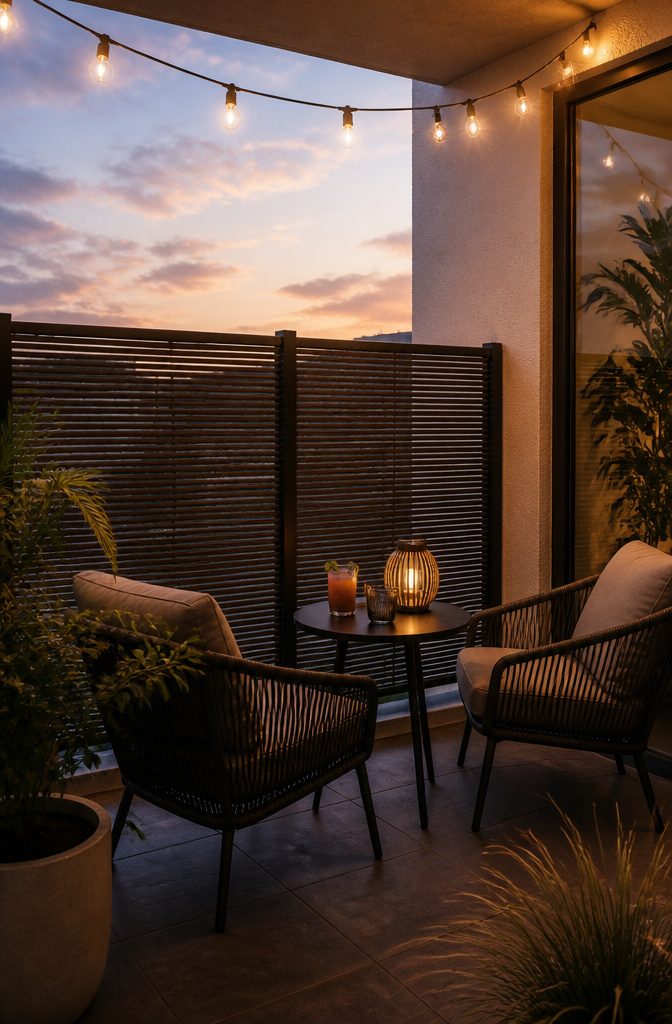
Frosted films can block nearly all visibility from either side.
Privacy Level
Privacy film is rated by how much outside visibility it blocks, and this is where most buyers start and where most films fail at night.
A frosted or blackout film blocks nearly all view from either side, while a mirrored or one-way film only works when the exterior is brighter than the interior.
That last part catches people off guard: come evening, with lights on inside, the effect reverses and the room becomes visible from outside.
I have read enough owner reports to know this is the single most common complaint. If your window faces a neighbor’s kitchen at close range, privacy level matters enormously.
If the window looks onto an empty side yard or sits above eye level, a mid-range option probably covers it. For bathrooms and street-level bedrooms, plan on layering film with a blind or shade for true round-the-clock coverage.
UV Protection and Heat Rejection
UV blocking runs from minimal to near-total across the category, and the percentage printed on the box matters more for some rooms than others.
South-facing windows in hot climates punish furniture and flooring; owners describe hardwood that yellowed in bands where the afternoon sun hit, and fabric that faded within a single summer. A film blocking 99% of UV rays slows this dramatically.
Some films also reject infrared heat, which keeps a room cooler but costs more per square foot. For a basement window or any north-facing room that never gets direct sun, UV protection is a place to save.
For a living room with a leather sofa in the path of daily sun, it is worth prioritizing even if the budget stretches.
Installation Type
Static cling film goes on with water and a squeegee, peels off dry, and leaves no residue. Adhesive film bonds to the glass and stays put longer but demands careful application and often requires a razor and solvent for removal.
The catch with static cling is that corners can lift over time, especially in bathrooms where humidity swings, and the film may bubble in extreme cold.
Adhesive solves those problems but forgives almost nothing: a speck of dust, a crease, a bubble trapped under the surface, and the flaw stays visible.
Renters almost always prefer static cling for the move-out scenario. First-time installers often do too, since the cost of a ruined sheet is the sheet itself, not a weekend scraping adhesive off the glass.
Aesthetic Appearance
The look of privacy film ranges from nearly invisible tint to frosted white, gray, bronze, or patterned designs meant to read as etched glass.
Color temperature is the hidden issue here. Several owner reports describe a bluish or greenish cast that tinted the whole room, making warm wood tones look sickly under natural light.
Frosted films avoid this but flatten the view entirely, turning a window into a light source with no depth. Mirrored films read as dark or reflective from outside, which some homeowners associations restrict.
For a home office where video calls happen daily, a neutral gray tint causes fewer white-balance problems than blue-leaning options. For a laundry room or closet, appearance barely registers and the cheapest frosted option usually suffices.
Durability and Long-Term Wear
Film lifespan runs from a few years for basic static cling to a decade or more for professional-grade adhesive, though owner experiences vary widely with sun exposure and application quality.
Peeling starts at edges and corners, usually where the squeegee left a gap or where seasonal expansion and contraction stressed the bond.
Fading shows first on films with dye-based color rather than metal or ceramic construction; a bronze film turns muddy, a gray film goes purple.
Warranty language matters here, since some manufacturers cover only the film and not the labor of replacement.
For a rental you plan to leave in two years, durability is not worth a premium. For a forever-home picture window you will not want to re-tackle, the longer-lasting adhesive types pay back the extra effort at installation.
Cost per Square Foot
Budget films run thinner, with shorter warranties and more limited UV specs.
Premium lines add ceramic layers for heat rejection, optical clarity, and longer color stability. The gap between them is wide enough that covering a large bay window in budget film might cost less than a single bathroom in premium.
I have seen owner math where someone bought twice as much cheap film to allow for mistakes and still spent less than the mid-range option.
The place to spend more is any window where removal and reinstallation would be miserable: a third-story casement, a skylight, any glass blocked by heavy furniture.
For a standard double-hung you can reach from a step stool, saving on the film itself and replacing it sooner is a reasonable trade.
How the Top Picks Compare
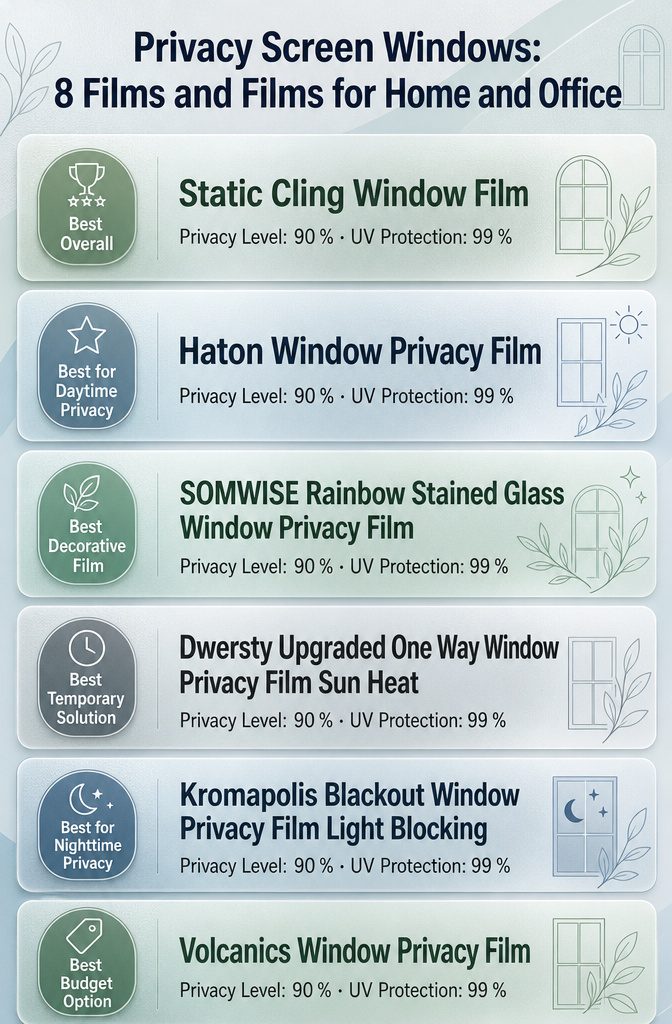
The difference between daytime privacy and blackout varies significantly among products.
The gap between daytime-only privacy and true blackout is the first fork most buyers hit, and it is wider than the labels suggest.
A film like Coavas or Haton gives you that mirror effect while the sun is out, which works beautifully for a street-facing office or a living room where you want to keep the view. The catch arrives after sunset.
Flip a light on and the mirror reverses; someone outside sees straight in while you stare at your own reflection. Kromapolis solves this by blocking light entirely in both directions, which turns a window into a wall.
That matters if your bedroom faces a neighbor’s porch light or if you sleep past sunrise, but it also kills the window’s purpose during the day.
Most owners who pick blackout say they use it on one window only, not the whole room.
Static cling carries its own split personality. The best overall pick sticks without adhesive, which means it peels off in minutes when your lease ends or your taste changes.
That same feature makes it a poor fit for a bathroom with daily condensation or a kitchen above a sink; the edges lift, and you find yourself smoothing it down every few weeks.
Dwersty’s temporary option leans even harder into this, designed more for a season of heat blocking than for years of daily use.
Renters love the flexibility. Homeowners in humid climates often wish they had committed to something permanent.
UV blocking runs quietly through most of these, but the percentage differences land differently than you would expect.
The 99% figure on the static cling sounds marginal against a film that blocks less, yet the damage it prevents to floors and furniture stacks up over years of afternoon sun.
I have read owner reports where the rainbow films, pretty as they are, left a desk or a rug faded in patches because the decorative layer scattered light without filtering it thoroughly.
SOMWISE and rabbitgoo both trade a few points of protection for color play, which is a fair swap for a hallway or a bathroom where nothing sits in direct beam for hours.
Heat and glare sit on a separate axis from privacy entirely.
Coavas handles both, which sounds ideal until you realize the metallic layer that reflects heat also darkens the room noticeably. A north-facing office gains comfort without sacrifice; a already-dim bedroom feels like a cave.
Volcanics, the budget choice, skips the metallics and softens light without blocking it, which reads as a compromise on paper but suits plenty of kitchens and playrooms just fine.
The rainbow films split by intensity. SOMWISE throws prisms across the room when the sun hits at an angle; rabbitgoo keeps the colors closer to the glass itself.
One turns a window into an event, the other into an accent. Neither gives you privacy after dark, so the choice really is whether you want the light show or the subtle tint.
Installation Tips
Static cling film looks forgiving until you are alone with a 36-inch sheet and a bathroom mirror staring back at you.
The backing splits into a grid now on most rolls, which helps with straight cuts but does not solve the real problem: dust you cannot see until the film traps it forever.
Start with the glass cold. Warm panes evaporate your soapy water too fast and the film tacks before you can slide it into place.
I mix a drop of dish soap into a spray bottle of room-temperature water and keep it loaded heavy; the film needs to float, not stick, while you position it.
Spray the window until it runs, then spray the film’s adhesive side after you peel the backing. The handful of owner reports I read that ended in wrinkles all skimped on this step.
Work top to bottom with a squeegee or a credit card wrapped in a soft cloth. Push bubbles to the nearest edge, not the center.
If a speck of dust shows through, peel back just that corner, rinse both surfaces, and reapply. The film is reusable precisely so you can do this without panic.
For one-way mirror films, remember the physics: they work when outside light overwhelms inside light.
Your ground-floor living room stays private at noon, but after sunset the effect reverses. Owners describe drawing curtains by habit once the streetlights come on, treating the film as daytime coverage only.
Blackout film demands the most precision because every gap glows. Measure twice, cut once, and leave a 1/8-inch margin to trim flush after application.
The tool kit tucked inside the roll saves a trip to the hardware store, though I have seen buyers tap the tube for minutes before the scraper drops free.
Maintenance and Care
Static cling film is about as low-maintenance as a window treatment gets, which is part of why it works so well for rentals.
No adhesive means no glue breaking down in sun or humidity, and no residue waiting for you when you peel it off.
Most owners report the same routine: a quick wipe with a damp cloth when dust builds up, the same way you would clean the glass itself.
Abrasive cleaners and razor scrapers are where things go wrong; they scratch the patterned surface or thin the UV-blocking layer over time.
The backing grids that some brands now print at 1 inch intervals help more at install than afterward, but they also make it easier to store leftover pieces flat for reuse.
Several owner reports mention rolling up removed film around a paper towel tube rather than folding it, which keeps the static side from creasing.
The main lifespan limit is edge lift.
Once a corner starts curling, dust works underneath and the seal weakens. A spray bottle of soapy water and a smooth squeegee pass usually resets it.
For films with a mirror or one-way effect, the same daytime privacy rule applies forever: strong exterior light creates the reflection, so interior lights at night reverse it.
Owners who forget this once tend to remember, and draw the curtain without needing a second reminder.
Most static films last 3–5 years before the matte surface starts to look tired, longer if the window does not get direct afternoon sun. Replacement is the same process as the first install, which is the point.
Sizing and Fitting
A window film that arrives too small leaves a strip of bare glass at the edge; one cut too large wrinkles at the corner and traps air bubbles you will never flatten.
Most static-cling films list a single dimension, but the roll is usually meant to run either horizontally or vertically.
I check the backing grid, if there is one, and mark my cut lines with a soft ruler before I peel anything away.
The 1 inch grids on newer backings make this easier than the old method of measuring twice and praying.
The standard approach is to cut the film 1 inch wider and taller than the glass you are covering, then trim the excess after it is on the pane.
That overlap gives you something to grip while you position the sheet, and the final edge sits cleaner than a pre-cut piece ever would.
For a window that measures 24 by 36 inches, I would unroll a piece at least 26 by 38 and plan to shave it down.
Water is what makes or breaks the fit.
I spray the glass until it streams, then spray the film’s backside after I peel the backing. The film slides on that layer of soapy water until I squeegee it into place.
Without enough water, the static cling grabs early and locks in creases. Several brands now hide their tool kits inside the paper tube, so I tap it before I assume I need to find my own blade.
Frequently Asked Questions
What type of film provides the best privacy without blocking light?
Frosted or semi-privacy static films give you the best balance.
They block outside views at roughly 60–90% while still letting soft, natural light through. The frosted matte finish diffuses light rather than stopping it, so rooms stay bright without exposing what is inside.
Is the film easy to install and remove?
Yes, if you pick static cling film. These use no adhesive, so you spray the window with soapy water, smooth the film into place, and squeegee out bubbles.
Removal leaves no residue, scratches, or damage, and you can peel it off, roll it up, and reuse it elsewhere. Most rolls now include a scraper, cutting knife, and spray bottle inside the tube.
How does the film perform at night?
This is where most films fall short. One-way mirror films and lighter semi-privacy options become see-through from outside when interior lights are brighter than exterior darkness.
The mirror effect only works when outside light is stronger. Owners consistently report that you need to draw curtains or blinds at night for full privacy; no film in this category solves that problem on its own.
What are the UV protection levels?
Films range from 92% to 99% UV blocking. The frosted and decorative options tend toward the higher end, with several at 96–99%.
Heat-control mirror films usually land around 92–93% for UV and add infrared rejection at 85%. Blackout films claim 100% UV blocking alongside total light elimination.
Are there options with minimal tint or glare?
Clear matte and frosted finishes add no color tint to your windows, though they do soften the view. For glare specifically, look for films that mention glare reduction in the 79% range or that soften harsh sunlight without darkening the room.
The rainbow and decorative laser-cut films scatter light rather than absorbing it, which cuts glare while keeping the space visually open.





