
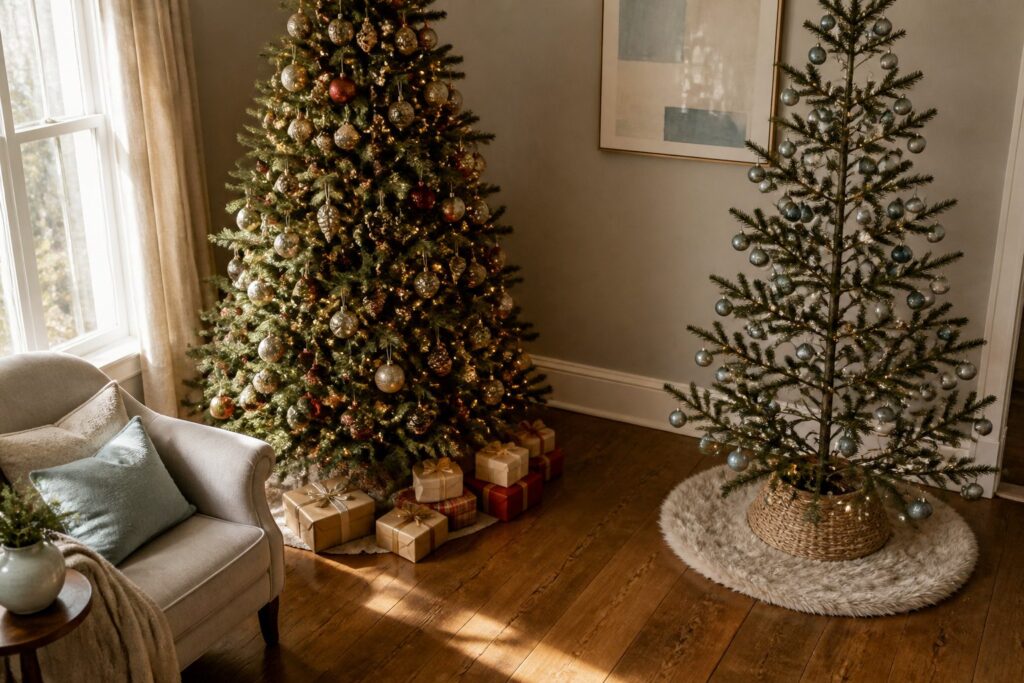
The modern American home now often holds more than one Christmas tree, but the shift only works if you are ready to manage the extra outlets, storage bins, and February teardown.
About sixteen percent of the ninety-four million households with Christmas trees now display multiple, a figure that started not in family tradition but in department store retail theater designed to move shoppers between cosmetics and toys.
Why One Tree Stopped Being Enough
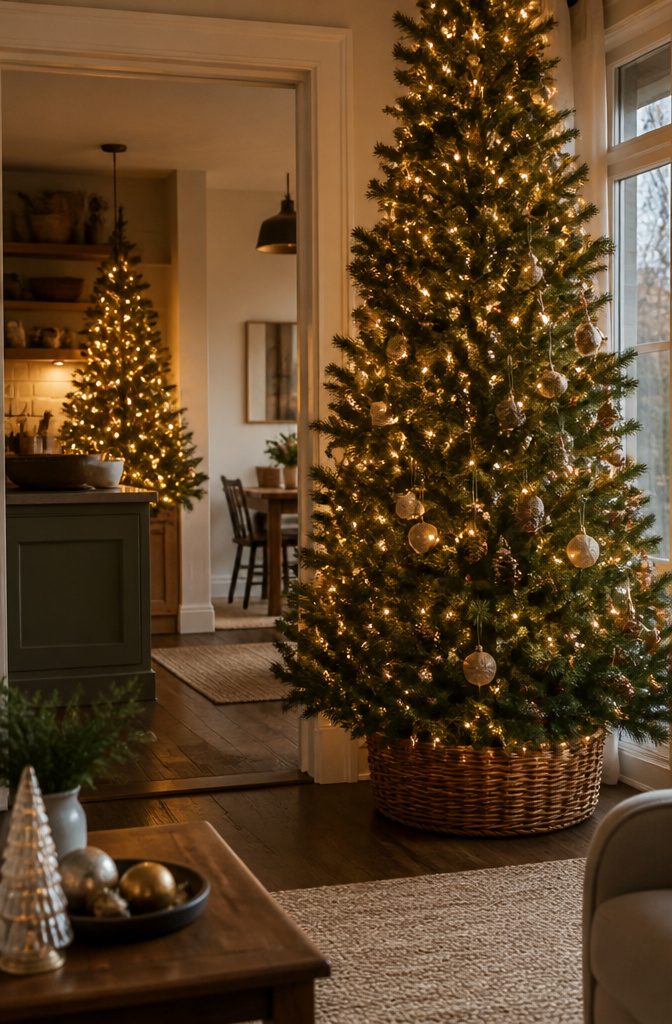
One tree in the living room leaves the rest of the house dark.
Families I talk to usually start with that problem: the kitchen window faces the street, the upstairs landing gets no glow, someone walks through the dining room and remembers there is a tree somewhere in this house but not here.
A second tree solves the visibility issue without running extension cords across hallways.
The design flexibility is harder to ignore once you try it.
A farmhouse tree in the kitchen and something moodier with dried oranges in the library means you are not locked into a single look that has to please every room.
I like being able to experiment without committing the whole house to one palette.
Then there is the ornament armistice.
His late grandmother’s glass balls versus the kids’ felt animals does not have to be a battle when there are two trees. Each collection gets its own space, and the annual negotiation shrinks to where to plug them in.
About 16% of the 94 million homes with Christmas trees now display more than one, and the broader number is striking too: 14% of Americans overall have at least two.
The American Christmas Tree Association also found that 20% of people who put up a tree feel one is not enough.
Those numbers track with what I see. The second tree is not a luxury add-on anymore; for a growing slice of households, it is the solution that keeps the holiday from feeling half-lit.
Real, Faux and In-Between
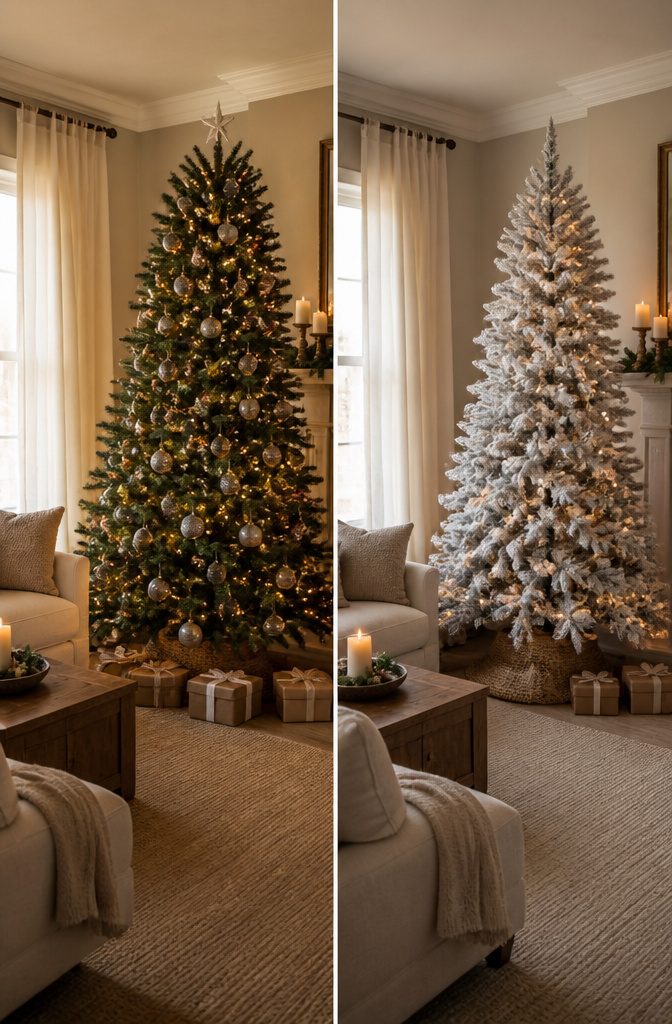
Real trees still own the scent category.
The pine hits every room, and that smell is half the reason people keep buying them. But once you are running more than one tree, the needle drop and daily watering turn from a ritual into a chore.
Artificial trees solve that: they collapse flat, go up the same way every year, and the mini sizes work for tabletops and stair landings where a 7-foot fir would never fit.
Some families skip the either-or and mix types across rooms.
A real tree goes where people gather, usually the living room or wherever you open presents. A faux tree handles the basement, the guest room, or anywhere you want the look without the maintenance.
The second tree is almost never the same kind as the first, because the idea is fitting the tree to the spot, not the spot to the tree.
Potted living trees and flocked versions are the in-between choices. A living tree stays planted or potted, so you get greenery without the landfill trip.
Flocked trees give you snow-dusted branches in any climate, and they only make sense in artificial since real flocking kills the tree. Neither option is cheap, but both let you do something a standard green fir cannot.
Giving Each Tree Its Own Look
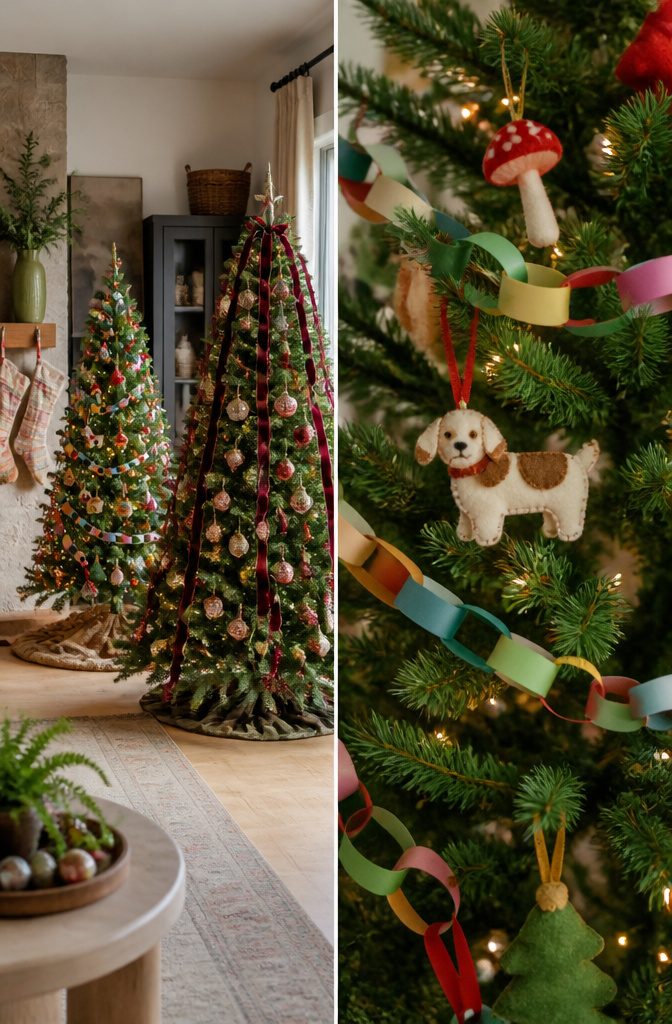
Multiple trees let you run different moods in different rooms without the whole house looking like a catalog spread.
I keep the living room tree formal, glass ornaments and velvet ribbon, and let my kids pile felt shapes and paper chains on a slim alpine in the family room. Neither cancels the other.
A second tree also means you can match what is already there, a copper-and-cream scheme against the sofa, a flocked tree picking up the bathroom tile.
Each tree becomes an experiment that does not risk your main display. If the monochromatic look falls flat, you unplug the lights and the heirloom ornaments on the family tree stay untouched.
The practical return is what sells the trend to renters and first-home owners working on a weekend.
One room gets the sentimental pieces, another tests whatever caught your eye on Pinterest. You are not committed to a single statement for the whole house, and that freedom matters more than any extra storage bins in January.
Grouping Trees for More Impact
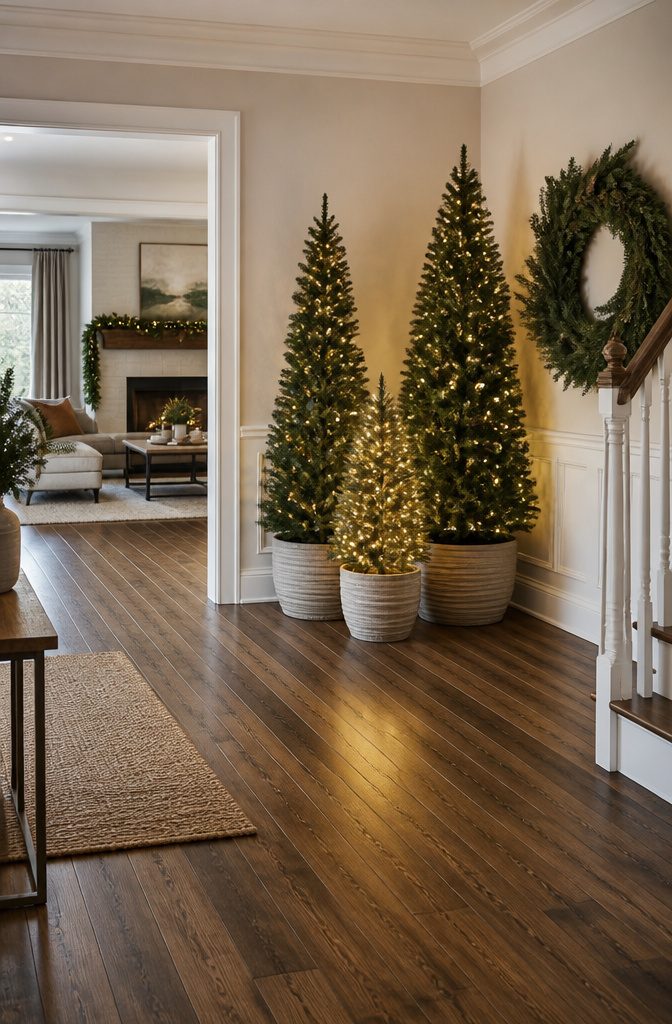
A cluster of trees reads as one display when you set them in odd numbers and vary the heights by at least a foot.
Three is the minimum that looks intentional; two can feel like a mistake in spacing unless the room is symmetrical by architecture.
Potted trees work best for this, especially in an entryway or corner where you need mass without width. I keep them simply decorated, or even just lit, so the grouping itself stays the statement.
The eye needs something to tie them together: one repeated element, like white mini lights or matching tree toppers, does more than matching the trees ever could.
Let each tree breathe.
Six to twelve inches between trunks is usually enough for them to read individually, though the exact gap depends on your pot size. Too tight and they blur into a single blob; too loose and the grouping breaks apart.
On a grander scale, full-size trees in a spacious family room command the same way, but the rules hold. Same style in different sizes keeps it calm; mixed styles need that repeated color or element even more.
I think the potted route wins for renters and first-home owners: the investment is lower, the storage is smaller, and you get the Pinterest impact without the lobby effect.
Lighting Each One Differently
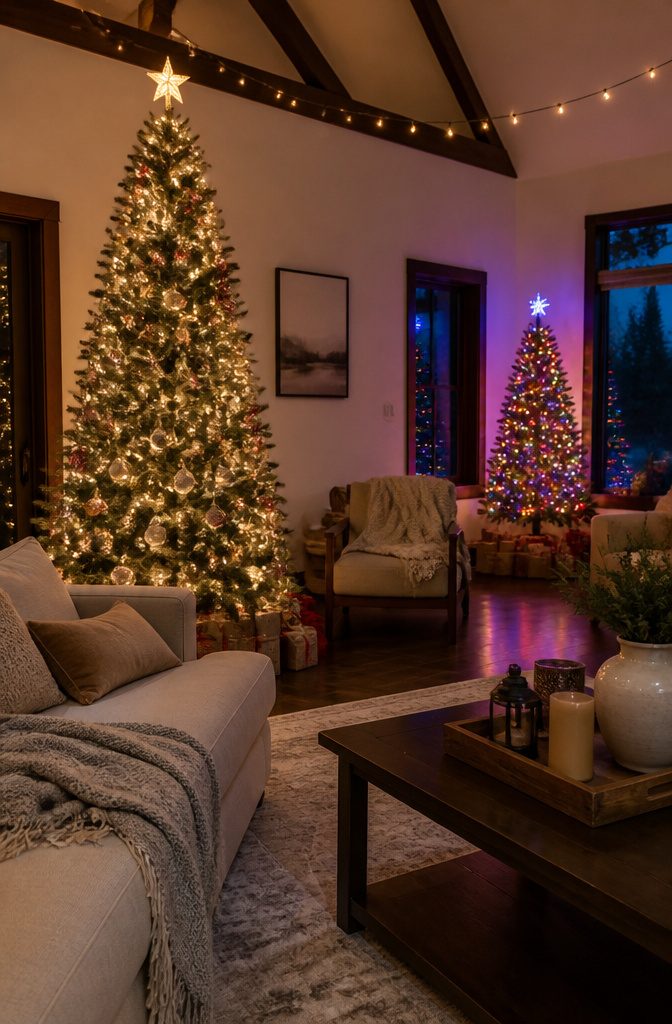
Multiple trees let you split the warm-white versus multicolor argument instead of settling on one.
The living room can hold the steady, classic glow you want to read under, while a kitchen or bedroom tree runs twinkle or chasing patterns without the two effects fighting each other.
Artificial trees pull ahead here. Real branches limit where you can string lights, their strength varies by moisture level, and a dry needle is a fire risk around a hot bulb.
An unlit faux tree gives you full control over LED count, spacing, and style, updated novelty options like C9s or bubble lights included.
Battery-operated strands on a second, smaller tree also free you from outlet hunting, which matters when you are placing a tree in a hallway or powder room that lacks a convenient plug.
Pre-lit artificial trees with dual lighting options exist now too, switchable between white and multicolor, though I would still buy unlit if I wanted to layer in fairy lights or themed novelty strands for something specific.
The cost is setup time. Building a light scheme from scratch takes an evening; a pre-lit tree takes minutes.
For a weekend project on a real budget, unlit wins if you already own the strands, but a pre-lit dual-mode tree earns its price if you are starting from zero.
Real Versus Faux on a Real Budget
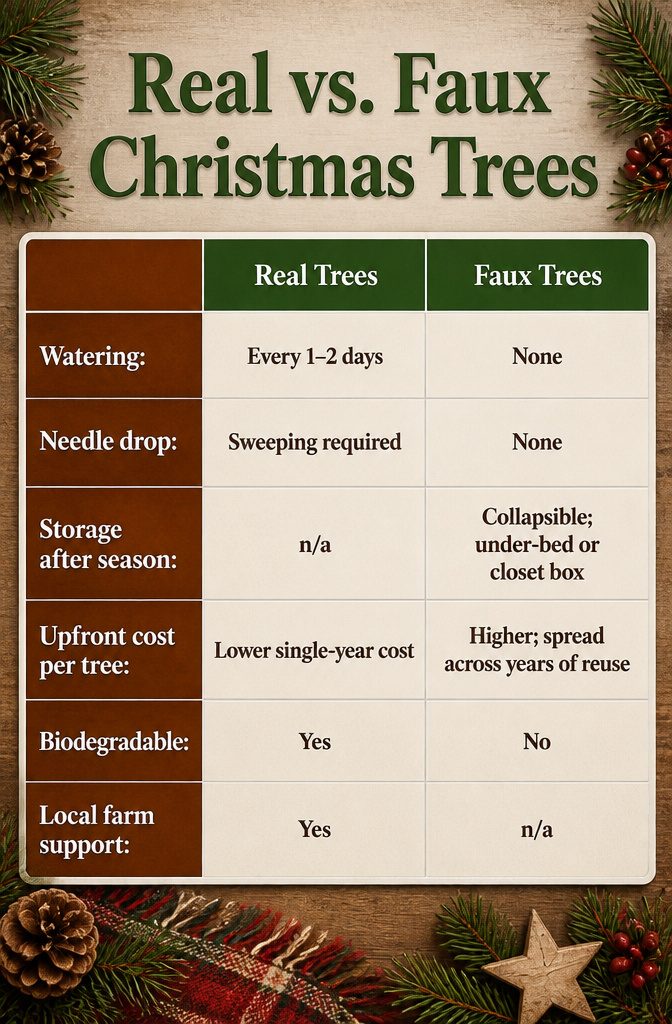
Real trees need water every day or two, and needle drop becomes a real chore when you are sweeping under three or four of them.
Artificial trees sidestep both headaches but trade them for storage volume. A collapsible faux tree breaks down to a box that slides under a bed; a real tree leaves nothing but compost.
The math shifts over years, though sources do not agree on figures. What changes it is how many years you keep an artificial tree before the upfront cost levels out, and whether you already own the closet space.
| Attribute | Real Trees | Faux Trees |
|---|---|---|
| Watering | Every 1–2 days per tree | None |
| Needle drop | Sweeping required; increases with multiple trees | None |
| Storage after season | n/a | Collapsible; under-bed or closet box |
| Upfront cost per tree | Lower single-year cost | Higher; spread across years of reuse |
| Biodegradable | Yes | No |
| Local farm support | Yes | n/a |
I would run one real tree in the main room for scent, then go faux everywhere else. The watering stops being romantic after the second daily trip with the pitcher, and the needle load scales fast.
What Changes When You Add a Second Tree
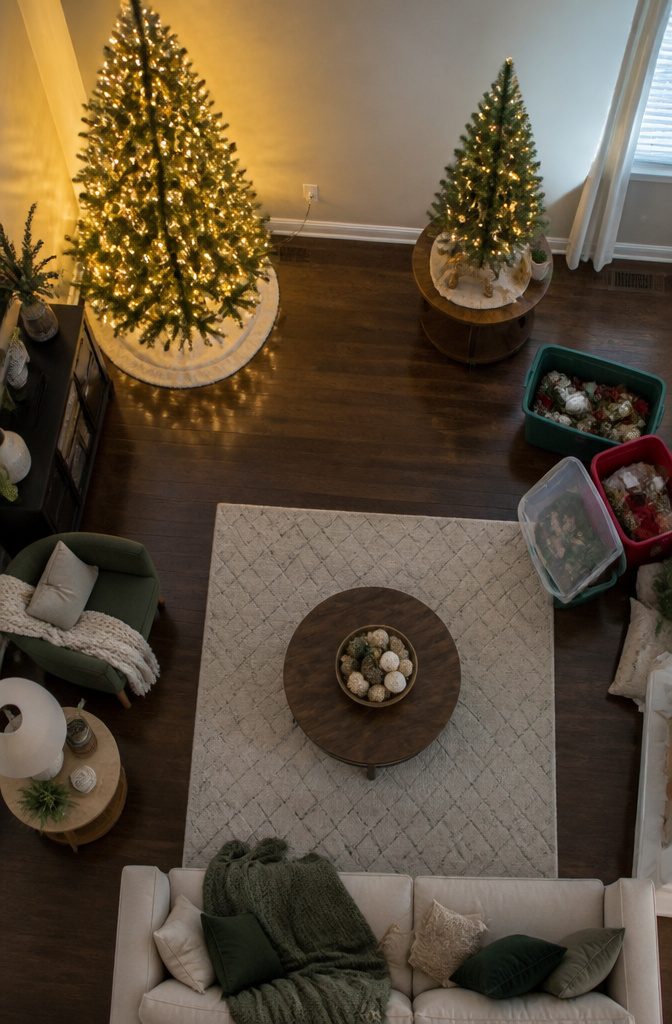
A second tree shifts the conversation from decoration to infrastructure. Most living rooms have two or three outlets on any given wall, and a pre-lit tree pulls steady current for weeks.
Two trees on the same circuit, plus the lamps you already run, can trip a breaker the first evening you plug them both in.
I spread mine across rooms now, but I learned that after walking downstairs to reset the box in the dark.
Storage is the quieter cost. One tree breaks down into three nesting sections that slide behind a guest room door.
Two trees need a bin, then a shelf, then eventually a corner of the basement that stays dry. The space a tree occupies in January is as real as the space it occupies in December.
The maintenance line arrives faster than you’d think. Two trees means two sets of lights to untangle, two top ornaments to wrap, two water reservoirs if either is real.
I keep my second tree simple, almost sparse, because I know I will not spend a Sunday afternoon refluffing two full canopies. Before you buy, test your storage footprint and your actual patience in February.
Where the Trend Actually Started
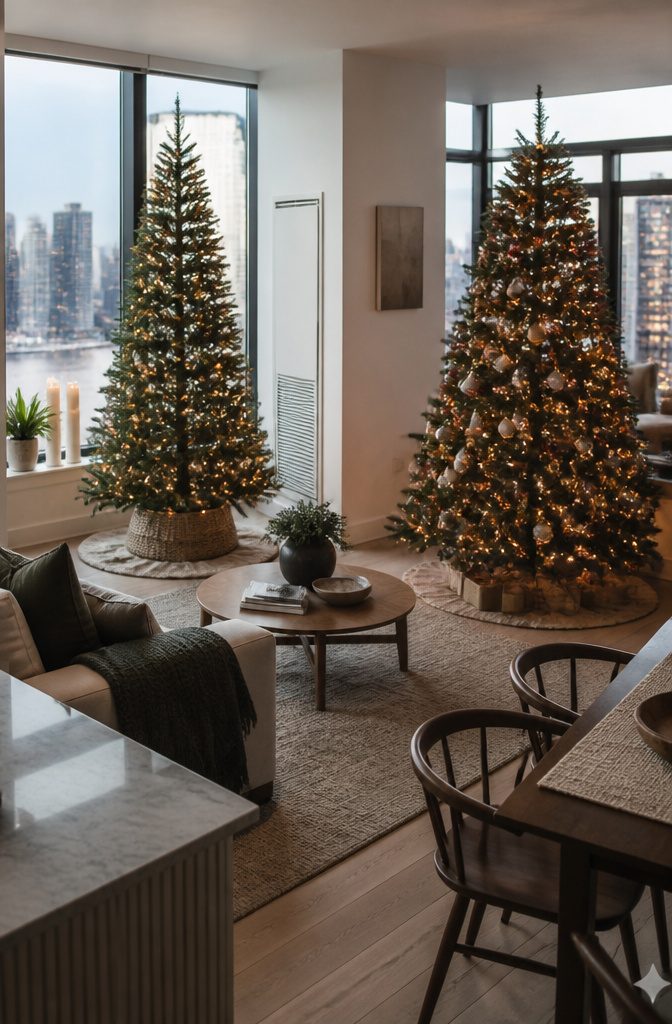
Multiple Christmas trees started as retail theater, not family tradition. Department stores built elaborate forest displays to move shoppers through toy sections and cosmetics counters, and that visual logic eventually followed customers home.
About 16% of American households with Christmas trees now display more than one, according to the American Christmas Tree Association, or roughly one in seven depending on which survey you catch. The spread is wide enough that neither figure is definitive.
What counts is that this is a modern phenomenon without deep roots in any single culture.
Scandinavian practice centers on one decorated tree; Victorian England popularized the parlor evergreen but never the grove. The multi-tree look draws from magazine staging and social media rather than handed-down ritual, which explains why no regional style dominates.
A homeowner in Texas might run three flocked trees with cowboy ornaments while a Minnesota apartment stacks slim pencil pines in corners, and both read equally current because neither carries generational weight.
The absence of tradition is the point; it leaves room for whatever arrangement fits the space and the weekend.
Frequently Asked Questions
Why have more than one Christmas tree?
Multiple trees solve visibility problems in large homes and let you run different decorating styles in different rooms. They also end the annual argument over whose ornaments go on the single tree, since each collection gets its own space.
What types of Christmas trees can I use?
Real trees, artificial trees, potted living trees, and flocked trees are all options. Most households mix types rather than matching, often placing a real tree in the main gathering room and faux trees everywhere else.
How can I decorate multiple Christmas trees?
Give each tree its own look so rooms feel distinct rather than matching. Groupings of three or more in odd numbers with varied heights read as one intentional display when tied together by a repeated element like white mini lights.
Can you have two Christmas trees?
About 16% of the 94 million homes with Christmas trees now display more than one, and 14% of Americans overall have at least two. The practice has moved well beyond novelty into mainstream holiday decorating.





