
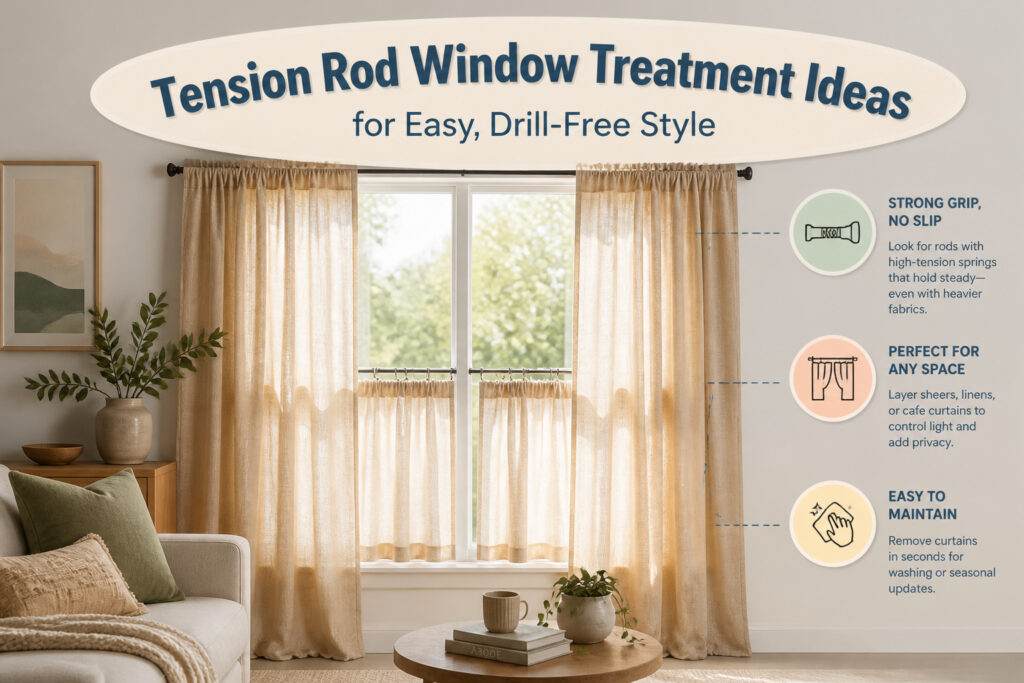
The best tension rod window treatment depends on one thing most renters skip checking: whether the rod’s grip can hold your fabric’s actual weight after hanging.
Standard rods work for sheers and lightweight cotton panels, but a linen blackout curtain will compress the spring past its limit and leave you fishing hardware off the floor at dinner.
Get the fit wrong and even the right room, the right finish, the right clip rings won’t save the setup.
1. Adjustable Tension Rods
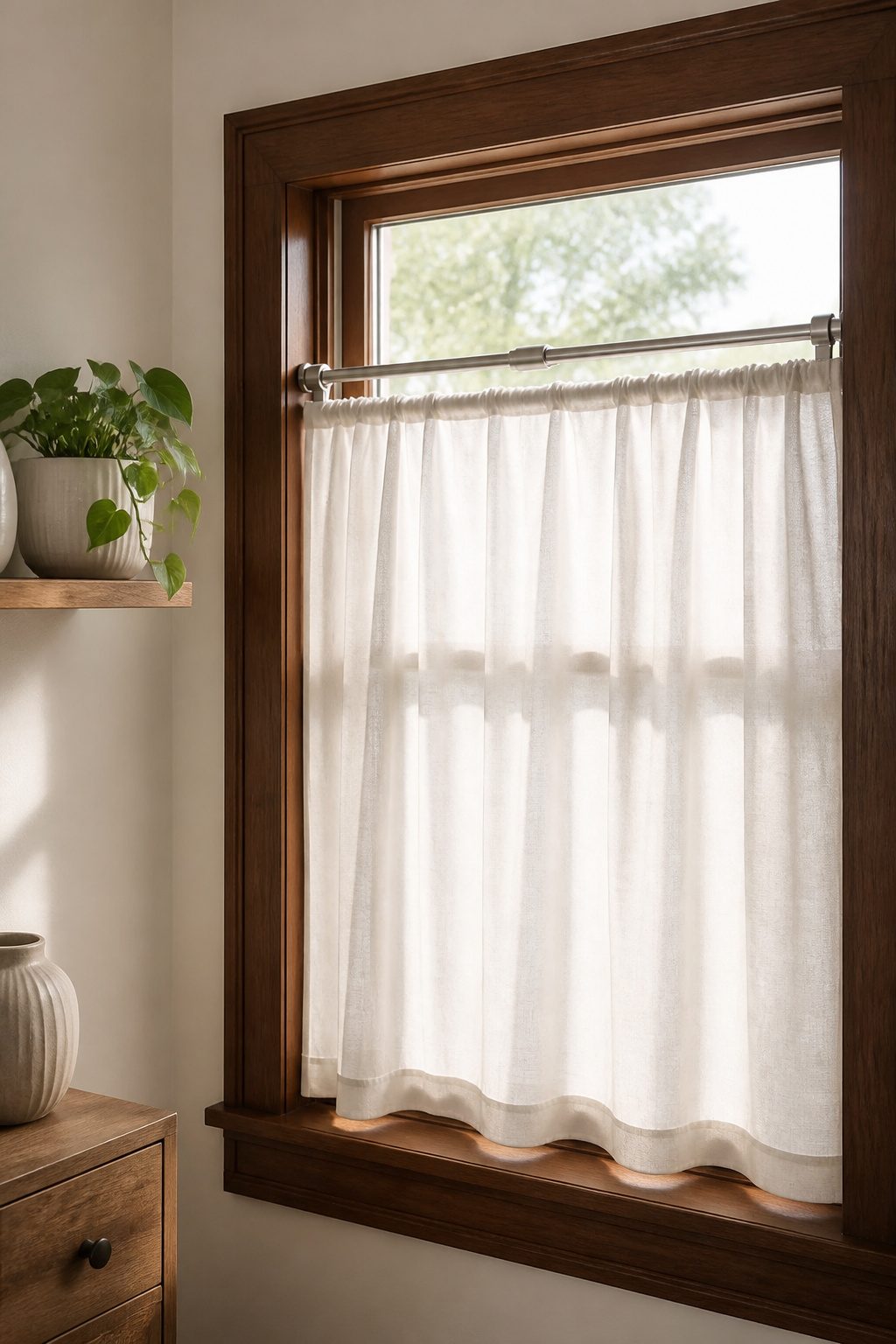
The twisting mechanism on adjustable tension rods is dead simple and exactly why these things have survived decades of trendier hardware.
You hold one end against the inside of the window frame, extend the rod to the opposite side, and twist the center section until the rubber pads grip tight enough to hold.
No drill, no brackets, no patching holes when the lease ends.
I have used these in at least two apartments where drilling was off the table.
The first was a 1920s building with plaster walls the landlord treated like museum artifacts; the second had a clause that made even picture-hanging feel risky.
In both places, the rod held a basic cotton curtain for the full year without slipping, though I learned to check the tension every couple months.
Temperature swings and humidity can loosen the grip, and a rod that fails at 6 a.m. on a winter morning is not the kind of alarm clock anyone wants.
The real limit is weight. These rods work for light to medium fabrics, maybe a lined cotton panel, but they are not the tool for blackout curtains with triple layers or thick velvet.
The rubber ends also leave faint marks on painted trim after a year or two, nothing a magic eraser won’t fix, but worth knowing if your deposit matters.

Spring-pull tension curtain rod for showers, windows, closet doors, and more

【Reinforced Support】 Our extendable curtain rod features a reinforced design with a 50% increase in wall thickness, providing unmatched support. It easily withstands 6 LBS of pressure without bending, ensuring a carefree user experience

【PACKING SPECIFICATIONS】: 2 pcs of white curtain rods, which can be extended from 26 to 39 inch, and the best use range is 28 to 36 inch,Scalable without drilling.
2. Linen Curtain Panels
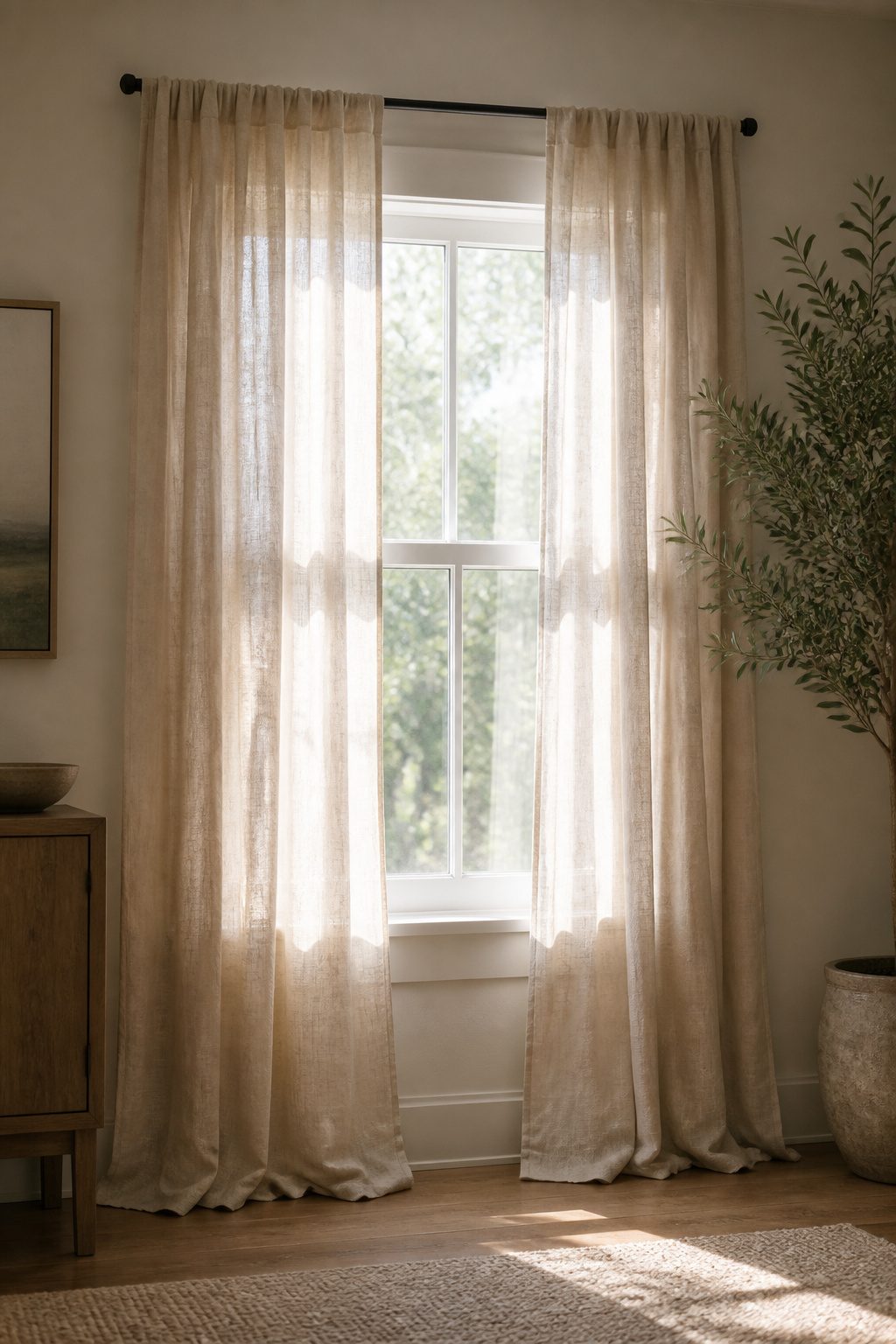
Linen curtain panels hang with a weight that reads as intentional, not temporary.
The slubbed texture catches light unevenly, which hides the kind of visual clutter, a stack of storage bins or a window AC unit, that smoother fabrics would silhouette.
To my eye, that irregular weave signals expensive even when it is not.
I bought a set from Target for about $40 to cover a sliding door in a rental where drilling was not an option.
The panels survived two moves, including one where the tension rod got knocked loose in the truck and they spent an hour crumpled behind a dresser.
A quick steam and the creases relaxed; the fiber tolerates abuse better than cotton blends at twice the price.
The catch is opacity. Standard linen panels filter light rather than block it, so they work best where privacy matters less than softness, or where you layer them over a shade.
For a bedroom facing a street, that $40 set would need backing, which changes the math.

【Superior Material】-Made from premium stainless steel, non-slip, no drilling, no Rust, never collapse, easy to clean, no need to spray before use.

【Adjustable Length】 The spring tension rod adjusts smoothly from 32 to 80 inches to fit most standard bathrooms. Its telescopic design allows perfect positioning without gaps.

【Premium Steel Rod for Lasting Use】 Crafted from high-carbon steel with a 5/8-inch diameter, this small tension rod features a durable anti-rust finish and sturdy construction for long-lasting use. The smooth white baked paint adds a clean, modern look to any room—whether you’re hanging a lightweight curtain in the kitchen or organizing a closet. It’s more than a spring tension curtain rod; it’s a reliable part of your home.
3. Curtain Rings with Clips
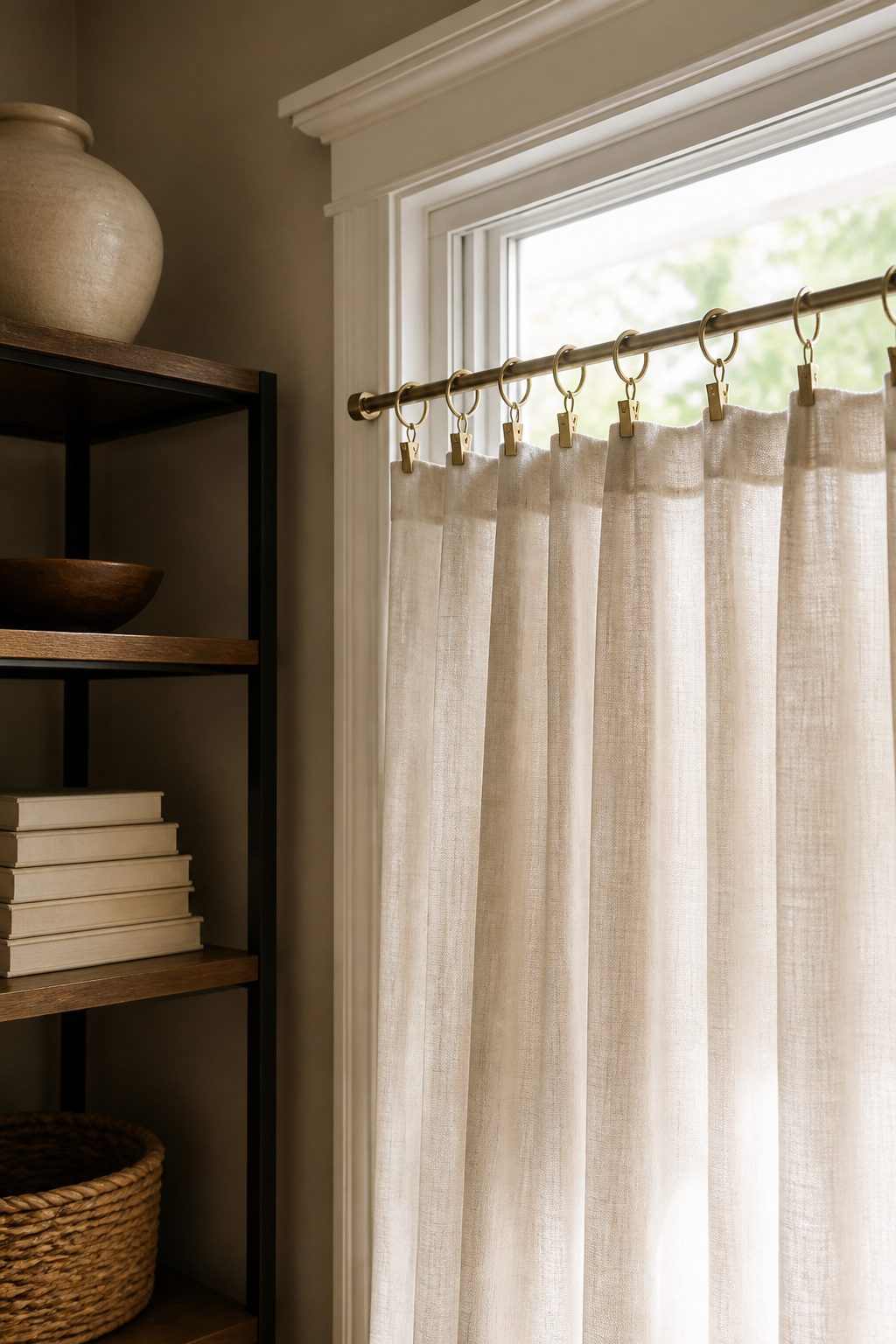
Clip rings turn any flat-panel curtain into a sliding system in about two minutes, which matters more than you’d think until you’re standing on a chair at 10 p.m. feeding fabric through a tight rod pocket.
The clips grab the top hem, the ring rides the rod, and the whole panel moves with one finger. The ring diameter has to clear the rod, though, and that is where I burned an evening.
My first tension rod was a 1-inch diameter, the rings I grabbed were sized for standard half-inch rods, and they sat there on the hardware store shelf mocking me while I made a second trip.
Most clip rings list their inner diameter on the back of the package; match that number to your rod and skip the return line.
Linen-textured panels with a loose weave grip especially well in the clips without sagging, and the metal slides quietly enough for a bedroom setup you actually want to live with.

LINEN CURTAINS 96 INCHES LONG: These stylish and elegant white curtains are the perfect addition to any living room. Made from high-quality 30% linen and 70% polyester(Tips: 100 percent linen is a no-no for draperies. 30% linen and 70% polyester fiber can maintain the best filtering effect and durability of curtains, as well as the texture of the product.)

WELL MADE: Sold as 2 panels, each panel is W52" x L84", and W104" x L84" in total. Each curtain panel has 2-in-1 top style design: back tab and rod pocket. With 3-inch inner diameter fits most standard rods. Curtains also can be hung with clip rings. 3 ways to meet your various needs.
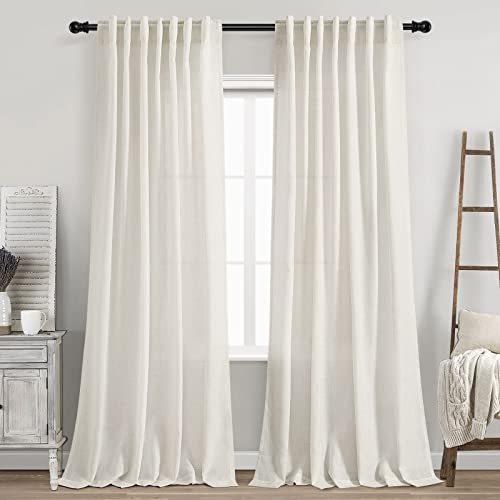
READY MADE: 2 Linen Curtain Panels per package.Each panel measures 52 inches wide by 84 inches long. Top design of Back tab & loop pocket provide 3 hanging options. <1> hanging from the back patch to create an elegant pleated look, <2> from the 3 inch rod pocket for a classic look <3> Hanging with clip rings for easy, slide open and closed (clip rings are not included)
4. Sheer Curtains
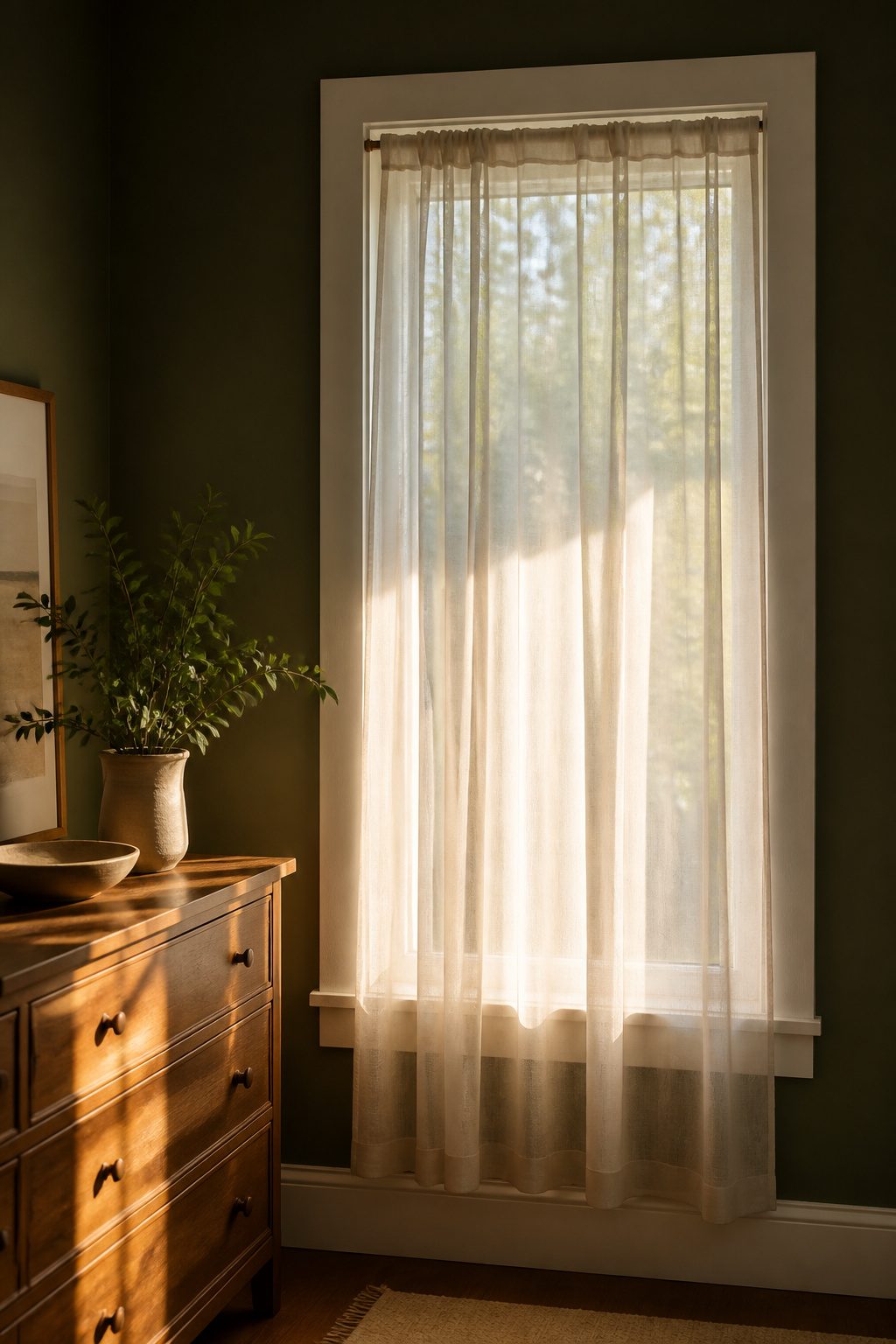
Sheers are the lightest weight option for tension rod window treatments, and that matters more than it sounds.
A basic rod with thin plastic ends can hold them without sagging, since the fabric puts almost no load on the mount. The payoff is clean lines inside the window frame and soft, diffused light that still gives daytime privacy.
In my last studio, I tucked a rod right into the frame and hung a simple sheer for that tidy, built-in look.
It filtered the afternoon sun beautifully. The mistake I made was assuming the same setup would work after dark.
Sheers do not block street view at night; anyone outside with a porch light sees straight in. I ended up layering a roller shade behind the sheer for evenings, which defeated some of the simplicity I had wanted.
If your window faces a neighbor or the sidewalk, plan for that second layer from the start, or at least keep the sheers to rooms where night privacy is not the main concern.
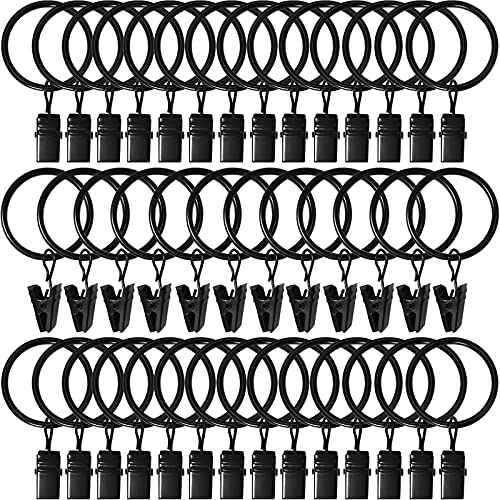
CURTAIN RINGS CLIPS PACKAGE: Set of 40 strong curtain rings with clips. Clip rings for curtains decorative drapery window.

CURTAIN RINGS CLIPS PACKAGE INCLUDING: This set includes 40 PCS black curtain rings with clips. Very suitable for decorative window, hangings hangers thick drapery

14 rings with clips to hang curtains
5. Heavy Duty Tension Rods
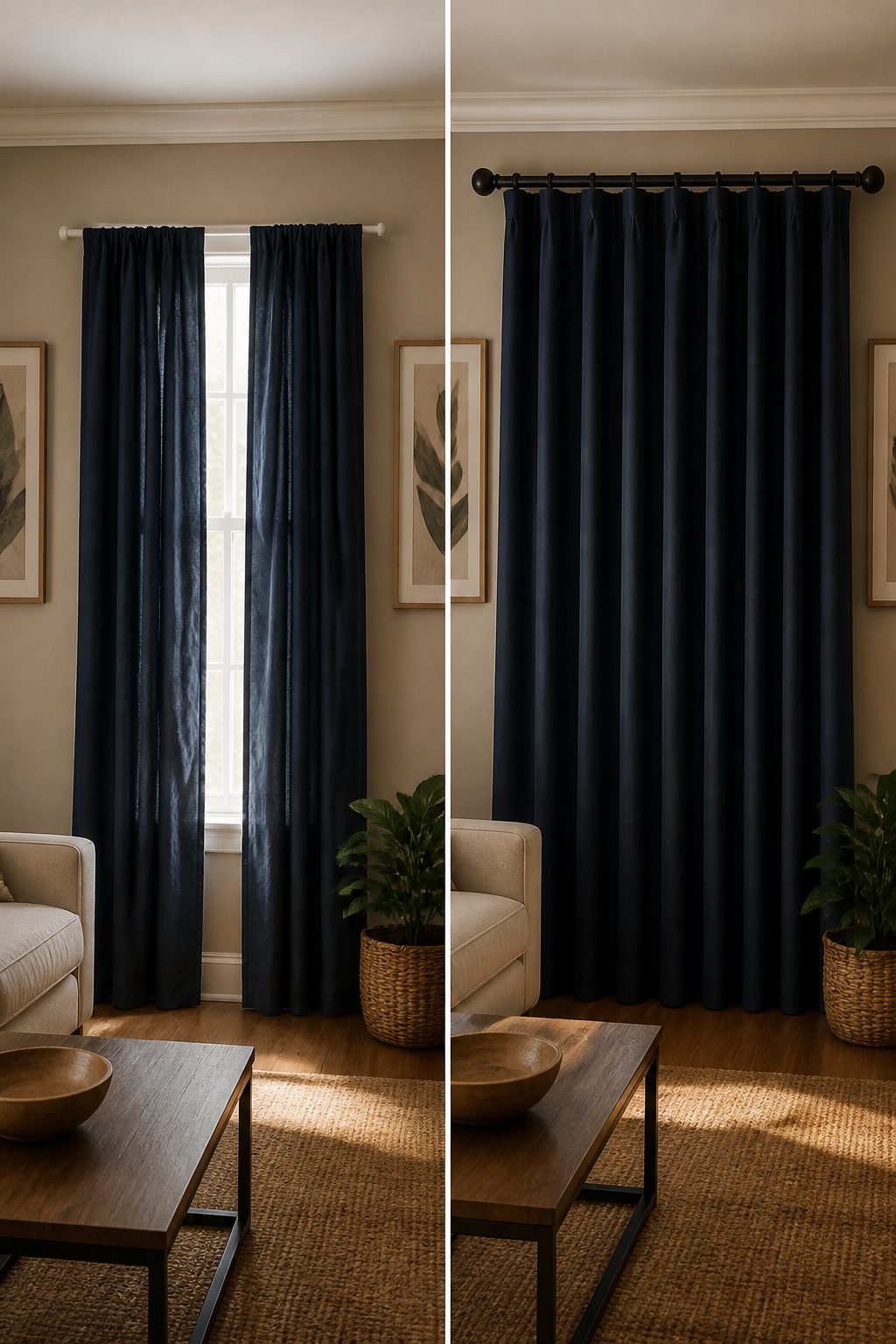
Standard tension rods have their place with sheers and lightweight drapes, but the spring inside them reaches its limit fast.
A wider window or any fabric with heft, like linen blackout panels, applies torque the thin tubing was never built to absorb.
The rod bows in the middle, the grip on the wall slips, and one morning you find the whole assembly on the floor.
Heavy duty versions solve this with thicker steel tubing and stronger internal springs, not by abandoning the drill-free premise. You still twist to expand, still wedge between the frame, still walk away without a single hole.
The difference is capacity. Where a standard rod might tap out at a narrow bathroom window or a sheer panel, the heavy variant holds blackout material across a double-wide span without sagging.
I learned the distinction the hard way after installing a standard rod beneath linen blackout panels in a bedroom with afternoon sun. The rod held for about three weeks, then dropped during dinner.
The springs had compressed past their useful range. Swapping to a heavy duty model in the same spot took no extra time and needed no new technique, but the curtain stayed put through a full summer of daily drawing.

Secure Lock-in Design for Windows: Built with a unique locking system and heavy-duty spring, these tension curtain rods for windows maintain their set length firmly. Enhanced stability allows them to support thick blackout curtains without sagging.

【No Drill Curtain Rod 5/8 Inch】SIMEWIN curtain rods no drilling is specifically designed for tenants in apartments where you can't punch holes on the walls.With our Newly Designed 3M Adhesive Brackets,everything will be easy .Say goodbye to traditional drilling methods,curtain rod brackets has a upgraded strong 3M adhesive that Gone are the days of drilling and hammering into walls, leaving unsightly holes.

ADJUSTABLE LENGTH CURTAIN RODS: 16-144" curtain rod fits windows 20 to 138 inches wide. The telescoping rod featuring a flexible 1 to 12 feet extension range for precise customization, while the adjustable heavy-duty brackets offer a 2" to 3.5" wall clearance to prevent curtains from rubbing against the wall and improve light blocking. Comes with 9 rods that need to be screwed together, not 2 poles, Note: This is not a tension rod
6. Industrial Style Tension Rods
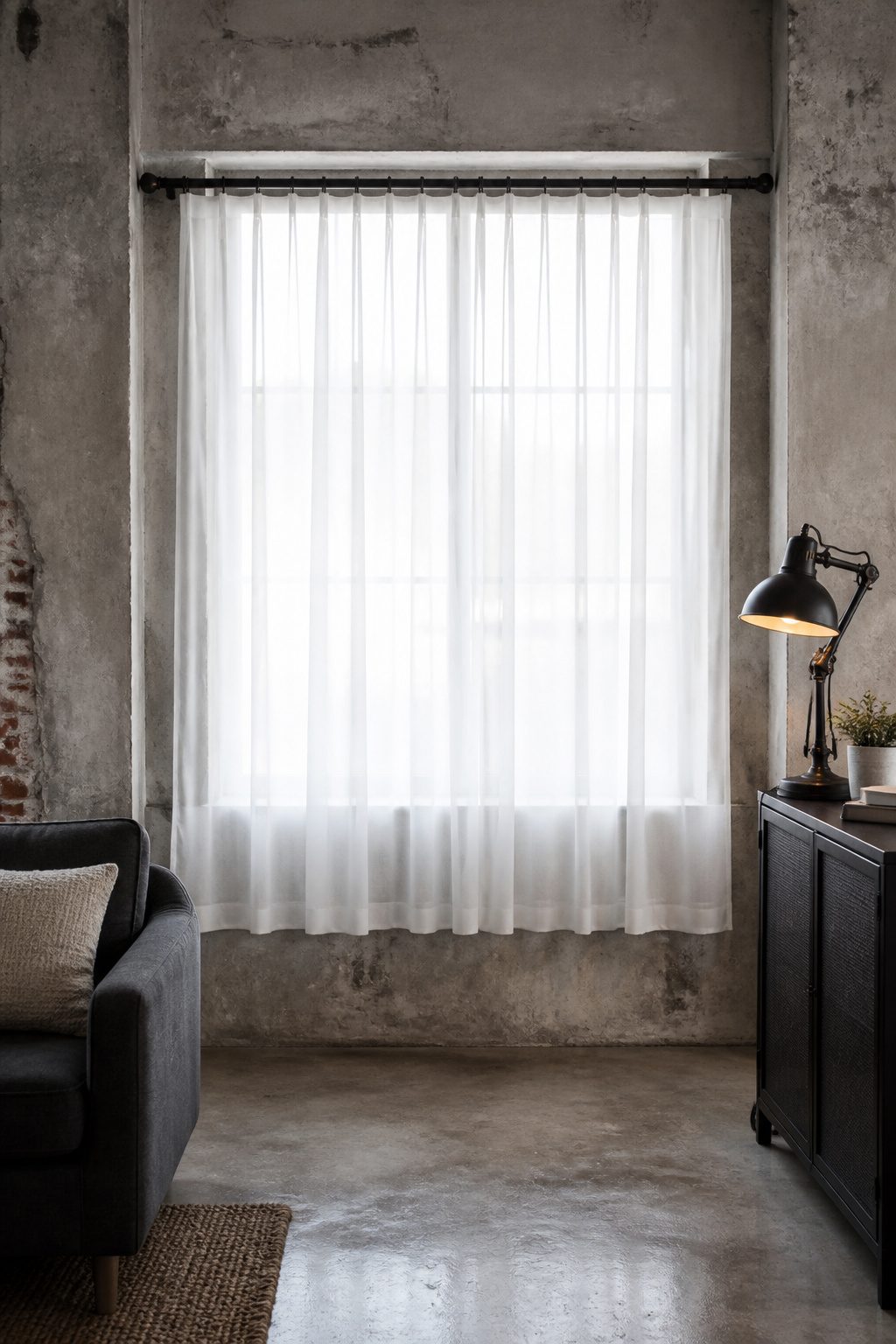
Dark metal tension rods with exposed hardware and straight lines read industrial without trying too hard. The finish matters more than the price point: matte black or oil-rubbed bronze carries the look, while anything too polished slips toward generic.
In my last rental, the bathroom had a wall-mounted faucet and a steel-framed mirror already going in that direction.
Swapping the flimsy white rod for a 1-inch black steel tension rod made the window look intentional, not like a temporary fix I would hide later.
Kitchens work the same way when the faucet or cabinet pulls already run industrial. The weight of the rod itself helps; heavier metal stays put on a tile surround or above a sink where humidity shifts lighter ones.
Straight lines keep it clean, so skip finials or curved ends. A simple cap or exposed rubber gasket at the end reads honest and fits the aesthetic better than something decorative pretending to be permanent.

Superior Material :Made from premium Inside and outside tube diameter: 13 and 16 MM Carbon steel,5/8-in Diameter sturty and durable

Easy Installation No Drilling: No tools required for installation. You can easily get a complete tension shower curtain rod within minutes.

【Size Introduction】Equipped with 2 tension rods,The actual length of the product is 17-28 inches (43-71cm).(Recommended best use range 17 to 26 inches (43-66cm))
7. Brass Tension Rods

Brass tension rods carry a warmth that chrome and black finishes never quite match. The yellow undertone reads traditional rather than trendy, which makes it a natural fit for vintage prints, ticking stripes, or heavy linen that already leans old-house.
Against white walls, the metal pops without shouting; near a cluster of green plants, the pairing softens the whole corner into something that looks collected rather than installed.
I have seen brass work in a bathroom exactly once, and once was enough.
The finish shows water spots within a day of a steamy shower, and wiping it down becomes part of the weekly routine whether you planned on it or not.
If you are hanging a curtain in a space where the rod sits inside the tub line, brass will demand more upkeep than you expect from a drill-free solution.

【Adjustable Length】Features a one-piece telescopic design that easily extends to fit window frames from 28 to 48 inches. No assembly required—simply adjust and secure into place.

【Check Your Wall Surface Before Installing】Designed for clean, smooth and stable surfaces. Works best on flat wall, tile, glass and wood with lightweight to medium curtains. Avoid textured, uneven, dusty, damp or peeling surfaces for better adhesion.

Curved Shower Rod Creates Valuable Extra Space: Rustproof shower curtain rod’s innovative curved design adds up to 6.5 inches of elbow room inside your tub or shower
8. Linen Textured Blackout Curtains
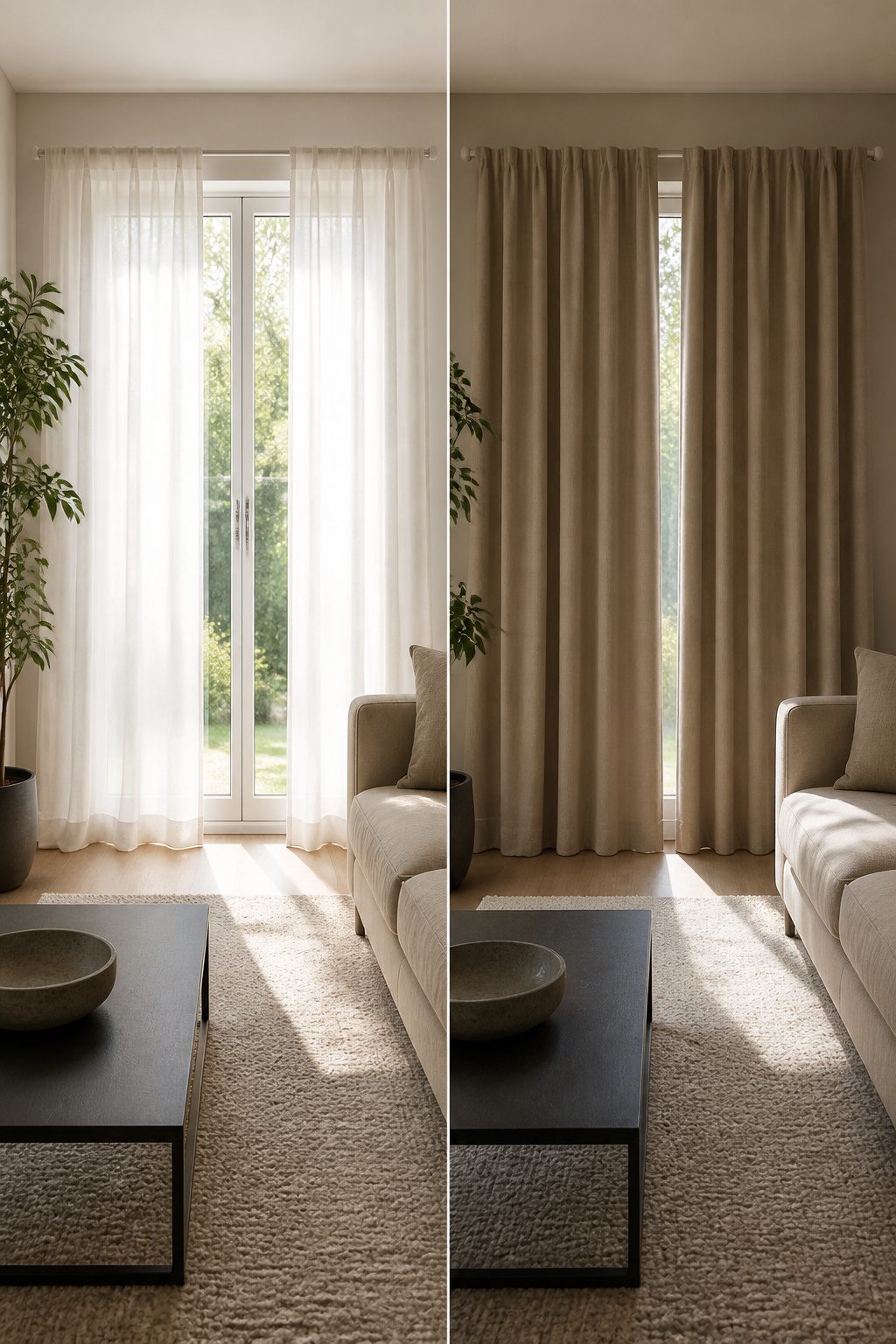
Linen textured blackout curtains give you the airy, slubbed look of natural fiber with the light-blocking performance most bedrooms actually need.
The weave mimics real linen’s irregular surface, but a dense acrylic or foam backing stops morning sun cold and keeps streetlights from leaking through at night.
That backing adds weight, though, and these panels run thicker than standard fabric. A flimsy tension rod will sag within a week or slip down the wall entirely.
Plan on spending roughly double what basic panels cost, which still lands below the price of separate blackout liners plus a lighter curtain.
You also skip the bulk of a two-layer setup, so the rod carries less total weight than it would with a liner combo.
For a tension rod installation, that single-layer construction matters. Check the rod’s weight rating against the panel’s listed heft, and size up if you’re close to the limit.

PINCH PLEATED DESIGN: Curtains top features 1.5 times length fabric design for an elegant pleated effect. Perfectly presenting a sense of stereoscopic and layering. Whether in living room, bedroom, dining room or sliding door etc, it fit perfectly into a variety of room decor style
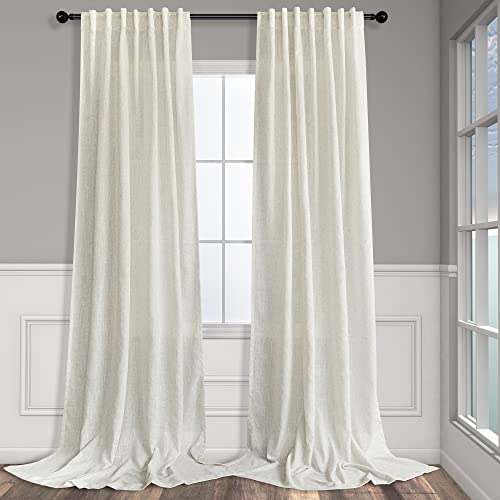
Basic Information: 2 LINEN PANELS in 1 package. Each panel measures width 52 x 84 length. 3-Way Hanging Options: Hang these curtain panels (1) using the back loops to create an elegant pleated effect, (2) from the 3 inch rod pocket for a classic look, or (3) using clip rings for easy, slide open and closed (clip rings are not included)

Ready Made: The package includes 2 panels of thick linen semi sheer curtains, and each panel 42"W (84"W for pair), 3 hanging options to meet your needs: rod pocket, back tab, or hanging ring (clips or hooks not included).
9. Curtain Clip Rings
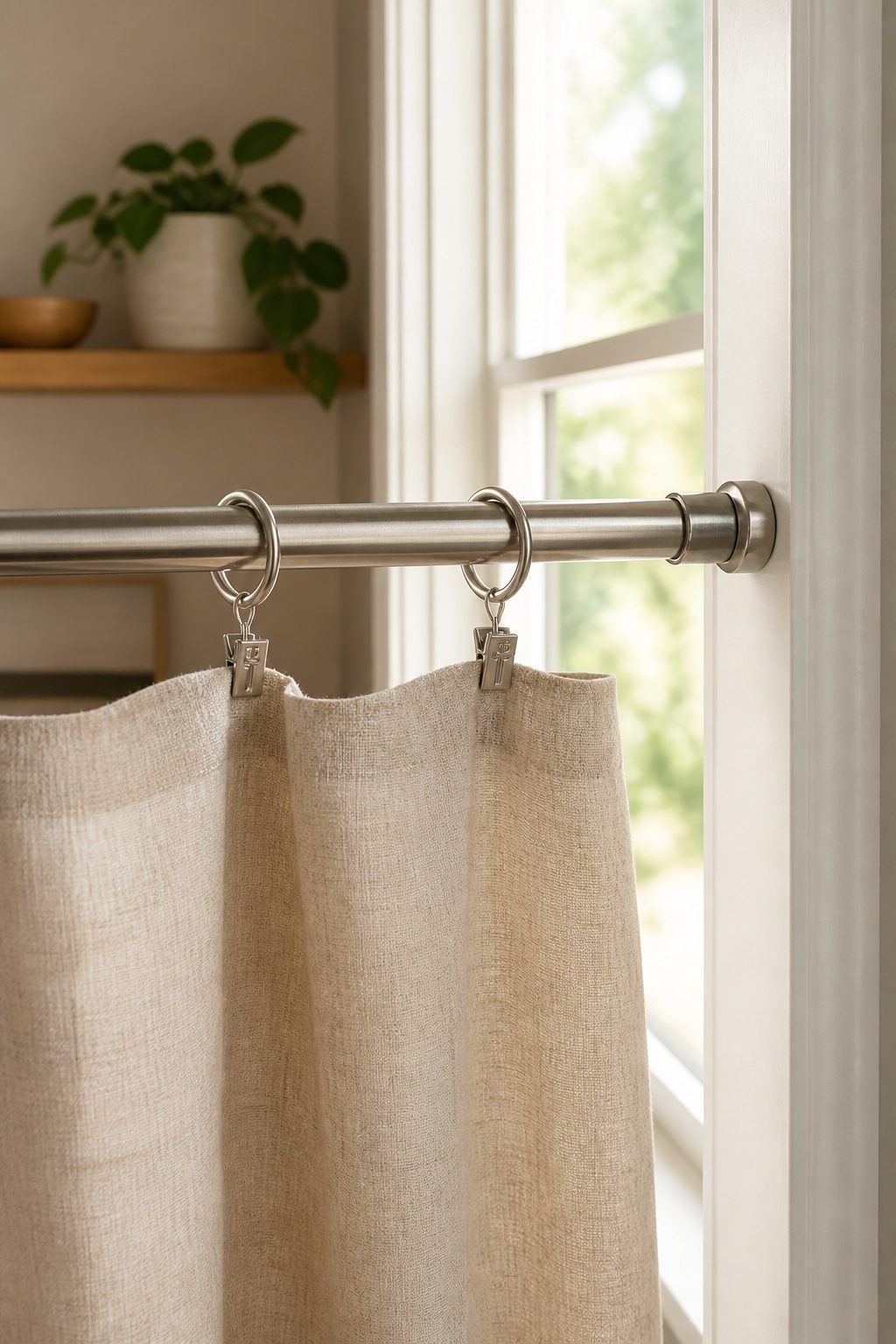
Clip rings and curtain clip rings look identical until you try to slide them open.
The cheap ones drag along the rod with that jerky, metal-on-metal scrape, while ball bearings or a nylon liner inside the ring let the curtain glide along with a push of one hand.
The difference matters more the more often you move them.
In my bedroom, I open those curtains every morning, and after switching to rings with bearings, the motion went from a two-handed tug to a single finger sending the panel across.
That smooth travel also keeps the clips from twisting, which means the hem hangs level instead of drifting crooked by Wednesday.
For a tension rod setup, where the whole bar can shift if you yank too hard, the reduced friction is half the point.
Standard clip rings cost less, but if you touch your curtains daily, the upgrade pays back in quiet and in not having to straighten the panel every time.

Open Easily and Lock Securely: Unlike traditional curtain rings with clips, these rings come with an openable design, allowing you to attach or remove the rings with hooks directly from the rod without disassembling it. Quick and convenient to use

CURTAIN RINGS CLIPS PACKAGE: Set of 40 gold color curtain rings with clips. Clip rings for curtains decorative drapery window.

CURTAIN RINGS CLIPS PACKAGE: Set of 40 strong curtain rings with clips. Clip rings for curtains decorative drapery window.
10. Decorative Finials
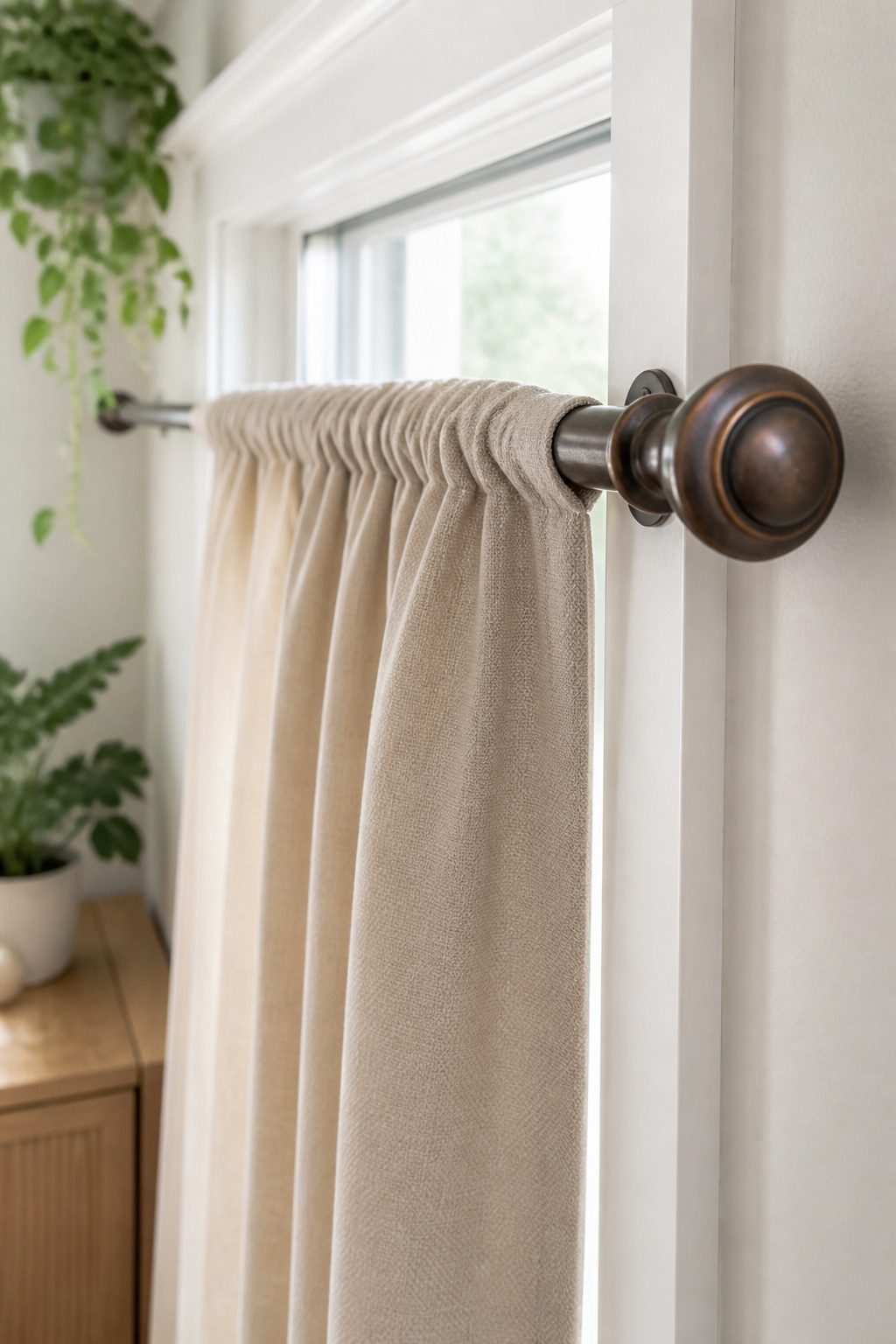
A bare tension rod disappears into the wall, but screw-on finials give it the deliberate end caps that read as real hardware.
The small shift turns a functional stick into something that looks chosen, which matters in a rental where you cannot drill for a proper rod bracket.
Some newer tension rods now ship with finial options that thread directly onto the end.
The threaded base adds length, though, and on a narrow window frame the extra bulk can snag the wall or keep the rod from seating flush.
I ran into this on a bathroom window with barely three inches of frame depth; the finial base butted against the trim and left the rod wobbling.
A few minutes with a metal file took the excess down, and the rod tightened properly after that. The finials still look finished, but now they fit the actual space instead of the packaging.
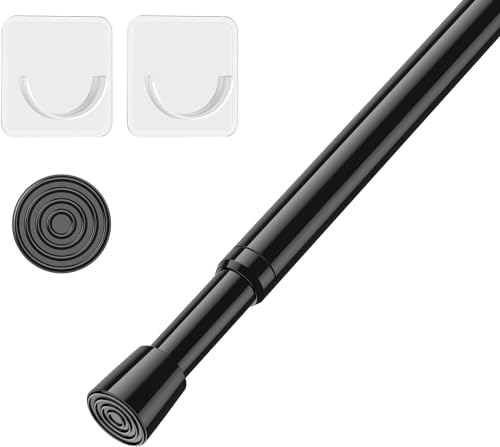
【PACKING SPECIFICATIONS】: 1 pcs of black curtain rods with 2PCS Curtain Rod Holde Scalable without drilling,curtain rod holde make installation easier and better to use.

𝗛𝗲𝗮𝘃𝘆-𝗗𝘂𝘁𝘆 𝗪𝗲𝗶𝗴𝗵𝘁 𝗖𝗮𝗽𝗮𝗰𝗶𝘁𝘆: Features premium thickened steel construction with reinforced internal structure that easily supports up to 50lbs - perfect for heavyweight blackout curtains, thermal drapes, and luxurious velvet curtains without bending or sagging. Ideal for master bedrooms and living rooms

【PACKAGE】Spring curtain rod consists of three sections: a spring telescopic main rod, a splicing rod and a tail rod. Available in 28″–37″ and 38″–48″ ranges.
Installation Without Drilling
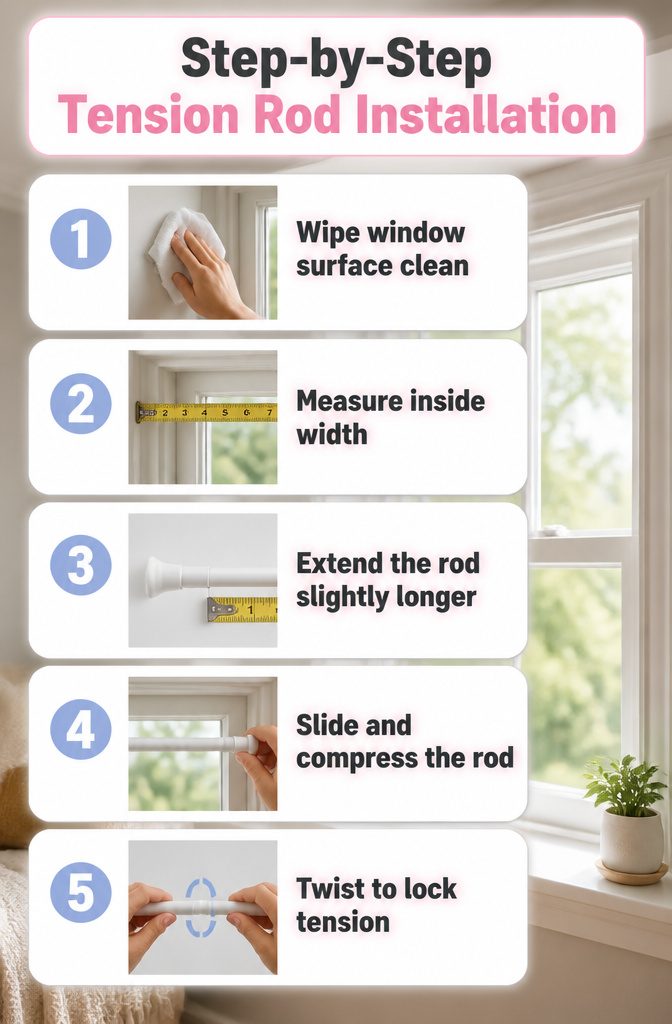
A tension rod window treatment only works if the rod stays put, which means the rubber ends need something clean to grip.
Dust or old paint flakes on the inside of the window frame will let the whole thing drop an hour after you finish. Wipe the surface with a damp cloth and let it dry before you start.
Measure the inside width of the window frame at the top, where the rod will sit. Extend the rod so it is slightly longer than that measurement, maybe half an inch to an inch past on each side.
Slide it into place, compress the ends, and twist the center section to lock the spring tension. The rod should feel tight enough to stay but not so tight that you are reefing on it with both hands.
Over-tightening is the mistake that will cost you.
I have done it twice, both times in a rental with soft drywall returns inside the frame. The pressure left a slight dent in the wall that I had to spackle before move-out.
A firm hand-tight twist is enough. If the rod slips after ten minutes, take it down and wipe the ends again, or try a slightly longer extension, before you crank harder.
Fabric Options by Room
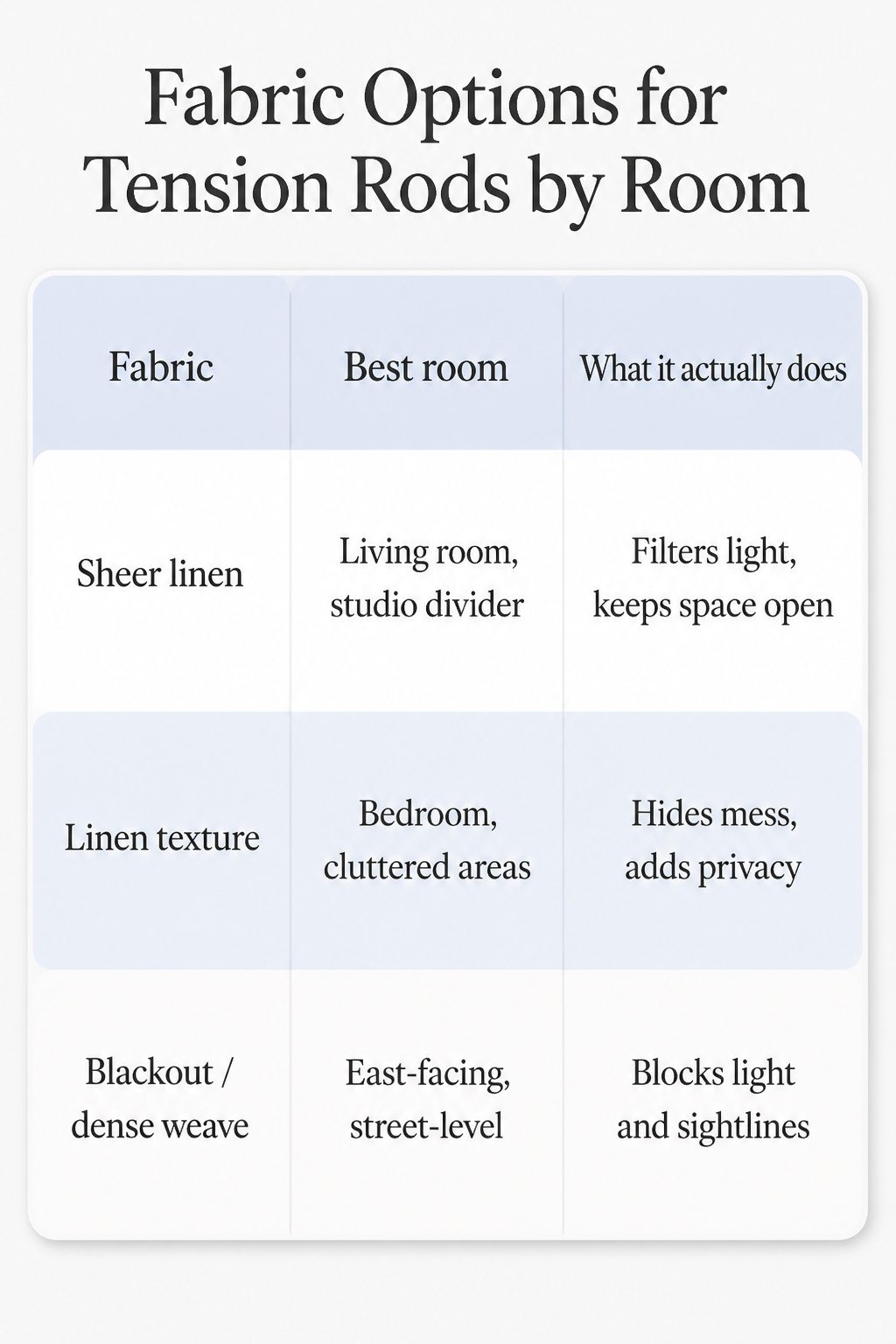
Sheer linen on a wide tension rod filters light without swallowing it, which makes it the default for living rooms where you still want the window to do its job.
In tighter setups, that same airy fabric can split a studio space without turning either side into a cave.
Bedrooms call for something with more heft. Linen texture hangs heavier and hides what you do not want on display, whether that is a cluttered dresser or a view straight onto the sidewalk.
The clips let you pleat the fabric directly onto the rod, so the whole thing goes up in minutes.
East-facing windows or street-level rooms need the third option: a denser weave that actually blocks light and glances. Sheer linen will not manage that job, and pretending otherwise wastes a Saturday.
| Fabric | Best room | What it actually does |
|---|---|---|
| Sheer linen | Living room, studio divider | Filters light, keeps space open |
| Linen texture | Bedroom, cluttered areas | Hides mess, adds privacy |
| Blackout / dense weave | East-facing, street-level | Blocks light and sightlines |
The rod matters less than the fabric choice here.
A wide tension rod will hold any of these if the weight is distributed, but the wrong fabric for the room’s real problem will have you swapping it out inside a month.
Renter Uses Beyond Windows

A tension rod and a drop cloth fixed the only eyesore in my first rental’s kitchen, a water heater closet with a door that had been removed years before.
The rod sat inside the frame at about six feet high, and the hemmed canvas hung straight enough that my landlord never asked what was behind it during inspections.
Open shelving gets the same treatment when the "organized" look collapses by day three; linen across the front hides the mess and slides back when you need a pan.
Room dividers work too, though anything heavier than a light curtain needs a floor-to-ceiling rod rated for the weight or it will sag by morning.
Doorways and odd corners, the gap beside a stacked washer or the open frame under a loft bed, turn private with a few clip rings and a tension rod fitted tight.
Brass rods add a deliberate accent against white paint, and the whole setup comes down in two minutes when the lease ends.
Product Features to Check
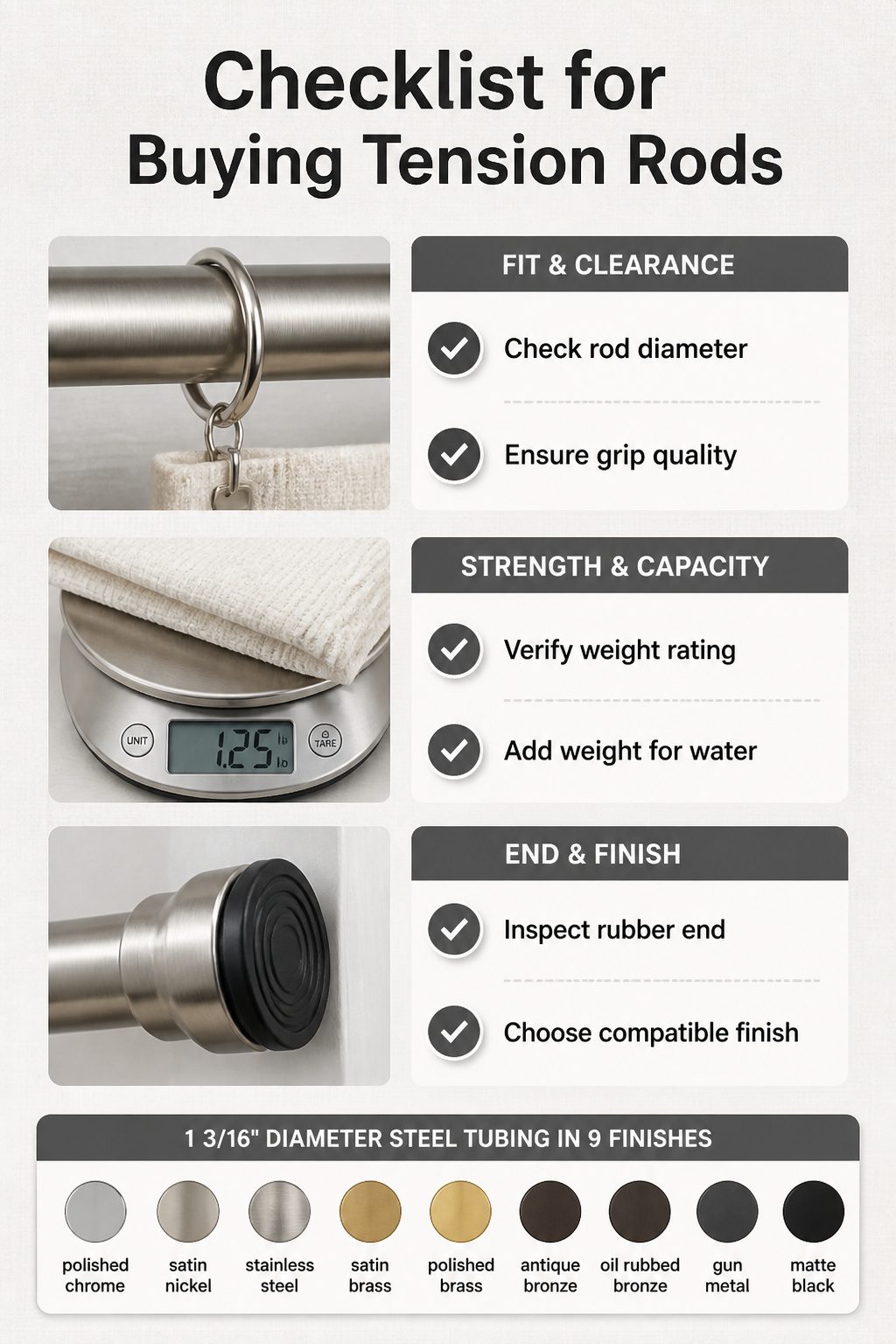
A tension rod lives or dies on three checks you can do in the store aisle. Rod diameter has to clear your clip ring; a 1 3/16 inch steel tube, for instance, won’t thread through a ring sized for standard café hardware.
Weight rating matters next, and the math is simple: weigh your curtain on a kitchen scale, then add a third for water if you ever plan to wash it in place.
The rod’s claimed limit should clear that total, not match it, because fabric picks up dust and weight over a season. The last check is the rubber end against your frame surface.
Glossy painted trim needs a softer, wider grip pad than raw wood or textured vinyl, and a cracked end cap is an immediate return; it will slip in the first humidity swing and take your finish with it.
1 3/16" diameter steel tubing in 9 finishes: polished chrome, satin nickel, stainless steel, satin brass, polished brass, antique bronze, oil rubbed bronze, gun metal and matte black
That diameter and finish range is what you are actually shopping for once the basic fit is settled.
The finishes let you match existing hardware without a full replacement, and the steel tube holds its shape under load better than the aluminum rods that dent if you over-tighten them against a stubborn frame.
Frequently Asked Questions
What are tension rod window treatments?
Tension rod window treatments are curtains or fabric panels hung using spring-loaded rods that wedge inside a window frame without brackets or drilling.
The rod stays in place through pressure alone, making them a go-to choice for renters and anyone who wants to avoid wall damage. You can hang anything from sheer panels to blackout curtains depending on the rod’s weight rating.
How do you install a tension rod?
Hold one end against the inside of the window frame, extend the rod past the opposite side by about half an inch to an inch, then twist the center section until the rubber pads grip tight.
Wipe the frame surface clean first so dust or paint flakes do not cause slippage. Stop at firm hand-tight; over-tightening can dent soft drywall and cost you your security deposit.
What types of curtains work with tension rods?
Sheers, linen panels, and lightweight cotton all work well on standard tension rods. Heavy blackout curtains or thick velvet need a heavy-duty model with thicker steel tubing and stronger springs to prevent sagging or mid-night crashes.
Match the rod’s weight rating to your fabric, and add a third again for water weight if you plan to wash curtains in place.